
Category Archives: PLI Press
New Answer Book! Antitrust Law Answer Book 2015
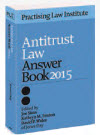 Practising Law Institute (PLI) has announced the release of their newest Answer Book title, Antitrust Law Answer Book 2015.
American antitrust law, now over a century old, is a huge and complex area of practice. Antitrust Law Answer Book 2015 steps back from the many details to provide a basic, practical overview of U.S. antitrust law for the non-expert who wants to understand the primary concepts and to know when to seek more expert help.
Antitrust Law Answer Book 2015 covers such issues as investigations and litigation, agreements between suppliers and customers, monopolization claims, pricing, and unilateral conduct not related to price. The authors, attorneys at Jones Day with decades of experience in the area, also provide suggestions for effective antitrust compliance programs that can help you avoid or minimize future problems.
The recently published Antitrust Law Answer Book 2015:
- Focuses on the most common business problems as well as those that illustrate the entire scope of the U.S. antitrust laws
- Includes illustrative examples and real-life case studies to provide additional background and practical guidance
- Is written in plain English to provide practical, useful answers, not just theoretical musings
- Contains a separate chapter on the complex antitrust issues arising in the intellectual property area
If you’d like to order Antitrust Law Answer Book 2015, please email the PLI Library Help Desk or call 877-900-5291.
PLI Treatises Updated in November 2014
In November 2014, PLI updated the following Treatises:
- Accountants’ Liability #17
- Deskbook on Internal Investigations Corp Compliance & White Collar Issues #13
- Exempt and Hybrid Securities Offerings (2nd Edition) #3
- Financial Product Fundamentals: Law, Business, Compliance (2nd Edition) #4
- Friedman on Leases #26
- Faber on Mechanics of Patent Claim Drafting #12
- How to Handle an Appeal #15
- Immigration Fundamentals: A Guide to Law & Practice (4th Edition) #39
- Internal Revenue Service Practice and Procedure Deskbook (4th Edition) #9
- International Corporate Practice: A Practitioner’s Guide to Global Success #9
- International Tax & Estate Planning #17
- Kane on Trademark Law: A Practitioner’s Guide (6th Edition) #2
- Manning on Estate Planning (7th Edition) #1
- Mutual Funds and Exchange Traded Funds Regulation (3rd Edition) #6
- Patent Licensing and Selling: Strategy, Negotiation, Forms (2nd Edition) #1
- Pharmaceutical & Biotech Patent Law #7
- Post-Grant Proceedings Before the Patent Trial and Appeal Board #2
Also in November 2014, PLI published the following new Treatise edition:
- Public Company Deskbook: Complying with Federal Governance & Disclosure Requirements (Third Edition)
If you are on standing order for any of these titles, the releases have already been shipped. If you would like to place an order, please email PLI Library Help Desk or call 877-900-5291.
PLI Course Handbooks Published in November 2014
Listed below are the PLI Course Handbooks published in November 2014:
Accounting:
Antitrust:
Communications/Telecommunications Law:
- Communication Law in the Digital Age 2014
- Law and Regulation of “Intermediary” Businesses 2014: Consumer-Facing Technology Providers, Online Platforms, and Online Media
Corporate & Securities:
- Advanced Compliance and Ethics Workshop 2014
- Bolstering Your Company’s Fraud Defenses 2014: Proactive Prevention and Responses
- Financial Services Industry Regulatory Compliance & Ethics Forum 2014
- Hedge and Private Fund Enforcement & Regulatory Developments 2014
- Securities Filings 2014: Practical Guidance in a Changing Environment
- Securities Regulation Institute (46th Annual)
Health Care:
Intellectual Property:
- Patent Licensing Today 2014: Making Money Without Getting Sued
- Patent Litigation 2014
- Think Like a Lawyer, Talk Like a Geek 2014: Get Fluent in Technology
- Tracking and Targeting Customers and Prospects Online, on Mobile Devices, and in Social Media 2014
Litigation:
Pro Bono:
Real Estate:
Updates to Pharmaceutical and Biotech Patent Law
 Looking for authoritative resources on Intellectual Property law? You can find acclaimed, expert-authored sources on PLI Discover PLUS, which provides you with the most up-to-date content such as the recently supplemented Treatise Pharmaceutical and Biotech Patent Law. This title offers legal, scientific, and technical information to help clients obtain, defend and challenge the validity of patents.
Updated information on:
Patentable subject matter – find updated details on the Supreme Court’s decision to revisit the question of patentable subject matter in Alice Corp. Pty. V. CLS Bank International. Questions on whether or not the Court decided that the laws of nature and abstract ideas are basic tools of scientific and technological work? Go to Section 3.8 to find the answers.
Indefiniteness – in Nautilus, Inc. v. Biosig Instruments, Inc. (2014), the Supreme Court adopted “reasonable certainty” standard for measuring indefiniteness. Read up on the standard in Section 5:7.2[B].
New chemical entity exclusivity-novel combinations – read up on how the FDA reversed its previous position and has proposed that fixed-combination drugs should be eligible for new chemical entity (NCE) exclusivity if any of the active ingredients in the combination had not been previously approved. Find the details on the FDA’s new policy in Section 8:3.2[B][2].
PLI Discover PLUS 2014 Third Quarter Coverage List
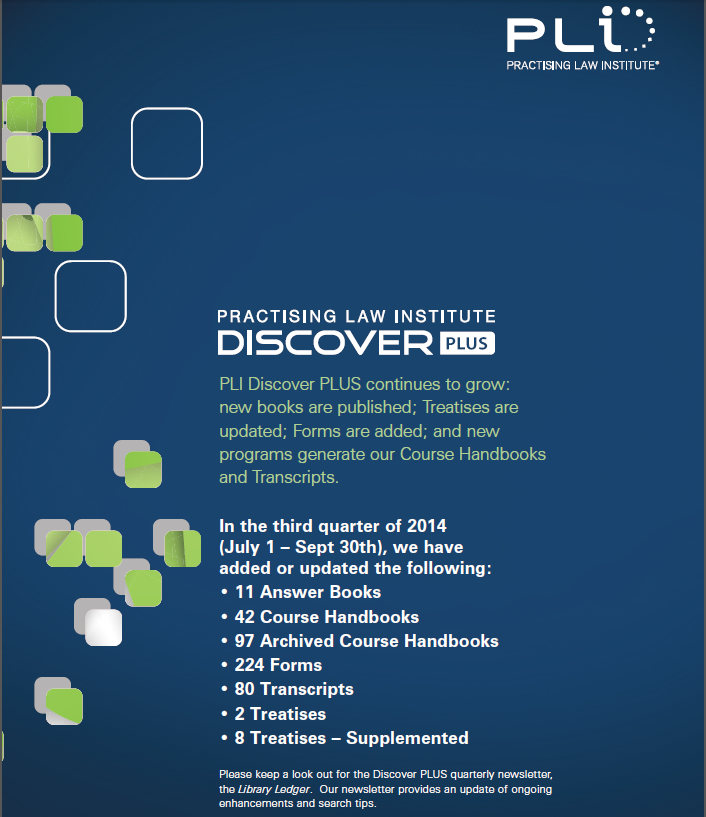
The Practising Law Institute 2014 Discover PLUS Third Quarter coverage list is out! Our coverage list is a reference guide for librarians, attorneys, researchers, and other PLI Discover PLUS subscribers. Inside the catalog is a listing of the books, forms, and transcripts that were added to Discover PLUS between July 1st and September 30th.
PLI Discover PLUS continues to grow: new books are published; Treatises are updated; Forms are added; and new programs generate our Course Handbooks and Transcripts. Check out the new titles – which include 97 Archived Course Handbooks – as we continue to develop our archival collection back to 2004!
New Book! International Tax Controversies: A Practical Guide
Practis ing Law Institute (PLI) has announced the release of their newest Treatise title, International Tax Controversies: A Practical Guide.
The new International Tax Controversies: A Practical Guide, authored by a team of experts from Steptoe & Johnson LLP, provides a detailed roadmap for resolving cross-border tax issues.
The new book is organized into three parts: “International Tax Audits and Appeals,” “Government-to-Government Cooperation” and “Litigating International Tax Cases.”
In Part 1, “International Tax Audits and Appeals,” the authors – Philip R. West, J. Walker Johnson, Michael Durst and Amanda Varma – offer clear guidance on handling international examinations, IRS appeals and special appeals procedures. They walk readers through pre-audit planning, including document retention and spoliation. They shed light on transfer pricing issues, as well as concerns regarding attorney-client privilege and other protections in the cross-border context. Additionally, the authors highlight special document issues in international examinations, including information document requests (IDRs) and administrative summonses.
In Part 2, “Government-to-Government Cooperation,” the authors outline and explain mutual agreement procedures (MAPs), which provide taxpayers the opportunity to ask the “competent authorities” of countries taking conflicting positions to reach an agreement that will protect them from double taxation. Additionally, the authors analyze advance pricing agreements (APAs), providing detailed guidance on the process by which taxpayers may obtain an APA.
In Part 3, “Litigating International Tax Cases,” the authors outline post-appeals litigation options. Entire chapters are also dedicated to discovery in international tax cases and trial and appellate practice.
International Tax Controversies: A Practical Guide is a much-needed guide providing skillful guidance to resolving U.S. international tax controversies.
If you’d like to order International Tax Controversies: A Practical Guide, please email the PLI Library Help Desk or call 877-900-5291.
PLI Course Handbooks Published in October 2014
Listed below are the PLI Course Handbooks published in October 2014:
Corporate & Securities
- Advanced Swaps & Other Derivatives 2014
- Broker Dealer Regulation and Enforcement 2014
- Corporate Counsel Institute 2014
- Fundamentals of Swaps & Other Derivatives 2014
- Hot Topics in Mergers & Acquisitions 2014
- Outsourcing 2014
Employment
Estates & Trusts
Intellectual Property
- Advertising Law Institute 2014
- Intellectual Property Law Institute 2014
- Representing the Games Industry Client 2014
- Technotainment 2014
Litigation
- 31st Annual Section 1983 Civil Rights Litigation
- California Trial Evidence 2014
- Managing Complex Litigation 2014
Real Estate
New Book! Attorney-Client Privilege Answer Book 2015
 Practising Law Institute (PLI) has announced the release of their newest title, Attorney-Client Privilege Answer Book 2015.
Attorney-Client Privilege Answer Book 2015 provides, in a Q&A format, clear answers to the questions that attorneys grapple with on a regular basis as to what is, or is not, covered by the attorney-client privilege. As the bounds of the attorney-client privilege are narrower and less clear than many lawyers —and most clients — believe them to be, Attorney-Client Privilege Answer Book clarifies, and provides practical examples, of what is covered. It also discusses how the attorney-client privilege differs from related legal concepts such as the work-product doctrine and the lawyer’s professional duty to preserve client confidences.
Attorney-Client Privilege Answer Book answers such questions as:
- How does the attorney-client privilege, which assures the confidentiality of client communication, coordinate with the fundamental tenet of the judicial system — to seek the truth?
- How does the court decide which body of law applies to the privilege issue being decided?
- When is an attorney acting as an attorney in a specific matter, as opposed to providing, for instance, simple business advice?
- Who is a client — for purposes of invoking the privilege? And if the client is not a person, which employees of the business may communicate with the attorney on behalf of the client?
- What is a communication that is protected? And what kinds of communications are not protected?
- Since only communications intended to be confidential are protected, when have courts not found the necessary intention to keep a communication secret?
If you’d like to order Attorney-Client Privilege Answer Book, please email the PLI Library Help Desk or call 877-900-5291.
PLI Discover PLUS Turns 2!
