Category Archives: Bankruptcy

Treatise Update: Bankruptcy Deskbook 

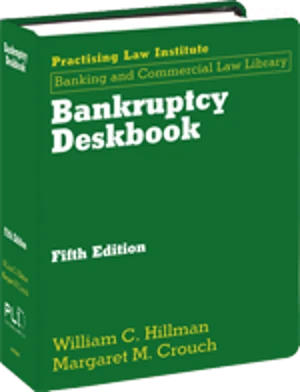
The Bankruptcy Deskbook provides both analysis and practical guidance regarding consumer and corporate bankruptcy. This newly updated treatise spans all aspects of the process, such as jurisdictional issues, automatic stays, avoidance powers, distribution of property, and appeals.  

Highlights of the update include: 

  • Chapter 2, Jurisdiction and Related Topics, provides a discussion of the Supreme Court’s clarification on the Rooker-Feldman doctrine, including the finding that the doctrine bars federal suits seeking review of state-court judgments, regardless of the finality of the judgments; it also includes the dissenting justices’ opinion that the doctrine could be constrained in the future 
  • Chapter 6, Avoidance Powers, covers the Supreme Court’s holding that the Takings Clause doesn’t require government to sell property at fair market value in the case of tax foreclosure 

Order a print copy today. 

Free Form of the Month

PLI PLUS offers unlimited electronic access to more than 4,500 downloadable, searchable, and editable legal forms ready for use in your practice. In an effort to highlight this unique content type, we’ve selected one form per month and made it available for anyone to download for free – no subscription required.

August’s free form:

Interim DIP Financing Order

More information about Legal Forms & Checklists:

  • Forms & Checklists Flyer – This flyer provides an overview of the forms & checklists on PLI PLUS and highlights a handful of popular examples.

Don’t Miss PLI’s End of Year Sale!

Browse our collection today and save big now through the end of December!

Don’t Miss PLI’s End of Year Sale!

Browse our collection today and save big now through the end of December!

Book Update: Bankruptcy Deskbook (Fifth Edition)

Bankruptcy Deskbook provides analysis of the current state of the law affecting all chapters of the Bankruptcy Code, along with practical advice for attorneys representing both debtors and creditors, in consumer and business bankruptcies.

Discussions of the following topics have been enhanced in this latest release (Release #22) to reflect recent rulings:

  • Bankruptcy court jurisdiction
  • Removal and remand
  • Fraudulent transfers
  • Disallowance of claims or interests
  • Willful failure to credit payments
  • Discharge injunction
  • Joint administration of estates
  • Third-party releases
  • Unsecured junior mortgages
  • Subchapter V eligibility

Order a print copy today.

PLI PLUS subscribers can access this title through their subscription.

Free Form of the Month

PLI PLUS offers unlimited electronic access to more than 4,500 downloadable, searchable, and editable legal forms ready for use in your practice. In an effort to highlight this unique content type, we’ve selected one form per month and made it available for anyone to download for free – no subscription required.

April’s free form:

List of Disclosure and Reporting Requirements for Debtor Under Bankruptcy Code and Rules

More information about Legal Forms & Checklists:

  • Forms & Checklists Flyer – This flyer provides an overview of the forms & checklists on PLI PLUS and highlights a handful of popular examples.

Treatise Update: Derivatives Deskbook: Close-Out Netting, Risk Mitigation, Litigation (Second Edition)

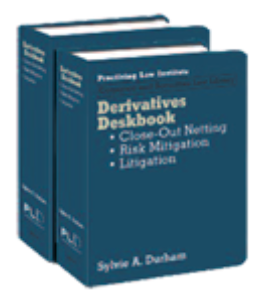
Derivatives Deskbook: Close-Out Netting, Risk Mitigation, Litigation (Second Edition) is a comprehensive resource for all users of swap agreements and derivatives, from financial institutions to corporate end-users. This treatise defines the key terminology and identifies the major players, discusses the full range of required documentation, highlights the best practices for the legal risk management of derivatives and includes numerous practice-tested legal forms.

The new release includes the following updates:

  • Chapter 1, Introduction, explains that statistics illustrate that in spite of the complete regulatory overhaul of the OTC derivatives market since the 2008 financial crisis, the use of OTC derivatives continues to grow rapidly (Section 1:1).
  • Chapter 7, U.S. Bankruptcy Implications of Close-Out Netting, examines the Supreme Court’s unanimous ruling that section 546(e) does not protect transfers made through a financial institution to a third party as an intermediary (Section 7:2.3).
  • Chapter 8, Best Practices Recommendations, advises parties to carefully consider forum and jurisdictional issues in the drafting of what are considered boilerplate provisions in an OTC derivatives contract, but which may impact the entire outcome of the transaction (Section 8.8).
  • Chapter 9, U.S. Regulatory Summary, explores the availability of judicial remedies for violations of the Commodity Exchange Act (CEA) by foreign counterparties (Section 9.1).

Order a print copy today.

PLI PLUS subscribers can access this title through their subscription.

Bankruptcy Deskbook (Fifth Edition)

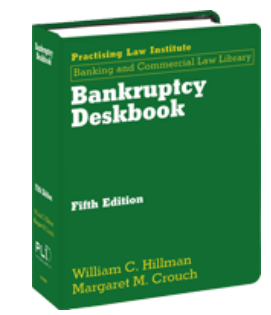
Bankruptcy Deskbook provides you with practical guidance to help clients achieve fair remedies and to ensure you avoid legal problems along the way. This treatise covers the demands on Chapter 7 debtors, rules for Chapter 11 small business debtors, requirements for Chapter 13 individual debtors and compliance burdens on attorneys — including strict certification requirements and fee-arrangement disclosure rules that, if unmet, can lead to harsh sanctions. This book guides you step-by-step through the bankruptcy laws, clarifying the purpose, features, mechanics, advantages, and drawbacks of Chapters 7, 11, 12 and 13 in the era of BAPCPA.

All chapters in this treatise have been updated in this release to incorporate the most recent case law affecting issues such as:

  • Whether bankruptcy courts are bound by the “case-or-controversy” requirement that governs Article III courts.
  • Whether suits between non-debtors that might diminish the estate are deemed to be “related to” the debtor’s bankruptcy.
  • Whether an award of damages to remedy a stay violation is entitled to post-judgment interest.
  • Whether the ruling in Bartenwerfer is to be limited to situations involving agency or partner relationships.
  • Whether consolidation of an existing student loan satisfies the prepetition debt, creating a new post-petition debt that cannot be discharged without filing a new case.
  • Whether the failure of a creditor to cast a written vote constitutes acceptance or rejection of a bankruptcy plan.
  • Whether a settlement need be formally reduced to a writing to be approved by the bankruptcy court.

Order a print copy today.

PLI PLUS subscribers can access this title through their subscription.

Treatise Update: Bankruptcy Deskbook (Fifth Edition)

Bankruptcy Deskbook provides lawyers with practical assistance on how to achieve fair remedies while avoiding legal problems for clients in bankruptcy proceedings. This treatise covers the demands on Chapter 7 debtors, rules for Chapter 11 small business debtor, requirements for Chapter 13 individual debtors, compliance burdens placed on attorneys, while also keeping readers up-to-date on legal developments through the analysis of recent Supreme Court, court of appeals, and bankruptcy court decisions. It also provides step-by-step guidance through the bankruptcy laws, clarifying the purpose, features, mechanics, advantages, and drawbacks of Chapters 7, 11, 12, and 13 in the era of BAPCPA.

The new release includes updates to the following chapters:

  • Chapter 6 discusses how the Eighth Circuit has followed the Second Circuit’s Post-Merit holding that an entity may immunize a transaction from attack by a trustee by employing a financial institution as its agent in connection with a leveraged buyout, an approach which has been criticized.
  • Chapter 7 mentions the split of authority over whether Social Security benefits withheld by the IRS and credited against the debtor’s tax liability retain their exempt status when refunded.
  • Chapter 9 breaks down the Supreme Court’s recent interpretation of section 523(a)(2)(A) to mean that nondischargeability “turns on how the money was obtained, not who committed fraud to obtain it.” As a result, where a debtor is held liable for a fraud committed by another— such as a partner or agent—the debt will be nondischargeable despite the debtor’s lack of deceit.

Order a print copy today.

PLI PLUS subscribers can access this title through their subscription.

Free Legal Form of the Month

PLI PLUS offers unlimited electronic access to more than 4,500 downloadable, searchable, and editable legal forms ready for use in your practice. In an effort to highlight this unique content type, we’ve selected one form per month and made it available for anyone to download for free – no subscription required.

April’s free form:

Illustrative Timeline for Traditional Plan Approval Process

More information about Legal Forms & Checklists:

  • Forms & Checklists Flyer – This flyer provides an overview of the forms & checklists on PLI PLUS and highlights a handful of popular examples.
  •  Popular PLUS Forms – This flyer provides a list of the top five most downloaded forms in prominent practice areas on PLI PLUS.

Send us an email at plus@pli.edu to learn more.