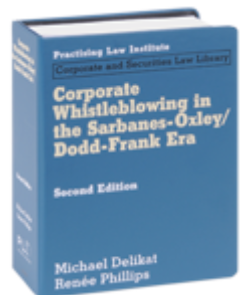
Corporate Whistleblowing in the Sarbanes-Oxley/Dodd-Frank Era (Second Edition)dives into the federal and state regulations and agency rules addressing whistleblowers and international investigations. It provides practical advice on minimizing the risk and damage of whistleblower complaints against employers and conducting effective internal investigations. Practitioners and business professionals dealing with SOX Act and Dodd-Frank whistleblower actions will find valuable insights into dynamic case law and evolving rules that shape the rights of whistleblowers and the responsibilities of their employers. Readers will gain thorough coverage of key topics, including the elements of a prima facie case, employer defenses, compliance and crisis communication strategies, whistleblower protections, bounty provisions, and more.
The new release includes the following updates:
Expanded section 2:1.3, Employees Outside of the United States, explores Daramola v. Oracle America, Inc., in which the Ninth Circuit held that in the case of a Canadian citizen working in Canada for the Canadian subsidiary of a publicly traded U.S. parent company, any domestic (that is, U.S.) duties the employee performed were incidental to his foreign employment and, therefore, the application of SOX under these circumstances would not be domestic in nature.
Revised section 5:5, Causation, explains Murray v. UBS Securities, LLC, in which the Supreme Court held, that while a whistleblower bringing a claim under SOX must prove that the protected activity was a contributing factor in the unfavorable personnel action, a whistleblower need not also prove that the employer acted with retaliatory intent.
New chapter 7, EU Whistleblower Protection Directive, examines the Whistleblower Protection Directive 2019/1937 adopted by the EU to enhance the enforcement of EU law and policies in specific areas by laying down common minimum standards providing for a high level of protection of persons reporting breaches of EU law.
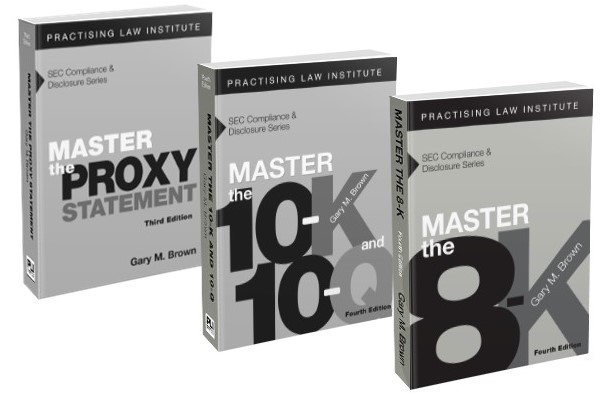
These step-by-step guides deliver clear explanations, comprehensive information, and essential practice tips to implement or refine corporate disclosure controls and procedures to ensure accurate and timely filings. Master the 8-K offers updated direction on filing the SEC’s Current Report on Form 8-K. Master the 10-K and 10-Q gives instructions and analysis to ensure accurate and timely filings. Master the Proxy Statement advises companies on year-end disclosures and preparing proxy materials. The series includes sample language, detailed appendices, key regulations, and related forms and checklists.
Some of the highlights from the recently published editions include:
The latest guidance on the instances in which an employment relationship or transaction and any resulting compensation involving an executive officer need not be disclosed (see Appendix 7, Section 5(a)(iii))
Added information on purchases of equity securities by the issuer and affiliated purchasers (see Appendix 2, Section 26)
A new appendix dedicated to Regulation S-K, Item 106 Cybersecurity (see Appendix 11)
Additional explanation of the information to be provided on the cover page of an Annual Report on Form 10-K including a new section on “clawback” disclosures (see Section 1:11)
Notification on updates to the disclosures required by Item 408(d) of Regulation S-K (see Section 3:8.4)
Communication about items required to be disclosed under Item 703 of Regulation S-K (see Section 8:3.6)
Announcement of an additional deadline that must be disclosed by the proxy statement (see Part 2, Chapter 1, Section 1:1)
A new section detailing the disclosures required by Item 408(b) of Regulation S-K (Insider Trading Policies) (see Chapter 7, Section 7:27)
Extensive new coverage of the disclosure required by Items 402(v), 402(w), and 402(x) of Regulation S-K (see Chapter 8, Sections 8:24, 8:25, and 8:26).
PLI PLUS offers unlimited electronic access to more than 4,500 downloadable, searchable, and editable legal forms ready for use in your practice. In an effort to highlight this unique content type, we’ve selected one form per month and made it available for anyone to download for free – no subscription required.
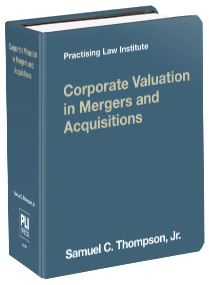
This book offers a solid primer on the legal, finance, accounting, and economic aspects of valuation in merger and acquisition (“M&A”) transactions. It addresses a wide range of issues that can arise in the process of evaluating a target or acquirer in an M&A transaction. The book also provides helpful reference materials in each chapter that the reader may consult when facing a particular issue, along with many documentary appendices relating to valuation issues.
This book offers a solid primer on the legal, finance, accounting, and economic aspects of valuation in merger and acquisition (“M&A”) transactions. It addresses a wide range of issues that can arise in the process of evaluating a target or acquirer in an M&A transaction. The book also provides helpful reference materials in each chapter that the reader may consult when facing a particular issue, along with many documentary appendices relating to valuation issues.
Notably, the book covers the following important topics:
Basic business and regulatory M&A principles (see Chapter 1)
Is your library interested in subscribing to PLI’s Standing Order Plan (SOP)? SOP subscribers automatically receive print copies of new titles to review upon release. If you decide to keep the title, you will receive a discount up to 25% off the title and all future supplements. Call 877.900.5291 or email libraryrelations@pli.edu to learn more.
PLI PLUS offers unlimited electronic access to more than 4,500 downloadable, searchable, and editable legal forms ready for use in your practice. In an effort to highlight this unique content type, we’ve selected one form per month and made it available for anyone to download for free – no subscription required.