Blockchain and distributed ledger technology have been
dramatically transforming all industries, including the legal profession. The
implementation of “smart contracts” is just one way blockchain technology
directly affects lawyers and law firms.
The following are some of the many key blockchain-related
topics that lawyers need to understand in order to effectively represent their
clients:
The evolving landscape of token and ICO regulation
The expansion of blockchain technology and smart contracts
Legislative and regulatory initiatives affecting blockchain technology and digital assets
Intellectual property and blockchain
The mechanics of cross-border payments through correspondent banks and payment systems
Challenges and solutions for GDPR compliance
Below, we’ve highlighted some of our blockchain articles that may be of particular interest:
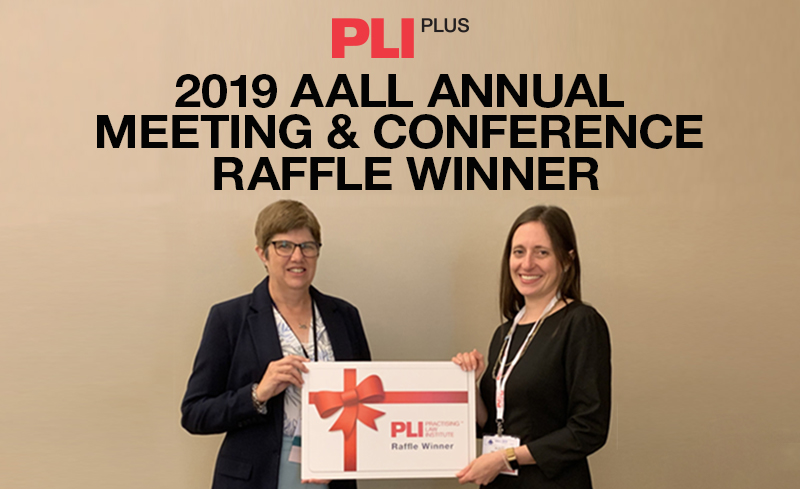
At the AALL Annual Meeting & Conference in Washington, D.C. this year, PLI raffled off an Amazon Echo. Caren Luckie, Research Attorney at Jackson Walker was our winner. Check out our interview with Caren below!
Tell me a little about yourself. Why did you become a librarian?
I became a librarian somewhat by default. I was looking for a job after college, and was talking to a friend of my parents who was in charge of the Shell Oil business library. She was a Seven Sisters graduate (Wellesley) and said she would be willing and happy to hire another Seven Sisters (Mount Holyoke) graduate. And so it began. I spent 4 years in the Shell Oil library as a ‘clerk’, but handled basic research and reference requests. I went on to another job as a bloodstock researcher for a thoroughbred breeding farm, and then to law school. I didn’t think much about becoming a librarian until I was practicing law and decided that I didn’t like being first chair in a litigation practice. I wanted to do research and the background work. So I went to grad school at UT and got my MLIS in one year. With a background in research of all types, plus a law degree, I wanted to focus on research and being a law librarian was the way to go.
What do you like most about your job at Jackson Walker?
The variety. Much of my work is for the litigation group, but I work with all of our practice groups. I’m a “generalist” rather than a specialist, and it never (rarely) gets dull. Also the people – attorneys, staff, administration – are great. This month marks my 25th anniversary with Jackson Walker, so I think it’s safe to say that I like it here.
What is a common research question you receive?
There is no common question J I do quite a bit of public records research, both for our real estate practice and for our litigation group. But I also get complex legal research questions. I think my most common research project/question is checking on the status of tenants for our commercial real estate clients.
Which PLI publication do you most frequently recommend to attorneys?
That would depend on the practice group. For our real estate group, it’s frequently Friedman on Leases. For my First Amendment attorneys, Sack on Defamation.
What did you think of AALL 2019? Did you do any sightseeing in Washington D.C.?
I thought it was an excellent conference. The programs were good, and it’s always great to network with old friends and meet new colleagues. I spent 2 days before the conference sightseeing – my husband and I toured the Capital, spent time at the Spy Museum, and got to see the pandas at the National Zoo. I also got to see the Carnegie Library building that has been turned into an Apple Store. They share the building with the historical society, and have kept the building’s integrity – simply whitewashed the whole thing – and have the old blueprints and quite a few old photos.
We add content to PLI PLUS every month to ensure our subscribers have access to the most up-to-date and relevant secondary source legal documents. Renowned legal experts regularly update our acclaimed Treatises, Course Handbooks, Answer Books, Transcripts, and Forms to reflect recent changes and developments in the law.
Did you know we have a PLI PLUS search widget? It can be embedded into any knowledge management portal, whether it’s your library’s intranet page or a standard webpage, a SharePoint page or another format. This simple and easy search box allows you to enter a search query without having to open a new window. This search box gives your organization a direct line to over 90,000 legal documents, all of which were written by experts in their respective fields.
Interested in adding this to your webpage? Write us at PLUS@pli.edu and we’ll send you the code.
Technology
Transactions: A Practical Guide to Drafting and Negotiating Commercial
Agreements is an indispensable guide to drafting, reviewing, and
negotiating technology transaction agreements. Editor Mark G. Malven, with more
than twenty years of experience handling thousands of tech transactions and
representing customers as well as technology vendors, combines his legal
expertise and that of eleven other contributors from the legal and business
worlds to deliver streamlined, practical, easy-to-access guidance.
This release presents the latest developments in the field,
affecting most of the chapters in the book. Among the changes are:
Chapter 10, Information Security Agreements: This new chapter covers the drafting, review, and negotiation of information security (“InfoSec”) agreements. InfoSec agreements have become more prevalent in service provider relationships as a result of the explosion of electronic data coupled with increasing legal and regulatory risk associated with privacy breaches. InfoSec agreements go beyond the basic limitations on use and disclosure of confidential information covered by NDAs, for example, by imposing specific obligations for each information type covered, imposing obligations as to how the recipient must safeguard information, and allowing for audits of the recipient’s treatment of information. A sample InfoSec agreement is included.
Chapter 21, Enforcement of Online Terms and Conditions: This new chapter provides an introduction to enforceability considerations when drafting online terms and conditions, including browsewrap, clickwrap, and in-box contracting. It includes discussion of arbitration clauses in such contexts.
Chapter 17, Privacy: HIPAA and Business Associate Agreements: New section 17:6, Enforcement Actions, discusses recent enforcement activity by the U.S. Department of Health and Human Services Office for Civil Rights (OCR), including an action against the University of Texas MD Anderson Cancer Center for violations arising from the loss of a laptop computer and two thumb drives, each of which stored unencrypted PHI, resulting in the OCR’s imposition of $4.3 million in penalties, and another action against Anthem, Inc. pertaining to the unauthorized disclosure of nearly 80 million unencrypted patient records, resulting in a resulting in a resolution agreement with a settlement of $16 million, the highest settlement amount to date associated with an OCR-enforced unauthorized disclosure matter.
This essential treatise is available on PLI PLUS. If you would like to order a print
copy, please contact libraryrelations@pli.edu.
Corporate Political Activities Deskbook provides a thorough grounding in the law of federal and state campaign finance, pay-to-play, lobbying, and gift compliance. It serves as a practical manual for attorneys who advise corporations about involvement in the political process.
Among the updates in this edition the 2019 Edition are the following:
Federal limits on campaign contributions: Revised contribution limits for both individuals and PACs under the Bipartisan Campaign Reform Act of 2002 are presented in Chapter 2, Political Action Committees.
State laws on corporate contributions and lobbying: Several states have recently changed their approach to corporate contributions, and a chart in Chapter 4, State Laws, Rules, and Policies Impacting Corporate Government Relations, provides a quick reference for determining which states prohibit corporate-funded campaign contributions, which impose limits, and which have no prohibitions or limits on corporate contributions. In addition, the detailed survey of federal and state lobbying laws and survey of state contribution laws in chapter 4 has been updated.
Pay-to-play: Chapter 5, Pay-to-Play Rules, provides up-to-date information on the state and local jurisdictions that have pay-to-play rules.
We add content to PLI PLUS every month to ensure our subscribers have access to the most up-to-date and relevant secondary source legal documents. Renowned legal experts regularly update our acclaimed Treatises, Course Handbooks, Answer Books, Transcripts, and Forms to reflect recent changes and developments in the law.
Practising Law
Institute will be at the AALL
Annual Meeting & Conference in Washington, D.C. from July
13 – 16. Stop by to chat with our team and learn more about PLI and PLI PLUS.
We know with all the interesting sessions and networking events taking place,
conference schedules get booked fast—so save some time to visit us at the PLI
booth!
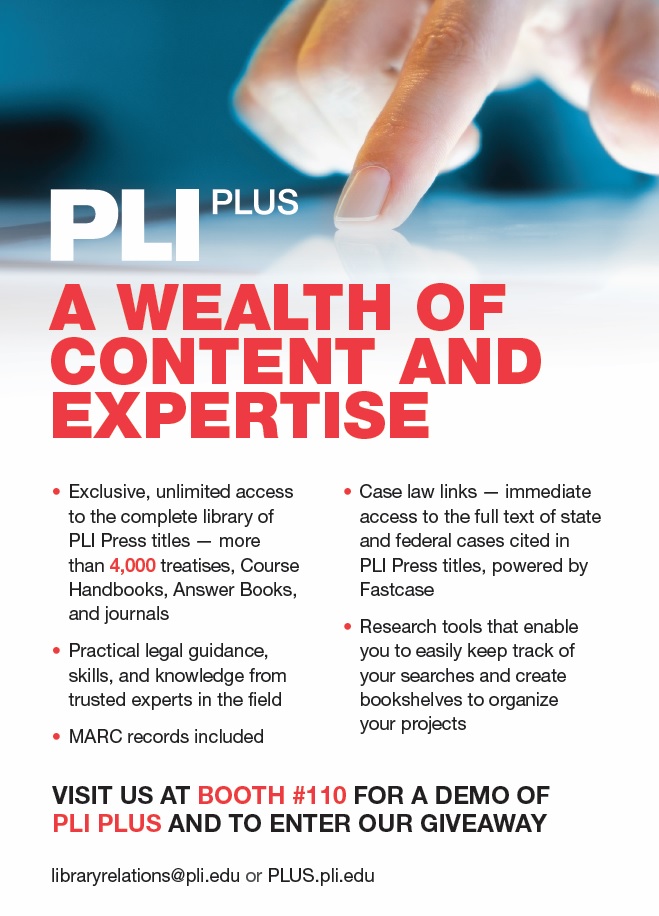
You can find us at booth
#110, where you can enter our raffle giveaway for an Amazon Echo Pro. Be sure
to see a demonstration of PLI PLUS, learn about the latest enhancements to the
platform, as well as new titles published by PLI Press.
We hope to see you at our Librarian Advisory Breakfast on Sunday, July 14th at 7:30am.
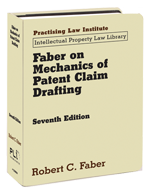
More patent applications are rejected because of claim
drafting flaws than because of problems with inventions. A trusted working tool
for more than two decades, Faber on Mechanics
of Patent Claim Drafting spotlights proven claim drafting practices and
techniques that have been firmly established by patent authorities and custom. Faber on Mechanics
of Patent Claim Drafting also provides full coverage of U.S. Supreme Court
and other court decisions critical to claim drafting.
In the latest release, author Robert C. Faber updates and
expands his treatise with practical information and commentary on a variety of
issues affecting patent claim drafting. Among the topics covered are the
following:
Patent Office guidance: In November 2018
and January 2019, the USPTO issued updated guidance memorandums for examiners
and administrative patent judges relating to (1) subject matter eligibility of
patent claims under 35 U.S.C. § 101 and (2) examination of functional claim
limitations under 35 U.S.C. § 112. The author highlights important points from
these documents. See Chapter 1.
Statutory Provisions—Some Basic Principles.
Preamble: The Federal Circuit notes that
a preamble limits the invention if it recites an essential structure or step or
is necessary to give life, meaning, and vitality to the claim. A preamble is
not limiting when a patent claim defines a structurally complete invention in
the claim body, which is after the preamble, and the preamble only states a purpose
or intended use for the invention claimed (Acceleration Bay, LLC v.
Activision Blizzard Inc.). See Chapter 2. Claim
Forms and Formats in General.
Indefiniteness: According to a federal
district court in Texas, when the specification has two different meanings for
the same word or term, and the claim includes the different meanings for that
word or term, the claim thereby lacks sufficient “objective boundaries,” so
that the claim is indefinite and invalid (Intellectual Ventures LLC v.
T-Mobile USA, Inc.). See Chapter 3.
Apparatus or Machine Claims.
Claim differentiation: According to the
Federal Circuit, if a dependent claim contains additional limitations not
present in the independent claim, then—under the doctrine of claim
differentiation—the limitations cannot be applied to limit the independent
claim, since the specification does not limit the invention to those additional
limitations (Knowles Electronics LLC v. Iancu). See Chapter 8. Nonart
Rejections.
This essential treatise is available on PLI PLUS. If you would like to order a print
copy, please contact libraryrelations@pli.edu.