Practising Law
Institute will be at the AALL
Annual Meeting & Conference in Washington, D.C. from July
13 – 16. Stop by to chat with our team and learn more about PLI and PLI PLUS.
We know with all the interesting sessions and networking events taking place,
conference schedules get booked fast—so save some time to visit us at the PLI
booth!
You can find us at booth
#110, where you can enter our raffle giveaway for an Amazon Echo Pro. Be sure
to see a demonstration of PLI PLUS, learn about the latest enhancements to the
platform, as well as new titles published by PLI Press.
We hope to see you at our Librarian Advisory Breakfast on Sunday, July 14th at 7:30am.
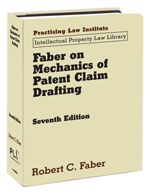
More patent applications are rejected because of claim
drafting flaws than because of problems with inventions. A trusted working tool
for more than two decades, Faber on Mechanics
of Patent Claim Drafting spotlights proven claim drafting practices and
techniques that have been firmly established by patent authorities and custom. Faber on Mechanics
of Patent Claim Drafting also provides full coverage of U.S. Supreme Court
and other court decisions critical to claim drafting.
In the latest release, author Robert C. Faber updates and
expands his treatise with practical information and commentary on a variety of
issues affecting patent claim drafting. Among the topics covered are the
following:
Patent Office guidance: In November 2018
and January 2019, the USPTO issued updated guidance memorandums for examiners
and administrative patent judges relating to (1) subject matter eligibility of
patent claims under 35 U.S.C. § 101 and (2) examination of functional claim
limitations under 35 U.S.C. § 112. The author highlights important points from
these documents. See Chapter 1.
Statutory Provisions—Some Basic Principles.
Preamble: The Federal Circuit notes that
a preamble limits the invention if it recites an essential structure or step or
is necessary to give life, meaning, and vitality to the claim. A preamble is
not limiting when a patent claim defines a structurally complete invention in
the claim body, which is after the preamble, and the preamble only states a purpose
or intended use for the invention claimed (Acceleration Bay, LLC v.
Activision Blizzard Inc.). See Chapter 2. Claim
Forms and Formats in General.
Indefiniteness: According to a federal
district court in Texas, when the specification has two different meanings for
the same word or term, and the claim includes the different meanings for that
word or term, the claim thereby lacks sufficient “objective boundaries,” so
that the claim is indefinite and invalid (Intellectual Ventures LLC v.
T-Mobile USA, Inc.). See Chapter 3.
Apparatus or Machine Claims.
Claim differentiation: According to the
Federal Circuit, if a dependent claim contains additional limitations not
present in the independent claim, then—under the doctrine of claim
differentiation—the limitations cannot be applied to limit the independent
claim, since the specification does not limit the invention to those additional
limitations (Knowles Electronics LLC v. Iancu). See Chapter 8. Nonart
Rejections.
This essential treatise is available on PLI PLUS. If you would like to order a print
copy, please contact libraryrelations@pli.edu.
We add content to PLI PLUS every month to ensure our subscribers have access to the most up-to-date and relevant secondary source legal documents. Renowned legal experts regularly update our acclaimed Treatises, Course Handbooks, Answer Books, Transcripts, and Forms to reflect recent changes and developments in the law.
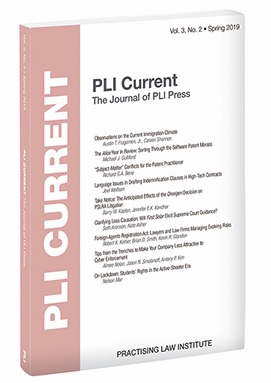
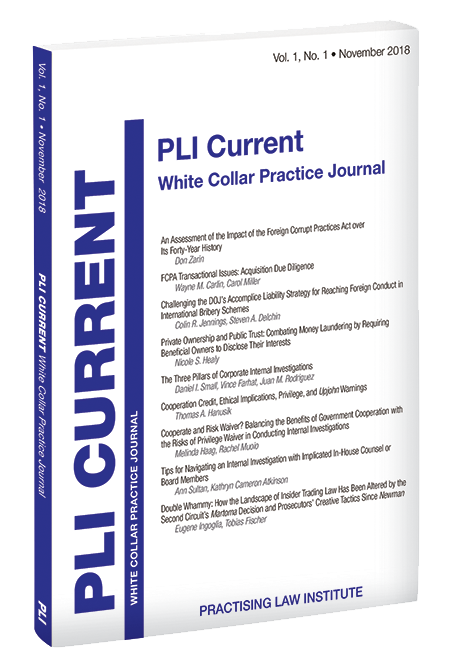
PLI Press publishes two journals–PLI Current: The Journal of PLI Press and PLI Current: White Collar Practice Journal. This page contains descriptions of each of these journals, as well as information on journal subscriptions.
PLI Current: The Journal of PLI Press is published quarterly and is available in print and online.
PLI Current: The Journal of PLI Press is a quarterly legal journal published by PLI Press and dedicated to providing timely and relevant analysis, insight, and commentary on topics of interest to practicing attorneys and others in the legal profession across a range of practice and interest areas. This journal contains original articles authored by practicing attorneys, including PLI authors and program faculty, as well as judges, scholars, and other professionals in the legal field with expertise in a given practice area or areas.
Print subscriptions include four issues for $300.00. Orders can be placed at www.pli.edu/PLICurrent. Online subscriptions include four issues per year as well as access to all back issues. Orders can be placed by emailing PLUS@pli.edu.
********
PLI Current: White Collar Practice Journal is published at least twice annually and is available in print and online.
PLI Current: White Collar Practice Journal is a legal journal that focuses on white collar/financial crimes and related matters. This journal contains original articles authored by practicing attorneys, including PLI authors and program faculty, as well as judges, scholars, and other professionals in the legal field with expertise in a given practice area or areas.
Print subscriptions include two issues for $249.00 per year. Orders can be placed at www.pli.edu/PLICurrentWC. Online subscriptions include two issues per year as well as access to all back issues. Orders can be placed by emailing PLUS@pli.edu.
For information on purchasing individual print issues, discounts for students and educational institutions, enterprise-wide subscriptions, and any other inquiries, email PLUS@pli.edu.
Friedman on Leases
is widely regarded as the leading authority on commercial real estate leasing,
recognized for its unsurpassed
comprehensive and practical instruction, as well as its extensive
and balanced coverage of the
full range of tenant and landlord concerns. The updated Friedman on
Leases, Sixth Edition continues to deliver not only the foundational
knowledge required by novice practitioners, but also analysis of and insight
into the most current and relevant developments facing seasoned practitioners
in the commercial real estate field.
Highlights of this Release #6
include the following:
Sample Provisions; Determination of Cancellation Fee. New sample provision to determine the Cancellation Fee. (See Chapter 22. Option to Cancel Lease section 22:5.5)
Case Developments. Includes the latest developments in the following areas:
Interruption of Services. If a tenant can establish that the interruption of services has caused a constructive eviction of tenant, most courts have allowed tenants to plead constructive eviction as a defense to a non-payment of rent action (see Chapter 12. Landlord’s Services section 12:2);
Tenant’s Retention of Possession After End of Lease: Liability for Damages. A tenant may be found to have retained constructive possession of the premises, giving rise to a holdover tenancy, by failing to remove fixtures or improvements as required to restore the premises (see Chapter 18. Termination of Lease section 18:2);
Effect of Bankruptcy on Landlord’s Remedies for Default; Claims for Damages. In finding that the damages cap in section 502(b)(6) does not apply to damages for waste, trespass, or nuisance, the Ninth Circuit Court of Appeals proposed a test to resolve the question of application of the cap, which test has been adapted by some jurisdictions (see Chapter 20. Tenant Bankruptcy section 20:6.3); and
Mechanics’ Lien. The New York Court of Appeals held that consent for purposes of the Lien Law can be inferred from lease terms, and no express consent or privity between landlord and contractor is required (see Chapter 23. Alterations and Improvements by Tenant section 23:9).
This essential treatise is
available on PLI PLUS. If you would like to
order a print copy, please contact libraryrelations@pli.edu.
Legal Guide to the
Business of Marijuana is a unique resource for lawyers who represent
clients in what has been called the fastest growing industry in the United
States. Many states now allow medical and/or recreational use of marijuana, but
it remains illegal under the federal Controlled Substances Act. As a result,
marijuana enterprises must operate in a legal and regulatory environment of
uncertainty and rapid change, and lawyers representing these enterprises must
tread carefully when advising clients.
Written by James T. O’Reilly, a lawyer and public health
specialist, Legal
Guide to the Business of Marijuana offers critical guidance to help lawyers
effectively represent their clients while steering clear of seen and as yet
unseen perils implicit in the continued federal-state conflict. Highlights of
the 2019 Edition include:
Discussion and summary of the new laws in Michigan, Missouri, Oklahoma and Utah, the latest states to enact some form of legalization.
Coverage of the Agriculture Improvement Act of 2018 (the “2018 Farm Bill”), which legalized production of hemp nationwide while also retaining the regulatory power of the FDA over CBD products derived from hemp.
Updated state-by-state Appendix of cannabis-related statutes, regulation, and court cases
This essential treatise is available on PLI PLUS. If you would like to order a print copy,
please contact libraryrelations@pli.edu.
Covering on the of most dynamic and rapidly changing sectors of the asset management industry, Hedge Fund Regulation (Second Edition) is designed to provide comprehensive understanding of hedge funds. It provides a single source that examines all aspects of these innovative investment vehicles and addresses current regulatory concerns that impact hedge funds, their managers and investors. Hedge Fund Regulation is updated regularly by its author to keep current with regulatory and enforcement developments. The latest release addresses current issues in structuring, launching, and operating a hedge fund.
Highlights of Release #13 include: • Chapter 9, Privacy Regulations. Revises discussion on the management of cybersecurity risks by commodity pool operators and commodity trading advisors to reflect recent updated guidance from the National Futures Association. See section 9:6.2. • Chapter 14, Books and Records. Discussion of recent SEC Risk Alert highlighting practices that can assist an investment adviser in meeting its obligations under the SEC’s Books and Records Rule and Compliance Rule with respect to the increasing use of electronic communications. See section 14:2. • Chapter 18, Commodity Pool Operators and Commodity Trading Advisers. New section 18:5.2, Internal Controls System, covering the NFA requirement for commodity pool operators to implement an internal controls system designed to protect operators to implement an internal controls system designed to protect customer funds, maintain accurate financial books and records, and assure compliance with NFA and CFTC requirements. • Chapter 23, Broker-Dealer Status and Relationships. Revised section 23:4, Best Execution, to include discussion of recently adopted revisions to Exchange Act Rules 600 and 606 regarding broker-dealer disclosure obligations on their handling of institutional orders and its implications for investment adviser best execution analysis. • Chapter 24, Disclosures of Market Participation. Revisions to discussion of Hart-Scott-Rodino Act (HSR Act) compliance, including updated HSR Act thresholds. See section 24:7.
This treatise is available on PLI PLUS. If you would like to order a print copy, please contact libraryrelations@pli.edu.
Sign up today for PLI’s monthly webinar series on PLI PLUS for law school librarians. Each monthly webinar will cover a different practice area; while also demonstrating the overall functionality of the research database.
These webinars are meant to be a convenient way to learn more about PLI content in an area of the law. Each webinar will start with an overview of relevant PLI resources to be followed by research scenarios. Attendees are welcome to submit their own research questions and scenarios up to one week prior to the webinar.
If you are interested in participating, please send an RSVP to PLUS@pli.edu.
Upcoming webinars:
MAY: Wednesday, May 29, 2019, 2:00pm ET: Immigration Law
JUNE: Wednesday, June 26, 2019, 2:00pm ET: Real Estate Law
JULY: Wednesday, July 31, 2019, 2:00pm ET: Tax Law
AUGUST: Wednesday, August 28, 2019, 2:00pm ET Corporate Law
We add content to PLI PLUS every month to ensure our subscribers have access to the most up-to-date and relevant secondary source legal documents. Renowned legal experts regularly update our acclaimed Treatises, Course Handbooks, Answer Books, Transcripts, and Forms to reflect recent changes and developments in the law.
Holtzchue on Real Estate Contracts and Closings: A Step-by-Step Guide to Buying and Selling Real Estate (Third Edition) provides thorough legal, technical, strategic guidance to help implement dispute-free residential and commercial deals more quickly and easily. Featuring checklists, highlighted practice tips, and dozens of useful forms, this treatise is a valuable step-by-step “how to” guide that ensures practitioners can successfully prepare for a sale or purchase of real estate.
Release #21 includes new and updated cases and other authority throughout the text, including in the following important areas:
Attorney Malpractice: New section collects malpractice cases (see Front Matter at “Ethics and Professional Responsibility,” section [10]).
Acceptable Title and Title Insurance: Where the N.Y. Appellate Division reversed annulment of Insurance Regulation 208, which prohibited title insurance corporations and title agents from providing any marketing payments or entertainments to attorneys, but affirmed annulment of regulations on closer fees and ancillary fee caps.
Closing Date and Place: Recent cases where the contract expressly states that time is of the essence (see section 2:2.9).
Condition of Premises and Caveat Emptor: Recent cases on affirmative representation on mold and Property Condition Disclosure Statement regarding water damage (see section 2:2.11[A][2]).
NYSBA Ethics Opinions: NYSBA Ethics Opinion 1161, opining that when a lawyer prepares a contract of sale, the lawyer may not disclose the contract to the broker who requested a copy without the client’s informed consent (see section 1:1.2).
This treatise is available on PLI PLUS. If you would like to order a print copy, please contact libraryrelations@pli.edu.