
In celebration of National Library Week, we’ve cleared our schedules and made ourselves available all week to answer any questions you may have about the electronic availability of titles on PLI PLUS, the online research database of PLI Press. Schedule a one-on-one session with a PLI librarian today!
Category Archives: PLI PLUS
New Edition! Product Liability Litigation
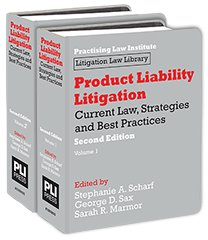
PLI Press is proud to announce the publication of the second edition of Product Liability Litigation: Current Law, Strategies and Best Practices.
This comprehensive treatise provides legal, technical, and strategic knowledge that can help maximize an attorney’s ability to prevail in consumer product liability cases. It covers trends in product claims and defenses, strategies for managing and resolving product litigation, and particular issues and tactics that can arise in different types of product cases. Chapters are written by lawyers who represent both plaintiff and defense perspectives.
The new edition is substantially revised and reorganized. In addition to fully updating chapters from the first edition on traditional areas of product liability litigation, the authors have added new content on cutting-edge product claims arising from the use of autonomous vehicles, vaping devices, cannabis products, blockchain technology and smart technology. There is also a new chapter on suing foreign defendants in the United States.
Order a print copy today.
PLI PLUS subscribers can access this title through their subscription.
Treatise Update – Faber on Mechanics of Patent Claim Drafting
Faber on Mechanics of Patent Claim Drafting (Seventh Edition) spotlights proven claim drafting practices and techniques that have been firmly established by patent authorities and custom. This lucid, time-saving handbook offers readers start-to-finish directions for every type of claim, numerous tips on how to avoid common mistakes, definitions and preferred usage of stylized words and phrases in patent law, and more.
The latest release updates and expands this treatise with practical information and commentary on a variety of topics, including:
- Software Inventions: New discussion of the Federal Circuit’s decisions in Tenstreet LLC v. DriverReach LLC, Uniloc USA, Inc. v. LG Electronics USA, Inc., Customedia Technologies, LLC v. Dish Network Corp., Ubisoft Entertainment, S.A. v. Oy, and Dropbox v. Synchronoss. See § 1:4.2[A].
- Laws of Nature: New analysis of Illumina, Inc. v. Ariosa Diagnostics, Inc., a method of preparation case in which the Federal Circuit found a procedure that exploits natural phenomenon to be patent-eligible. See §§ 1:4.4 and 1:4.6.
- Methods of Treatment: New commentary on CardioNet v. Infobionic in which the Federal Circuit has shown that diagnosis techniques involving improved devices or laboratory techniques may be patent-eligible. See § 1:4.6[A].
- Preamble: New discussion of Shoes by Firebug LLC v. Stride Rite Children’s Group, LLC in which the Federal Circuit concluded that the “textile” preamble was not limiting because the body of the claim was a structurally complete invention without the preamble but that, in another patent, the preamble was limiting because the body of the claim recited footwear and cited the preamble for an antecedent basis for footwear. Also discussed is Bio-Rad Labs, Inc. v. 10X Genomics Inc. in which the Federal Circuit held that the preamble may not be divided into separate portions but must be read together as a whole. See § 2:4.
- “Consisting essentially of”: New analysis of PPG Industries v. Guardian Industries Corp. in which the Federal Circuit said that, despite its indefiniteness, “consisting essentially of” has a definite meaning when used in the description of a composition that includes listed ingredients that follow the phrase. See § 2:6.
- Order of Elements: A new section discusses challenging an obviousness rejection premised on the Burhans rule when the prior art does not teach of limitation of the claimed process. See § 3:21.
- Use of “Means for” or “Step for”: New discussion of Fiber LLC v. Ciena Corp. and whether the definiteness requirement of section 112(f) is satisfied when a means-plus-function structure is incorporated by reference. See § 3:29.2.
Order a print copy today. PLI PLUS subscribers can access this title through their subscription.
Treatise Update – Circular 230 Deskbook
The Circular 230 Deskbook is an essential compliance resource for every tax professional who practices before the IRS, helping practitioners comply with complex Circular 230 amendments more easily — and avoid costly penalties and sanctions. This treatise was recently updated to include analysis of the latest developments in tax and estate law relating to IRS Circular 230 including the following:
- Discussion of conflicting 2020 decisions on whether a penalty under section 6707A is void if the IRS notice designating the transaction as a listed one is issued without notice and comment in violation of the Administrative Procedure Act (Michigan) or if that argument can only be pursued in a refund action (Arizona) (See Chapter 1 and Chapter 3).
- Examination of the difference between the “substantial authority” (having a 40% chance of success on the merits) and “reasonable basis” (where a taxpayer cannot be found negligent if its tax position has a 20% chance of success on the merits) standards under section 6694 (See Chapter 4).
Order a print copy today.
PLI PLUS subscribers can access this title through their subscription.
New Title! Master the Proxy Statement
PLI Press is pleased to announce the publication of Master the Proxy Statement.

This standalone handbook is a step-by-step guide to preparing proxy solicitation materials in compliance with the Securities Exchange Act of 1934, Regulation 14A, Schedule 14A, and all applicable federal securities laws and regulations. Like its counterparts Master the 8-K and Master the 10-K and 10-Q, this thorough book draws on the expertise of author Gary M. Brown to deliver clear explanations, detailed guidance and essential practice tips.
Order a print copy today. PLI PLUS subscribers can access this title through their subscription.
Other PLI Press Treatises by Gary M. Brown:
What’s New on PLI PLUS

We add content to PLI PLUS every month to ensure our subscribers have access to the most up-to-date and relevant secondary source legal documents. Renowned legal experts regularly update our acclaimed Treatises, Course Handbooks, Answer Books, Transcripts, and Forms to reflect recent changes and developments in the law.
Click here to see what we added in February!
Insurance Law Webinar – Tuesday!
Please join us on Tuesday, January 26 at 3:00 p.m. ET for a brief demo highlighting the Insurance Law resources available on Practising Law Institute’s (PLI) online research database, PLI PLUS. Led by PLI’s Associate Director of Library Relations Kay Mitchell, this 30-minute demo will cover popular Insurance Law titles and review research scenarios to demonstrate key features of PLI PLUS.
POPULAR INSURANCE LAW TITLES AVAILABLE ON PLI PLUS INCLUDE:
- COVID-19 and Other Pandemics: Business and Legal Challenges
- Variable Annuities and Other Insurance Investment Products
- Insurance and Investment Management M&A Deskbook
- Reinsurance Law
- Insurance Regulation Answer Book
This demo is part of our ongoing webinar series. Each month we highlight PLI’s resources in a different practice area while also demonstrating the overall functionality of the research database. For registration and a list of upcoming webinars, visit PLI Practice Area Webinars.
Treatise Update – Public Company Deskbook
Public Company Deskbook: Complying with Federal Governance & Disclosure Requirements (Third Edition) provides expert counsel on how to deal effectively with the overlapping legislative, regulatory and private initiatives to reform public company governance and disclosure practices over the past decade.
Highlights of from the latest update–Release #12– include:
- Updates to Chapter 2A, Annual Meeting Timeline and Script, to reflect the dates relevant to the 2021 proxy season.
- Updates to Chapter 2F, Rule 14a-8 Shareholder Proposals, to reflect lessons learned from 2020 for the 2021 proxy season, including shareholder proposals and SEC no-action relief.
- Updates to Chapter 5B, Stock Exchange Annual Reporting and Compliance Certifications, and Chapter 5D, Stock Exchange Interim Reporting and Compliance Affirmations, to reflect the revised forms of NYSE annual and interim reporting and compliance affirmations.
- Updates to Chapter 5E, Website Disclosures, to reflect changes to various required or permitted disclosures.
- Updates to Appendix L, Private Sector Corporate Governance Recommendations and Voting Policies, to reflect current voting policies of major institutional investors.
Order a print copy today.
PLI PLUS subscribers can access this title through their subscription.
PLI PLUS on ‘Above the Law’
“We hear people talk about the ‘new normal’ and an increasing preference for resources that cater to remote work – that is something we will continue to respond to as we look ahead to the post-pandemic world.”
That’s a quote from our director Alexa Robertson from a Q&A recently featured on Above the Law. Read the full interview here: Remote Research? No Problem – Meet PLI PLUS
Treatise Update – Likelihood of Confusion in Trademark Law
Likelihood of Confusion in Trademark Law illuminates the pivotal multiple-factor test, giving readers a strong grasp of the key elements used by the courts to determine if likelihood of confusion exists. Packed with hundreds of real-world examples and updated with every relevant U.S. Court of Appeals decision, this treatise is a must-have reference for trademark specialists and other intellectual property attorneys, and important reading for corporate counsel, generalists, and corporate executives.
This update includes a new addition to the color illustrations in the appendix and new case law integrated into the text throughout. Among the topics addressed in this latest release:
- Purposes of trademark law: As summarized by the Supreme Court summarized in United States Patent & Trademark Office v. Booking.com: Trademark protection “secures to the owner of the mark the goodwill of her business and protects the ability of consumers to distinguish among competing producers . . . . Federal trademark protection, supplementing state law, supports the free flow of commerce and fosters competition.” See § 1:2, at note 43.1.
- First Amendment concerns—artistic expression cases: According to the Ninth Circuit, the likelihood of confusion test for infringement “ordinarily” strikes “a comfortable balance between the Lanham Act and the First Amendment. That said, where artistic expression is at issue, we have expressed concern that the traditional test fails to account for the full weight of the public’s interest in free expression” (Gordon v. Drape Creative, Inc.). See § 1:8.2, at note 183.1.
- Confusion and fair use: The Second Circuit, in Tiffany & Co. v. Costco Wholesale Corp., notes that “a defendant may raise a fair use defense even where the challenged material is likely to cause some confusion.” See § 1:10, at note 244.1.
- The multi-factor test in registrability proceedings: The TTAB follows the multi-factor du Pont test of the Federal Circuit, requiring consideration of thirteen factors which must be considered when relevant evidence is of record. See § 2:8, at note 158.1.
- Geographic terms: The TTAB says that “geographically descriptive terms are usually accorded less weight” in a confusion analysis, but it distinguishes certification marks. See § 3:4.1, at note 93.1.
- Disclaimers: A party’s disclaimer of one portion of its mark may result in the remaining portion being treated as dominant and a source of confusion. See § 4:9.4, at note 272.
- Collateral goods: Mark owners in every field commonly apply their brands to collateral items such as mugs and caps distributed as promotional giveaways. Collateral goods may provide significant revenue streams in cases of well-known brands. See § 5:7, at note 75.
- Actual confusion: Lack of evidence of actual confusion was not probative, according to the TTAB, where the Board found no “specific geographical areas of overlap between the [parties’] consumer markets” to create opportunities for actual confusion to occur (In re Guild Mortgage Co.). See § 7:7, at note 131.
- Bad faith: The Second Circuit observes in Tiffany & Co. v. Costco Wholesale Corp. that “[p]rior knowledge of a senior user’s trademark does not necessarily give rise to an inference of bad faith and may [actually] be consistent with good faith.” See § 8:4.2, at note 125.
Order a print copy today.
PLI PLUS subscribers can access this title through their subscription.