Category Archives: Treatise Update

Treatise Update: Friedman and Smith on Contracts and Conveyances of Real Property

The Business Lawyer calls this PLI title “The ‘bible’ for any lawyer handling a real estate conveyance.” providing more than 140 sample forms, sample forms, sample clauses, and checklists that simplify and accelerate transactions, Friedman and Smith helps readers to carefully consider all the issues and options before finalizing a contract. This definitive resource gives guidance on how to handle unexpected problems and contingencies before they become deal-breakers; factor in a relevant case law when structuring sound agreements; and avoid drafting ambiguous or incomplete contracts that can lead to delays and aborted deals.

Highlights of this latest update of Friedman and Smith on Contracts and Conveyances of Real Property include:

  • Chapter 3, Assignments of Contracts. New discussion covers the rights of an assignee against the seller if the seller fails to perform a promise to the buyer included in the contract of sale (see section 3:2.4).
  • Chapter 14, Marketable Title. New discussion of Loring v. Whitney, 46 N.E. 57 (Mass. 1987), which illustrates how courts deal with drawing the line between litigation risk that is substantial versus too remote (see section 14:1.2).
  • Chapter 19, Easements—Creation. New discussion of the distinctions between easements appurtenant and easements in gross, including court-developed tests in cases of ambiguity (see section 19:3).
  • Chapter 22, Covenants—Scope and Termination. New discussion of eminent domain reviews the majority and minority views on whether restrictive covenants are property for takings purposes (see section 22:2.12).
  • Chapter 24, Contract Remedies for Seller Default. New discussions cover challenges to specific performance as a workable remedy for the buyer when the seller has problems with the title (see section 24:44.2), and review the viability of specific performance as a remedy for part of a contract and not for the remainder because the remainder is impossible to perform or the matter is one into which equity will not venture (see section 24:4.3).
  • Chapter 25, Time for Performance. Updated discussion of the “time of the essence” doctrine, including “time is of the essence” as an implied term and the consequences when time is essential and when time is not essential (see sections 25:2.1-25:2.4).
  • Chapter 26, Deed Elements. Updated discussion covers transfer tax, which is payable upon the recordation of a deed, triggering a requirement that the grantee report the amount of consideration to the reocording office that becomes part of the public record, which allows a title searcher to determine the parties’ reported consideration (see section 26:4).

This essential treatise is available on PLI PLUS. If you would like to purchase a print copy, please email libraryrelations@pli.edu.

Technology Transactions Update

Technology Transactions: A Practical Guide to Drafting and Negotiating Commercial Agreements is an indispensable guide to drafting, reviewing, and negotiating technology transaction agreements. Editor Mark G. Malven, with more than twenty years of experience handling thousands of tech transactions and representing customers as well as technology vendors, combines his legal expertise and that of eleven other contributors from the legal and business worlds to deliver streamlined, practical, easy-to-access guidance.

This release presents the latest developments in the field, affecting most of the chapters in the book. Among the changes are:

  • Chapter 10, Information Security Agreements: This new chapter covers the drafting, review, and negotiation of information security (“InfoSec”) agreements. InfoSec agreements have become more prevalent in service provider relationships as a result of the explosion of electronic data coupled with increasing legal and regulatory risk associated with privacy breaches. InfoSec agreements go beyond the basic limitations on use and disclosure of confidential information covered by NDAs, for example, by imposing specific obligations for each information type covered, imposing obligations as to how the recipient must safeguard information, and allowing for audits of the recipient’s treatment of information. A sample InfoSec agreement is included.
  • Chapter 21, Enforcement of Online Terms and Conditions: This new chapter provides an introduction to enforceability considerations when drafting online terms and conditions, including browsewrap, clickwrap, and in-box contracting. It includes discussion of arbitration clauses in such contexts.
  • Chapter 17, Privacy: HIPAA and Business Associate Agreements: New section 17:6, Enforcement Actions, discusses recent enforcement activity by the U.S. Department of Health and Human Services Office for Civil Rights (OCR), including an action against the University of Texas MD Anderson Cancer Center for violations arising from the loss of a laptop computer and two thumb drives, each of which stored unencrypted PHI, resulting in the OCR’s imposition of $4.3 million in penalties, and another action against Anthem, Inc. pertaining to the unauthorized disclosure of nearly 80 million unencrypted patient records, resulting in a resulting in a resolution agreement with a settlement of $16 million, the highest settlement amount to date associated with an OCR-enforced unauthorized disclosure matter.

This essential treatise is available on PLI PLUS. If you would like to order a print copy, please contact libraryrelations@pli.edu.

Treatise Update: Trade Secrets

Trade Secrets: A Practitioner’s Guide is an indispensable resource that discusses all aspects of protecting trade secrets. It covers what a trade secret is, how it should be protected, and what to do when its secrecy is compromised. Trade Secrets examines in detail what trade secret misappropriation is, how can you prove it in court, how you can protect trade secret information during the course of litigation, and how you can gain appropriate legal and monetary remedies for clients for proven violations. It compares and contrasts trade secret protection with other forms of intellectual property such as copyright, patents, and trademarks.

This release updates and expands the text with new discussions of the law of trade secrets and related topics, including the following:

  • State statutory preemption of common law: The Fifth Circuit, reversing the district court in material part, held that the Louisiana Uniform Trade Secrets Act does not preempt civil law claims for conversion of information that does not constitute trade secrets (Brand Services, L.L.C. v. IREX Corp.). See § 1:5.5, at note 60.1.
  • Patent versus trade secret: In SAP America, Inc. v. Investpic, LLC, the Federal Circuit held that allegedly novel ideas for applying statistical techniques to financial information were unpatentable abstract ideas. If they were protectable at all, they were protectable as trade secrets. See §2:3.4, at note 87.40.
  • Secrecy: In CPI Card Group, Inc. v. Dwyer, the federal district court in Minnesota found that plaintiff CPI did not assure secrecy in emails that included alleged trade secrets. Although it could point to general measures it took to protect confidential information, “CPI has not shown a likelihood of proving that it took reasonable measures to protect the secrecy of the contents of this particular presentation.” See §4:13.1, at note 107.1.
  • Jury instructions: On December 6, 2018, the Florida Supreme Court approved changes in standard form jury instructions for trade secrets misappropriation cases; the new instructions are reproduced in chapter 12. See § 12:11.2, at note 127.1.
  • Remedies—disgorgement: In Texas Advanced Optoelectronic Solutions, Inc. v. Renesas Electronics America, Inc., the Federal Circuit held that a trade secret owner did not have the right to have a jury decide its claim for disgorgement of profits as a remedy for misappropriation. See § 13:3.5, at note 324.14.

This treatise is available on PLI PLUS. If you would like to order a print copy, please contact libraryrelations@pli.edu.

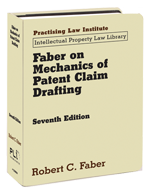
Treatise Update: Faber on Mechanics of Patent Claim Drafting

More patent applications are rejected because of claim drafting flaws than because of problems with inventions. A trusted working tool for more than two decades, Faber on Mechanics of Patent Claim Drafting spotlights proven claim drafting practices and techniques that have been firmly established by patent authorities and custom. Faber on Mechanics of Patent Claim Drafting also provides full coverage of U.S. Supreme Court and other court decisions critical to claim drafting.

In the latest release, author Robert C. Faber updates and expands his treatise with practical information and commentary on a variety of issues affecting patent claim drafting. Among the topics covered are the following:

  • Patent Office guidance: In November 2018 and January 2019, the USPTO issued updated guidance memorandums for examiners and administrative patent judges relating to (1) subject matter eligibility of patent claims under 35 U.S.C. § 101 and (2) examination of functional claim limitations under 35 U.S.C. § 112. The author highlights important points from these documents. See Chapter 1. Statutory Provisions—Some Basic Principles.
  • Preamble: The Federal Circuit notes that a preamble limits the invention if it recites an essential structure or step or is necessary to give life, meaning, and vitality to the claim. A preamble is not limiting when a patent claim defines a structurally complete invention in the claim body, which is after the preamble, and the preamble only states a purpose or intended use for the invention claimed (Acceleration Bay, LLC v. Activision Blizzard Inc.). See Chapter 2. Claim Forms and Formats in General.
  • Indefiniteness: According to a federal district court in Texas, when the specification has two different meanings for the same word or term, and the claim includes the different meanings for that word or term, the claim thereby lacks sufficient “objective boundaries,” so that the claim is indefinite and invalid (Intellectual Ventures LLC v. T-Mobile USA, Inc.). See Chapter 3. Apparatus or Machine Claims.
  • Claim differentiation: According to the Federal Circuit, if a dependent claim contains additional limitations not present in the independent claim, then—under the doctrine of claim differentiation—the limitations cannot be applied to limit the independent claim, since the specification does not limit the invention to those additional limitations (Knowles Electronics LLC v. Iancu). See Chapter 8. Nonart Rejections.

This essential treatise is available on PLI PLUS. If you would like to order a print copy, please contact libraryrelations@pli.edu.

Treatise Update: Friedman on Leases

Friedman on Leases is widely regarded as the leading authority on commercial real estate leasing, recognized for its unsurpassed comprehensive and practical instruction, as well as its extensive and balanced coverage of the full range of tenant and landlord concerns. The updated Friedman on Leases, Sixth Edition continues to deliver not only the foundational knowledge required by novice practitioners, but also analysis of and insight into the most current and relevant developments facing seasoned practitioners in the commercial real estate field.

Highlights of this Release #6 include the following:

Sample Provisions; Determination of Cancellation Fee. New sample provision to determine the Cancellation Fee. (See Chapter 22. Option to Cancel Lease section 22:5.5)

Case Developments. Includes the latest developments in the following areas:

  • Interruption of Services. If a tenant can establish that the interruption of services has caused a constructive eviction of tenant, most courts have allowed tenants to plead constructive eviction as a defense to a non-payment of rent action (see Chapter 12. Landlord’s Services section 12:2);
  • Tenant’s Retention of Possession After End of Lease: Liability for Damages. A tenant may be found to have retained constructive possession of the premises, giving rise to a holdover tenancy, by failing to remove fixtures or improvements as required to restore the premises (see Chapter 18. Termination of Lease section 18:2);
  • Effect of Bankruptcy on Landlord’s Remedies for Default; Claims for Damages. In finding that the damages cap in section 502(b)(6) does not apply to damages for waste, trespass, or nuisance, the Ninth Circuit Court of Appeals proposed a test to resolve the question of application of the cap, which test has been adapted by some jurisdictions (see Chapter 20. Tenant Bankruptcy section 20:6.3); and
  • Mechanics’ Lien. The New York Court of Appeals held that consent for purposes of the Lien Law can be inferred from lease terms, and no express consent or privity between landlord and contractor is required (see Chapter 23. Alterations and Improvements by Tenant section 23:9).

This essential treatise is available on PLI PLUS. If you would like to order a print copy, please contact libraryrelations@pli.edu.

Treatise Update: Hedge Fund Regulation

Covering on the of most dynamic and rapidly changing sectors of the asset management industry, Hedge Fund Regulation (Second Edition) is designed to provide comprehensive understanding of hedge funds. It provides a single source that examines all aspects of these innovative investment vehicles and addresses current regulatory concerns that impact hedge funds, their managers and investors. Hedge Fund Regulation is updated regularly by its author to keep current with regulatory and enforcement developments. The latest release addresses current issues in structuring, launching, and operating a hedge fund.

Highlights of Release #13 include:
Chapter 9, Privacy Regulations. Revises discussion on the management of cybersecurity risks by commodity pool operators and commodity trading advisors to reflect recent updated guidance from the National Futures Association. See section 9:6.2.
Chapter 14, Books and Records. Discussion of recent SEC Risk Alert highlighting practices that can assist an investment adviser in meeting its obligations under the SEC’s Books and Records Rule and Compliance Rule with respect to the increasing use of electronic communications. See section 14:2.
Chapter 18, Commodity Pool Operators and Commodity Trading Advisers. New section 18:5.2, Internal Controls System, covering the NFA requirement for commodity pool operators to implement an internal controls system designed to protect operators to implement an internal controls system designed to protect customer funds, maintain accurate financial books and records, and assure compliance with NFA and CFTC requirements.
Chapter 23, Broker-Dealer Status and Relationships. Revised section 23:4, Best Execution, to include discussion of recently adopted revisions to Exchange Act Rules 600 and 606 regarding broker-dealer disclosure obligations on their handling of institutional orders and its implications for investment adviser best execution analysis.
Chapter 24, Disclosures of Market Participation. Revisions to discussion of Hart-Scott-Rodino Act (HSR Act) compliance, including updated HSR Act thresholds. See section 24:7.

This treatise is available on PLI PLUS. If you would like to order a print copy, please contact libraryrelations@pli.edu.

Updated Treatise: Holtzchue on Real Estate Contracts and Closings

Holtzchue on Real Estate Contracts and Closings: A Step-by-Step Guide to Buying and Selling Real Estate (Third Edition) provides thorough legal, technical, strategic guidance to help implement dispute-free residential and commercial deals more quickly and easily. Featuring checklists, highlighted practice tips, and dozens of useful forms, this treatise is a valuable step-by-step “how to” guide that ensures practitioners can successfully prepare for a sale or purchase of real estate.

Release #21 includes new and updated cases and other authority throughout the text, including in the following important areas:

  • Attorney Malpractice: New section collects malpractice cases (see Front Matter at “Ethics and Professional Responsibility,” section [10]).
  • Purchase Money Note and Mortgage: Recent cases on installment land sale contracts (see section 2:2.5[B]).
  • Acceptable Title and Title Insurance: Where the N.Y. Appellate Division reversed annulment of Insurance Regulation 208, which prohibited title insurance corporations and title agents from providing any marketing payments or entertainments to attorneys, but affirmed annulment of regulations on closer fees and ancillary fee caps.
  • Closing Date and Place: Recent cases where the contract expressly states that time is of the essence (see section 2:2.9).
  • Condition of Premises and Caveat Emptor: Recent cases on affirmative representation on mold and Property Condition Disclosure Statement regarding water damage (see section 2:2.11[A][2]).
  • Remedies for Breach or Failure to Close: Recent cases on breaches by seller and specific performance (see section 2:2.17[A],[A][3]).
  • NYSBA Ethics Opinions: NYSBA Ethics Opinion 1161, opining that when a lawyer prepares a contract of sale, the lawyer may not disclose the contract to the broker who requested a copy without the client’s informed consent (see section 1:1.2).

This treatise is available on PLI PLUS. If you would like to order a print copy, please contact libraryrelations@pli.edu.

Treatise Update: Derivatives Deskbook

Derivatives Deskbook: Close-Out Netting, Risk Mitigation, Litigation (Second Edition) is a comprehensive resource geared to all users of swap agreements and derivatives, from financial institutions to corporate end users. Derivatives Deskbook defines the key terminology and identifies the major players; discusses the full range of documentation; and highlights techniques and best practices that can significantly minimize risks. It examines the termination events and events of default that can trigger the early termination of OTC derivative transactions; the complex process of calculating the early termination amounts due the parties under the transactions; and how these transactions can be terminated in ways that minimize the damage to the parties and to the global financial system.

Derivatives Deskbook further examines the impact of U.S. bankruptcy interrelationship on the termination and close-out netting process and what steps must be taken to comply with a counterparty that is or may become bankrupt. It also serves as a comprehensive resource to key litigation involving derivative transactions in major jurisdictions around the world.

Highlights of this Release #3 include:

  • Chapter 3: Collateral and Security Arrangements; New sections explore the new variation margin regulations adopted by regulators in a variety of major jurisdictions in reaction to the financial crisis to govern the posting of collateral in OTC derivative transactions. The regulations have been enacted by applicable regulators in the European Union, the United States, Switzerland, Canada, and Japan.
  • Chapter 6: Risk Mitigation and Close-out Netting; Revised section 6:6, Collateral Arrangements, examines the need, in large financings with multiple banks and counterparties, for intercreditor agreements to sort through the rights of the various creditors to the collateral securing their obligations. Typically, in an intercreditor agreement, a swap counterparty would agree to abstain from declaring certain events so that a minor breach with one swap counterparty under a swap agreement for dealers and those costs will likely be passed on to counterparties.
  • Chapter 8: Best Practices Recommendations; Revised section 8:4.1, Credit Support Annex, explains that the restrictions on hypothecation in the initial margin regulations are expected to increase the costs of swap agreements for dealers and those cost will likely be passed on to counterparties.

This treatise is available on PLI PLUS. If you would like to purchase a print copy, please contact libraryrelations@pli.edu.

Reinsurance Law Update

Reinsurance Law examines the intricacies of U.S. reinsurance law in the twenty-first century, giving readers a practical grasp of the purpose, benefits, markets, and costs of reinsurance; the features, operation, and risk-and-return characteristics of the full range of reinsurance products; state, federal, and international regulation of reinsurance; and a full understanding of resolving disputes in the industry.

This practical treatise is enhanced with time-saving checklists and numerous adaptable sample agreements and sample clauses.

Release #13 expands and updates the treatise with coverage of the latest developments in reinsurance law. Highlights of the update include the following:

  • Revised Section 3:4, Reinsurer’s Obligation Regarding Supplemental Benefits Outside of the Applicable Limits of Liability, discusses the New York Court of Appeals decision in Global Reinsurance Corp. of America v. Century Indemnity Co., in which the court observed that its 2004 decision in Excess Insurance Co. v. Factory Mutual Insurance Co. did not hold that third-party defense costs under any facultative reinsurance contract are unambiguously or presumptively capped by the liability limits.
  • Revised Section 6:8.4, Subpoenas, in the book’s chapter on arbitration, explains that in CVS Health Corp. v. Vividus, the Ninth Circuit found that a “plain reading of the text of Section 7 [of the Federal Arbitration Act] reveals that an arbitrator’s power to compel the production of documents is limited to production at an arbitration hearing.”

In addition, the Table of Authorities has been updated to reflect the revisions found in Release #13.

This essential treatise is available on PLI PLUS. If you would like to purchase a print copy, please contact libraryrelations@pli.edu.

Treatise Update: Directors’ and Officers’ Liability


Directors’ and Officers’ Liability: Current Law, Recent Developments, Emerging Issues (Third Edition) provides a cutting-edge, straightforward explanation of the obligations of directors and officers of public companies, the penalties they face if they fail to meet their obligations, and the protections available to them under the law or by agreement. Authors Barry Kaplan and Gregory Watts provide solid coverage of topics of utmost importance to directors and officers—the sources of law governing the duties of directors and officers; the key facets of board committees; D&O duties under state corporate law and federal and state securities laws; private civil actions and public enforcement; exculpations, indemnity, and insurance; cybersecurity; contested mergers and acquisitions; Securities Act suits filed in state court; special issues in pharma and biotech; and more.

Of particular note, the chapter on Emerging Issues provides readers with coverage of the latest new developments in the area. Regularly updated, this chapter brings readers’ attention to the latest on dynamic issues like D&O liability related to data breaches, sexual harassment, and climate change.

Director’ and Officers’ Liability is a vital resource for corporate and outside counsel and private practitioners—particularly those whose expertise and specialized training may not include corporate governance and securities.

Highlights of Release #2 include:

  • Emerging Issues: Chapter 8 has been extensively updated to bring you timely discussion of emerging areas of potential liability for directors and officers such as cryptocurrency and initial coin offerings, sexual harassment, and climate change.
  • Board Membership Policies: Gender and ethnic diversity is increasingly a criterion for membership on the board of a public company, and in September 2018, California became the first state to require public companies to have female directors on their boards.

This essential treatise is available on PLI PLUS. If you would like to purchase a print copy, please contact libraryrelations@pli.edu.