
Category Archives: PLI

New Title! An Associate’s First Year: A Guide to Thriving at a Law Firm

An Associate’s First Year: A Guide to Thriving at a Law Firm is a new published title from PLI Press.

There is more to thriving as a new law firm associate than doing great legal work. Associates must also demonstrate commitment to law firm values; capably manage up and down within their firm; successfully interact with people of different generations, cultures, and backgrounds; champion diversity and inclusion; work smartly and efficiently; contribute to innovation within their firms; manage their workloads; continually learn about their clients’ businesses; and so much more.

An Associate’s First Year, edited by Jennifer L. Bluestein and featuring contributions from more than a dozen experts—including partners, professional developments directors, law firm associates, and other legal industry professionals—provides new associates first-hand insights and guidance on:

Each chapter is full of practical suggestions to help new associates navigate their first year of practice at a law firm.

If you would like to order a print copy, please email libraryrelations@pli.edu.
Copyright Law Treatise Update!

Copyright Law: A Practitioner’s Guide (Second Edition)

Written by two nationally recognized lawyers who have litigated major copyright cases, Copyright Law: A Practitioner’s Guide (Second Edition), provides up-to-date analysis of court decisions and practical advice for the protection of copyrights. In this release, the authors update and expand your book with discussion of the following topics, among others:

  • Pre-1972 sound recordings: Under the Classics Protection and Access Act of 2018, sound recordings fixed before February 15, 1972 (previously outside the scope of federal copyright laws)are, as of October 11, 2018, afforded rights and remedies largely analogous to those enjoyed by sound recordings that have always been within the subject matter and protections of the Copyright Act.
  • Standing: According to the Ninth Circuit, a suit brought in the name of an animal may state a case or controversy for Article III purposes, but does not expressly authorize animals to file copyright infringement suits” (Naruto v. Slater).
  • First sale doctrine—electronic transmissions: in Capital Records,LLC v. ReDigi, Inc., the Second Circuit concluded that ReDigi—a business built on allowing users to “resell” uploaded digital copies to other users—infringed the plaintiffs’ reproduction right, rejecting application of the first sale doctrine as a defense. The court held that the ReDigi technology allowed for a reproduction of the digital file in a new material object “for a period of more than a transitory duration,” both in ReDigi’s server and in the new purchaser’s device. That results in the creation of a new phonorecord, which is a reproduction.
  • Fair use—parody: According to a New York federal district court, a one-woman play written in the style of Dr. Seuss and featuring a forty-five-year-old version of Cindy-Lou Who parodied How the Grinch Stole Christmas! And qualified as a fair use (Lombardo v. Dr. Seuss Enterprises, L.P.).

This essential treatise is available on PLI PLUS. If you would like to order a print copy, please email libraryrelations@pli.edu.

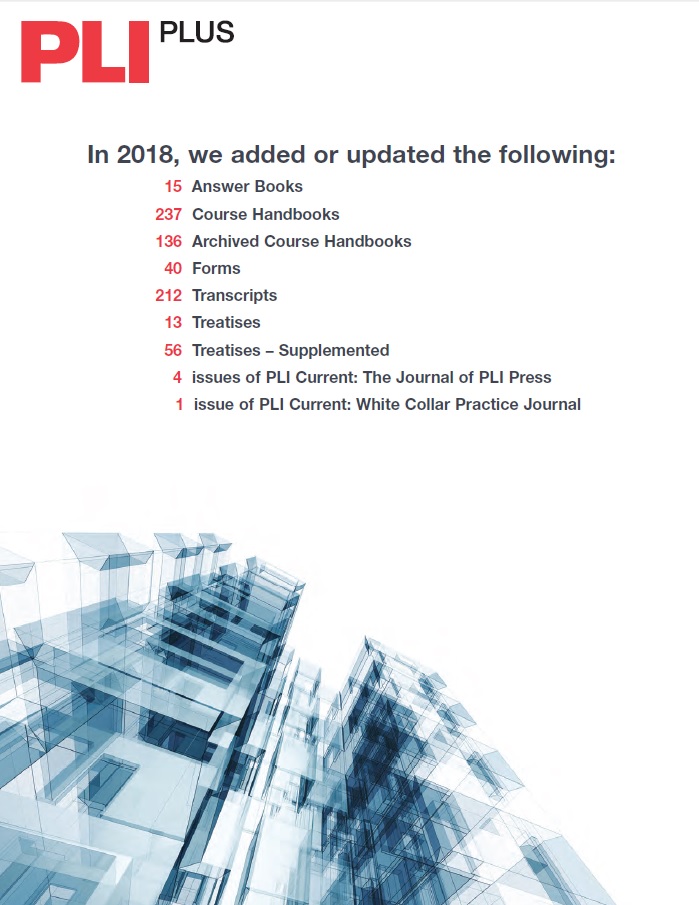
PLI PLUS New Content Added in 2018

PLI PLUS, PLI’s online research database, provides unlimited access to PLI Press Treatises, Course Handbooks, Answer Books, Journals, in addition to Legal Forms and Program Transcripts. To reflect recent changes and the latest in legal developments, PLI PLUS is updated continuously with supplements and new editions as well as completely new titles. Here is what we’ve added in 2018:


What’s New for January on PLI PLUS

We add content to PLI PLUS every month to ensure our subscribers have access to the most up-to-date and relevant secondary source legal documents. Renowned legal experts regularly update our acclaimed Treatises, Course Handbooks, Answer Books, Transcripts and Forms to reflect recent changes and developments in the law.

Click here to see what we added in January!


Updated Treatise! Friedman on Leases (Sixth Edition)

Friedman on Leases is widely regarded as the leading authority on commercial real estate leasing, recognized for its extensive and balanced coverage of tenant and landlord concerns. This fifth release of Friedman on Leases, Sixth Edition continues to deliver not only the foundational knowledge required by novice practitioners, but also analysis of and insight into the most current and relevant developments facing seasoned practitioners in the commercial real estate field.

The author, Andrew R. Berman, is Senior Vice-President and Associate General Counsel with Savills Studley in New York. He is a former real estate partner at Orrick Herrington, Akerman, and Sidley Austin, and is a law professor at New York Law School, where he founded the Center for Real Estate Studies and the Institute for In-House Counsel. Mr. Berman’s expertise in both practice and academia enable him to provide the broad perspective and insight that real estate professionals need in this rigorous and dynamic field.

Highlights of Release #5 include the following:

  • Fiduciary Capacity; Authority. Updated discussion reviews how Illinois, New York, and Pennsylvania approach a landlord-trustee’s power to lease in the absence of a special power. (See section 2:1.2.)
  • Taxes, Assessments. Updated discussion covers when a lease requires the tenant to pay the landlord additional rent based on future increases in real estate taxes. (See section 5:2.1.)
  • Amount of Percentage Rent. Updated with new examples that illustrate the different approaches to determine percentage rent, as well as a new sample percentage rent provision with percentages that vary and a cap. (See section 6:2.)
  • Holdover Tenant Versus Foreclosing Mortgagee. Updated to include cases that illustrate the uncertainty over whether an attornment provision affirms that privity of estate exists between the tenant and the purchaser, or whether it extends liability by way of privity of contract. (See section 8:3.)

This essential treatise is available on PLI PLUS. If you would like to order a print copy, please email libraryrelations@pli.edu.

Treatise Update: Mutual Funds and Exchange Traded Funds Regulation (Third Edition)

Mutual Funds and Exchange Traded Funds Regulation offers definitive and up-to-date legal and compliance information. This two-volume treatise is filled with practical advice on complex issues involving valuation, distribution through intermediaries, structuring a 12b-1 plan, conducting a compliance review, and guarding against conflicts of interest. Mutual Funds and Exchange Traded Funds Regulation is an essential compliance tool for securities attorneys, mutual fund practitioners, compliance personnel, and risk officers in fund complexes, and a valuable reference for business professionals and investors.

The latest update to Mutual Funds and Exchange Traded Funds Regulation, Third Edition expands the treatise to cover developments affecting mutual funds and exchange traded funds. Highlights of this release include:

  • Chapter 5, Shareholder Reports. New discussion covers the June 2018 changes to Form N-1A adopted by the SEC regarding the reporting and disclosure of liquidity information by mutual funds in fund shareholder reports (see section 5:2.2[D]); reviews the SEC’s June 2018 adoption of new Rule 30e-3 under the Investment Company Act, which gives mutual funds a “notice and access” option for delivering shareholder reports (see section 5:3.2[B]); and examines Form N-PORT, which is the new form in which funds (except for money market funds) are required to provide additional and more frequent reports of portfolio holdings, risk metrics, and other data monthly (see section 5:4).
  • Chapter 13A, Liquidity Risk Management Programs and Swing Pricing. New discussion covers the SEC’s statement in the Investment Company Liquidity Disclosure Release that “funds that believe they would have to maintain dual liquidity classification programs” may apply for exemptive relief from the liquidity classification requirements of Rule 22e-4 if they believe their existing liquidity risk management programs would “effectively accomplish the Commission’s stated goals.” (See section 13A:4.7.)
  • Chapter 16, Purchase and Sales of Mutual Fund Shares. Updated discussion reviews FASB Accounting Standards Codification 820 (ASC 820) (previously FAS 157), including its definition of and framework for measuring fair value (see section 16:3.2); covers the amendments to Rule 22c-1 to permit certain registered open-end investment companies (not money market funds or ETFs) employing so-called “swing pricing” (see section 16:3.3); and examines Rule 22e-4 under the Investment Company Act, which requires open-end investment companies, including ETFs (but not money market funds), to adopt a liquidity risk management program that satisfies certain minimum requirements (see section 16:4.1).

This treatise can be found on PLI PLUS. If you would like to order a print copy, please email libraryrelations@pli.edu.

New Treatise Edition: Variable Annuities and Other Insurance Investment Products

The growth of variable insurance products has been dramatic and reflects broader trends that have occurred in financial services over the past few decades. Variable products are a clear example of how insurance companies have expanded their product base to more directly link insurance and investment. In recent years, other insurance investment products, such as SEC-registered fixed annuities, have grown in importance. PLI helps you keep pace with these developments.

Edited by Clifford E. Kirsch, noted authority in the area of securities regulation and compliance, and with valuable contributions from more than two dozen other distinguished practitioners in the field, PLI Press’s new Third Edition of Variable Annuities and Other Insurance Investment Products (formerly Variable Annuities & Variable Life Insurance Regulation) provides attorneys, compliance personnel, and business professionals with the most current legal, regulatory, and procedural guidance regarding variable annuities and other insurance investment products.

The comprehensive coverage in Variable Annuities and Other Insurance Products is grouped broadly into two sections. Part I focuses on variable insurance products, which are subject to a complex regulatory framework that includes the federal securities laws, state insurance laws, ERISA, and tax. Part II covers other types of insurance investment products such as insurance-linked securities.

This essential treatise can be found on PLI PLUS. If you would like to order a print copy, please email libraryrelations@pli.edu.

What’s New for December

What's New on PLI PLUSWe add content to PLI PLUS every month to ensure our subscribers have access to the most up-to-date and relevant secondary source legal documents. Renowned legal experts regularly update our acclaimed Treatises, Course Handbooks, Answer Books, Transcripts and Forms to reflect recent changes and developments in the law.

Click here to see what we added in December!

Treatise Update! Investment Adviser Regulation

Investment Adviser Regulation: A Step-by-Step Guide to Compliance and the Law (Third Edition) guides practitioners through the maze of statutory, SEC, and state standards impacting investment advisers, as well as provides advice on the practical aspects of building a practice. This book clarifies key status issues that determine registration and disclosure duties as well as liability exposure.

The most recent update to this treatise expands its coverage of the rules and regulations affecting investment advisers. Highlights of this release include:

This treatise is available on PLI PLUS, our online research database. If you’d like to purchase a print copy, please email libraryrelations@pli.edu or call 877.900.5291.