Category Archives: PLI

What’s New on Discover PLUS for August

08-2016 What's New

We add content to PLI Discover PLUS every month to ensure our subscribers have access to the most up-to-date and relevant secondary source legal documents. Renowned legal experts regularly update our acclaimed Treatises, Course Handbooks, Answer Books, Transcripts and Forms to reflect recent changes and developments in the law.

Click here to see what we added in August.

Meet Our AALL 2016 Orbitz Gift Certificate Raffle Winner: Dennis Sears

Our AALL 2016 Orbitz gift card winner, Dennis Sears of the J. Reuben Clark Law School at BYU.

Dennis Sears of the J. Reuben Clark Law School at BYU.

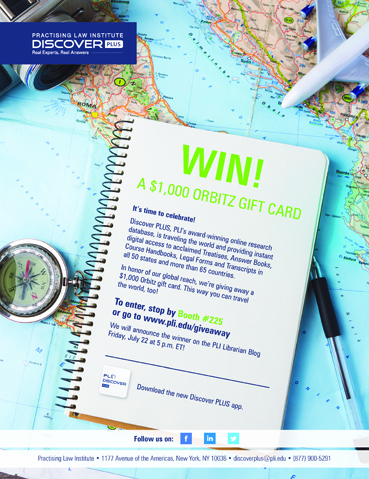
At the AALL Annual Meeting & Conference in Chicago this year, PLI celebrated the global reach of Discover PLUS–which is now being accessed from all 50 states and more than 65 countries–by raffling off a $1,000 Orbitz gift card at our booth. Dennis Sears of the J. Reuben Clark Law School at Brigham Young University won the raffle. Check out our interview with Dennis below!

Tell  me a little about yourself.  Why did you become a librarian?

I worked in the law library during my time as a student in law school.  After graduating, I clerked for a judge and then as a hearing officer for the the Salt Lake County Tax Administration.  A position came open and I was approached about joining the law library faculty.  Evidently, they liked the work I did for them while I was in law school.

What do you like most about your job at BYU Law?

Working with the students and teaching legal research.  Having clerked for a judge, I became acutely aware of how important effective, efficient, and accurate legal research is and to be effective and efficient, you have to be familiar with the secondary sources out there so that you don’t reinvent the wheel every time you get another research project.

What is the most common research question of law students?

Probably, where do I go to begin my research?  Usually, by this time, students have thrashed about on their own looking for cases and statutes (maybe successfully, but maybe unsuccessfully) but they don’t know where to go from there.

Have you used PLI publications for your own research? Which ones?

Yes, I used the trial practice materials, such as jury instructions, depositions, etc. as well as appellant materials dealing with brief writing and oral argument.  Now, I search for whatever will help students in the trial and appellant practice courses and even help professors find materials for the courses and their research.

 What did you think of AALL 2016? Did you do any sightseeing in Chicago?

I thought the annual meeting was a good experience.  The workshop I attended was outstanding.  There was good programming and a lot to learn in the exhibit hall.  I did visit the Chicago Institute of Art the afternoon that I arrived for a couple of hours.

Tell me about your best vacation ever.

My best vacation was after the annual meeting in Boston (which was also great for sightseeing historical sights) to Plymouth, Massachusetts.  I had never traveled in the northeast, but visiting Plymouth,  Plimoth Plantation, and Mayflower II and drinking in the ambiance of that area was a real treat for me and my wife.

 Where do you plan on traveling with your Orbitz gift card?

To be honest with you, I was so caught off guard by winning this gift card that my mind has been in a whirl.

Thank you, Dennis. And bon, voyage!

6 Temporary Detention Tips for Defense Attorneys

John L. Weinberg’s Federal Bail and Detention Handbook 2016 offers insightful advice on temporary detention. Below, find Judge Weinberg’s six temporary detention tips for Defense Attorneys:

  1. Prior to the initial appearance, gather as much information as possible as to whether the case is appropriate for entry of an order of temporary detention. Be prepared to argue these issues at the initial appearance. Determine also, if possible, whether the other court or INS intends to place a detainer or has already done so.
  2. If the U.S. Attorney moves for temporary detention at the initial appearance, be prepared to present any available challenge to its eligibility, under either half of Sec. 3142(d).
  3. Be prepared to propose and defend a specific duration of temporary detention. Whatever duration is set, ask the court to schedule a further hearing on release or detention for the day the temporary detention order expires.
  4. Decide whether you will move for pretrial detention, which extends beyond any period of temporary detention. If so, make this motion as well at the initial appearance. The court should set the hearing for the last day of the period of temporary detention.
  5. If at the initial appearance the court has ordered temporary detention, contact the other court or agency promptly thereafter. Attempt to persuade the other authority to decline to seek custody of defendant.
  6. If a detainer is lodged or if the other authority declines to proceed before the order of temporary detention expires, contact the court and attempt to reschedule the bail status hearing for an earlier date.


TO LEARN MORE ABOUT TEMPORARY DETENTION TIPS, INCLUDING ADVICE FOR U.S. ATTORNEYS, READ:

Federal Bail and Detention Handbook 2016 John L. Weinberg (U.S. Magistrate Judge for the Western District of Washington at Seattle)

Subcribe to Discover PLUS? Read it here — ›

3 Elements of an FDA Recall Strategy

James P. Ellison and Anne K. Walsh’s FDA Deskbook: A Compliance and Enforcement Guide provides an in-depth discussion on recalls.

A firm conducting a recall must develop a recall strategy taking into account the results of the Health Hazard Evaluation (HHE), ease in identifying the product, the degree to which the product’s deficiency is obvious to the consumer or user, the degree to which the product remains unused in the marketplace, and the continued availability of essential products. FDA will review and approve the recall strategy of a recalling firm. The elements of a recall strategy are:

  1. Depth of Recall The depth of recall pertains to the level in the distribution chain to which the recall will be extended. This will depend on the product’s degree of hazard and extent of its distribution. For example, the recall could extend all the way to the consumer or user level, it could stop at the retail level, or it may not need to go beyond the wholesale level.
  2. Public Warning A public warning is intended to alert the public that “a product being recalled presents a serious hazard to health.” It is only used in urgent situations for which other means of preventing use of the product appear inadequate. FDA will usually issue the warning in consultation with the recalling firm. If the firm issues its own warning, it should submit the warning to FDA for review and comment prior to distribution, along with a plan for distribution. The recall strategy should indicate whether a public warning is needed and how it will be issued, for example, via general or specialized news media.
  3. Effectiveness Checks Effectiveness checks are required to confirm that all consignees at the specified recall depth received the notification. Consignees may be contacted by whatever means deemed appropriate by the recalling firm, including by letter, telephone calls, or a combination. It is recommended that a firm conduct at least the initial effectiveness check in writing, and may then follow up via telephone if no response is received. When a phone call is made, the firm should document the call and that documentation should be retained in the recall record. The recall strategy will specify the methods to be used and the level of effectiveness checks that will be conducted. Depending on the product involved and the health hazard presented by the product, a firm may be required to contact 100% of consignees, or may not be required to conduct an effectiveness check at all.


TO LEARN MORE ABOUT THE FDA, READ:

FDA Deskbook: A Compliance and Enforcement Guide Edited by James P. Ellison and Anne K. Walsh (Hyman, Phelps & McNamara, P.C.)

Subcribe to Discover PLUS?  Read it here — ›

New Answer Book! Privacy Law Answer Book

Privacy Law Answer BookPLI’s new Privacy Law Answer Book answers key questions related to the evolving collection, use, and storage of consumers’ personal information.

The Q&A-formatted guide makes clear sense of the patchwork of federal, state and international laws and regulations, with expert guidance on privacy policies, COPPA, financial privacy, medical privacy, and more.

Edited by Jeremy Feigelson (Debevoise & Plimpton LLP), the Answer Book will help readers keep clients and companies one step ahead of the data privacy challenges of tomorrow.

This essential new title is available on PLI Discover PLUS, our online research database. If you’d like to order a print copy, please email the PLI Library Help Desk or call 877-900-5291.


Announcing our $1,000 Orbitz Gift Card Winner!

Congratulations to Dennis Sears, Associate Director for Legal Research Instruction at the Howard H. Hunter Law Library at Brigham Young University, on winning our 2016 AALL raffle. To celebrate our global reach – Discover PLUS is now in all 50 states and more than 65 countries –  we raffled a $1,000 Orbitz gift card at this year’s AALL Annual Meeting and Contest. Bon voyage, Dennis!

We would like to thank everyone who stopped by our booth and entered our raffle.  It was a pleasure meeting and re-connecting with all of you and we hope to see you next year!


AALL Librarian Advisory Breakfast Wrap-Up and Raffle Winner!

Many thanks to everyone who came to our Librarian Advisory Breakfast during AALL! We had a full house, great conversation, and delicious food!

2016 AALL Breakfast Room 2

Alexa Robertson (Director of Legal Information Services & Electronic Publishing) reviewed the changes we’ve made to PLI Discover PLUS since last summer’s conference and highlighted the many new titles that are now in our catalog.  Alexa also updated those in attendance on the archive project and showed our enhanced date range filter, which allows you to filter by decade as well as individual year.

Next, Christina Davis (Library Relations Manager) provided a demo of both Discover PLUS and the Discover PLUS app, which showcased our platforms, the ease of use, and our invaluable content.

On to the raffle. In an effort to pay homage to Chicago–known for its deep dish pizza, pierogies, and jibaritos–we raffled off a $150 gift certificate to Open Table. It was a fitting prize since Discover PLUS allows you to bring the experts to your table! Congratulations to Gina Cartusciello of Cahill, Gordon & Reindel, who won!

PLUS Advisory Council

Your feedback is requested!

We at PLI worked closely with the legal research community to develop our online legal research database. Now we have created the PLUS Advisory Council to continue to work with you as the product evolves.

The PLUS Advisory Council is an advisory group of Discover PLUS customer members that provides input to PLI on product direction for the PLUS legal research database. The Council submits and reviews enhancement requests, and determines the validity and value of each request. The Council then makes recommendations to PLI to help with future planning and better prioritize the enhancements made to the PLUS platform.

PLI will communicate primarily through email to accommodate members’ schedules. Participation is voluntary. If you are interested in participating, or would like additional information, please write PLUS@pli.edu.

PLI Discover PLUS Sample Search Video Tutorial – The Panama Papers

PLI Discover PLUS provides expert analysis of ripped-from-the headlines legal issues from today’s leading practitioners.

Here’s a 1.16 minute sample search video tutorial, which illustrates how to search for documents about the Panama Papers. Make sure to check out the rest of our videos on the PLI Librarian YouTube channel!

We will continue to add instructional videos to this channel, so stay tuned for more! And if you have any suggestions on search tips videos you would like to see, please contact the PLUS Help Desk .