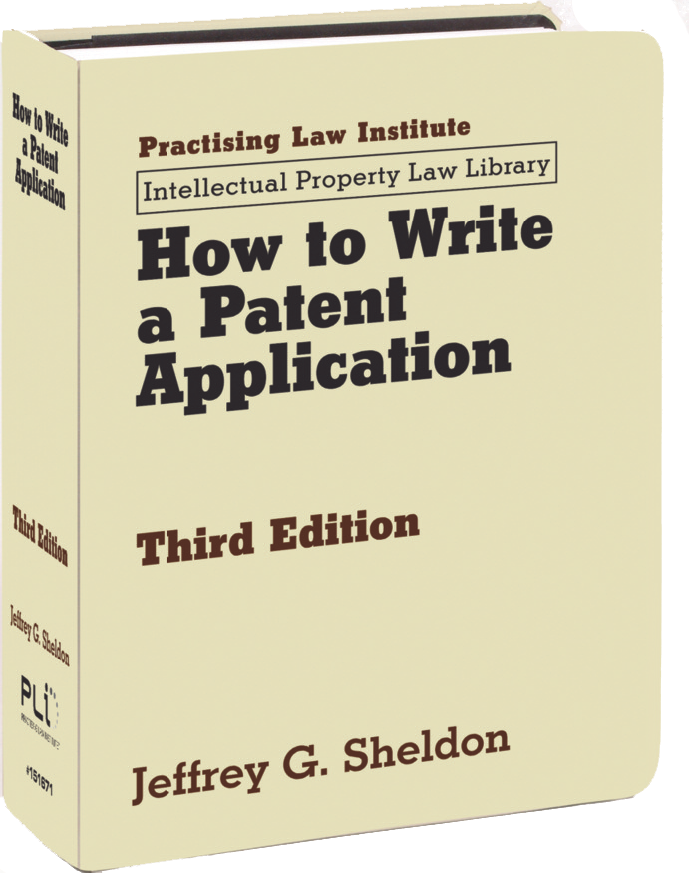
Stocked with drafting checklists and sample drafting language, documents, and drawings, How to Write a Patent Application (3rd Edition) is a hands-on resource that equips readers to claim an invention with the sufficient breadth and required elements necessary for its validity to be sustained by courts. The book analyzes the latest USPTO initiatives, and key decisions of the federal courts, and provides the author’s practical suggestions and commentary.
Key updates in the new release include:
Grounds for Requesting Expedited Examination: Added discussion of The Climate Change Mitigation Pilot program and how it impacts the examination of nonprovisional utility patent applications involving technologies that mitigate climate change by reducing greenhouse gas emissions (see section 2:9.2).
Electronic Filing Document Format: Updated information about the PTO’s new format requirement for electronic filings (see section 3:5).
Identifying the Inventor or Inventors: Elucidation of whether artificial intelligence systems qualify as inventors (see section 4:3).
Abstract and Nonabstract ideas: Additional examples of both (see sections 7:4.1[B] and [C]).
Statutory Requirements for Claims: Discussion of recent Federal Circuit cases related to the terms “resilient” and “pliable” and terms susceptible to more than one meaning (see section 8:2.1).
Patentable Designs: News and statistics related to acquiring, defending, and enforcing design patents (see section 11:1.1).
Written Description Requirement: Commentary on the high level of disclosure being required by the Federal Circuit to satisfy the written description requirement and the “troublesome” opinion in Biogen Int’l GmbH v. Mylan Pharm. Inc. (see section 17:4.2). For additional related discussion about the written description requirement, read also the recent PLI Chronicle article “Patent Antibody Case Law Continues to Mature.”
We add content to PLI PLUS every month to ensure our subscribers have access to the most up-to-date and relevant secondary source legal documents. Renowned legal experts regularly update our acclaimed Treatises, Course Handbooks, Answer Books, Transcripts, and Forms to reflect recent changes and developments in the law.
Regularly updated, Langer on Practical International Tax Planning gives you the latest news on the legal, tax, business, financial, social, political, technological, geographical, and regional factors to consider when developing and implementing customized planning strategies for clients. It is an invaluable tool for tax and estate planners, tax attorneys, accountants, and sophisticated investors.
This new release updates the treatise with up-to-date practical information and analysis to help preserve your clients’ assets.
Highlights include:
New section 36:6.1[E] explores a 2002 revenue procedure providing the exclusive steps for requesting a determination under section 4672(a)(2) that a substance be added to, or removed from, the “list of taxable substances” under section 4672(a).
New section 42:1.6[D][7][c] discusses whether a taxpayer is entitled to treat as DPGR gross receipts derived from providing customers access to computer software for the customers’ direct use.
New Chapter 88 explains that in 2022 the Fifth Circuit addressed whether agreements entered into by Exxon (with Qatar and Malaysia) were mineral leases, or mineral “sales.” The court noted that the answer was “worth” a billion dollars.
Miscellaneous revisions are found throughout the other chapters published in this release.