PLI PLUS offers unlimited electronic access to more than 4,500 downloadable, searchable, and editable legal forms ready for use in your practice. In an effort to highlight this unique content type, we’ve selected one form per month and made it available for anyone to download for free – no subscription required.
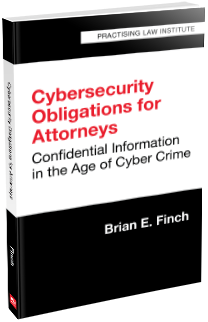
This book provides a general understanding of the scope of cyber threats facing the legal profession. It focuses on the expansion of Rule 1.6 (confidentiality) obligations to specifically address cyber threats and security measures. It also gives lawyers ways to think about cyber risks when managing their practices on a day-to-day basis. Attorneys can use this one-stop reference to determine their baseline cybersecurity obligations to clients and third parties.
The book covers the following important topics:
The cybersecurity threat landscape (see Chapter 1)
Cyber threat prevention under the Model Rules and various state codes (see Chapter 2)
Obligations imposed by federal and state data breach and privacy laws (see Chapter 3)
Federal regulation of cybersecurity obligations (see Chapter 4)
How to demonstrate that cybersecurity measures are reasonable using the SAFETY Act (see Chapter 5)
Notably, the book also offers attorneys practical recommendations on creating a cybersecurity strategy (see Chapter 7). All lawyers, ranging from solo practitioners to senior managers at large firms, can benefit from the information and guidance in this book.
Is your library interested in subscribing to PLI’s Standing Order Plan (SOP)? SOP subscribers automatically receive print copies of new titles to review upon release. If you decide to keep the title, you will receive a discount up to 25% off the title and all future supplements. Call 877.900.5291 or email libraryrelations@pli.edu to learn more.
We add content to PLI PLUS every month to ensure our subscribers have access to the most up-to-date and relevant secondary source legal documents. Renowned legal experts regularly update our acclaimed Treatises/Practice Guides, Course Handbooks, Answer Books, Transcripts, and Forms to reflect recent changes and developments in the law.
This book serves as a valuable reference for employment law practitioners and individuals interested in helping their organizations effectively navigate employment discrimination-related investigations, mediations, litigations, and jury trials. Presented in a straightforward, comprehensible manner, it provides the reader with information relating to the full range of employment discrimination litigation from an active practitioner’s perspective.
Notably, the book covers the following important areas:
Responding to employment discrimination and harassment complaints (see Chapter 1)
Is your library interested in subscribing to PLI’s Standing Order Plan (SOP)? SOP subscribers automatically receive print copies of new titles to review upon release. If you decide to keep the title, you will receive a discount up to 25% off the title and all future supplements. Call 877.900.5291 or email libraryrelations@pli.edu to learn more.
PLI PLUS offers unlimited electronic access to more than 4,500 downloadable, searchable, and editable legal forms and checklists ready for use in your practice. In an effort to highlight this unique content type, we’ve selected one form per month and made it available for anyone to download for free – no subscription required.
Are you attending the 2023 AALL Annual Meeting & Conference in Boston this summer? Join us for a luncheon to reconnect and learn what is new with PLI, including enhancements and upgrades to PLI PLUS.
The luncheon will take place on Sunday, July 16 from 12:45 to 1:45 p.m.
Email us at libraryrelations@pli.edu to RSVP if you will attend, and we will include location details in your confirmation email.
Advertising and Commercial Speech: A First Amendment Guide offers a practical examination of how the U.S. Supreme Court’s commercial speech doctrine impacts advertising across nearly 50 industries and professions. The book explores legal standards for defamation, false commercial speech, and disparagement along with developments around advertising for alcohol, financial institutions, professional services, medication, real estate, tobacco, and more.
Among the many topics discussed in this new release are the following:
Compelled editorial transparency: New section 12:13 discusses laws passed in Florida and Texas targeting social media platforms’ efforts to combat user-generated disinformation posted on their websites.
On-site and off-site signs and billboards:Section 13:2.1[A][7] covers the Seventh Circuit’s ruling regarding whether to apply strict scrutiny or intermediate scrutiny to an ordinance limiting digital displays and off-premises signs.
Drugs & drug paraphernalia:Section 14:14 explores a case from the Washington Court of Appeals rejecting a challenge to the state’s advertising restrictions on marketing cannabis products.
Regulation of advertising content: Revisions to chapter 14 include:
The ruling of a Florida judge regarding whether part of the state’s Stop W.O.K.E. Act, which forbids companies from undertaking mandatory employee DEI training programs designed to limit or avoid discrimination practices, is unconstitutional (see section 14:16 on fair employment); and
The Eastern District of Arkansas’ final ruling in the Tofurky case involving marketing of plant-based foods (see section 14:20 on food).
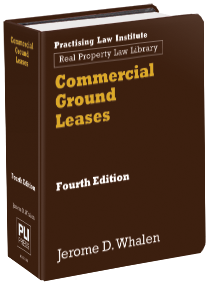
Commercial Ground Leases is a definitive guide to drafting, negotiating, and finalizing equitable, error-free leasing documents that address the needs of both landlord and tenant. It features adaptable, time-saving agreement language and contains numerous appendices, including forms of letter of intent, leasehold mortgagee protection clauses, intercreditor agreements, fee and leasehold deed of trust provisions, estoppel certificate and guaranty, and a complete ground lease with many alternative clauses.
Highlights of the new release include:
Chapter 1: Updated discussion reviews ground lease terms and situations that necessitate their review (see section 1:4.2).
Chapter 3: Updated discussion closely examines inflation indexing as provided in Appendix X (see section 3:4.3).
Chapter 8: New discussion of Freddie Mac’s Multifamily Seller/Servicer Guide, specifically chapter 30, which sets requirements of ground lease mortgages (see section 8:14).
Chapter 16: Updated discussion of exceptions to nonrecourse liability (see section 16:6).
Appendix X: Chart 1 attempts to show how several elements of common indexing formulae would have fared over the fifty-year period from 1972 through 2021 using actual CPI data from the U.S. Bureau of Labor Statistics. Chart 2 uses the same historical CPI data, but starts the hypothetical lease term ten years later, in 1982.
We add content to PLI PLUS every month to ensure our subscribers have access to the most up-to-date and relevant secondary source legal documents. Renowned legal experts regularly update our acclaimed Treatises, Course Handbooks, Answer Books, Transcripts, and Forms to reflect recent changes and developments in the law.