PLI PLUS offers unlimited electronic access to more than 4,500 downloadable, searchable, and editable legal forms ready for use in your practice. In an effort to highlight this unique content type, we’ve selected one form per month and made it available for anyone to download for free – no subscription required.
Holtzschue on Real Estate Contracts and Closings is an invaluable resource for attorneys and general practitioners who handle real estate deals as well as an important reference for brokers, title insurers, and inspectors. It distills more than thirty years of transactional experience into one plain-English treatise that clearly explains governing law and customary industry practices. The book provides useful legal, technical, and strategic guidance and checklists for sellers’ and purchasers’ attorneys preparing them to execute dispute-free residential deals quickly and easily.
This new release offers the latest information crucial to your practice. Highlights include:
Chapter 2, Drafting and Negotiating the Contract: Discussions updated to include: the New York City Bar Association and the NYSBA Real Property Section’s contract for the sale of a cooperative apartment (see section 2:1.2[A]); and a new 114-page commercial contract of sale created by the American College of Real Estate Lawyers and published earlier this year (see section 2:1.2[C]). New and updated cases and other authority throughout the chapter, including in the following areas: findings on whether the statute of frauds is satisfied (see section 2:1.1); time of the essence (see section 2:2.9[A]); entitlement of brokers to commissions (see section 2:2.10[A]); and caveat emptor exceptions requiring disclosure (see section 2:2.11[A][2]).
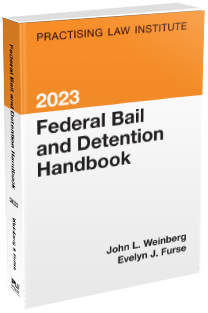
This helpful resource provides on-point answers to all aspects of federal bail and detention law — especially those involving critical provisions of the Bail Reform Act of 1984. Through discussions told from grounded judicial perspectives, the book presents helpful practice pointers when confronting common Bail Reform Act problems. It also showcases an extensive series of forms, sample orders, and sample motions that defense counsel and assistant U.S. attorneys can reference.
Some of the recent developments reflected in this new edition include:
Weight of Evidence: Coverage of the United States v. Zhang case in which the Second Circuit ruled on whether the Bail Reform Act provides guidance on the relative weight the court should give the various section 3142(g) factors in deciding questions of release and detention (see Section 4:3).
Least Restrictive Possible Conditions: An update on a case arising from the January 6, 2021, invasion of the Capitol about whether the D.C. Circuit Court upheld or reversed the district court’s denial of the defendant’s request to travel abroad for three weeks for an educational opportunity (see Section 5:3).
Conditions in Every Bond: New discussion of a Third Circuit ruling regarding whether the “no crimes while on bond” condition prohibits the possession or use of marijuana in a state where marijuana is legal and in a situation in which the defendant has a “medical marijuana” authorization from a physician for its use (see Section 5:4).
Detention or Release Pending Competency Examination: New information about a Ninth Circuit case which considered whether a lack of an available bed at an appropriate facility relieves the Attorney General of the duty to attempt to rehabilitate the defendant within a brief period (see Section 14:10).
Sack on Defamation—widely cited by U.S. courts including the U.S. Supreme Court, academics, and attorneys—offers strategic guidance for both plaintiffs’ and defense attorneys and fully covers the basic elements of a defamation claim. The treatise pinpoints how to identify practical legal issues such as when “truth” is not a defense, insults and name-calling that cross the line into defamation, how “public disclosure of private facts” becomes actionable, why statements of “opinion” are not protected, and when defamatory communications are privileged. It also integrates coverage of Internet and social media issues.
Highlights of the new release include developments covering the following topics:
Statements held to be nonactionable: Discussion of a Delaware case in which the court considered the issue of whether a letter to an employer calling an employee’s outside actions “racist” is constitutionally protected (see section 4:3.5).
Standard of conduct: public plaintiffs: The list of “vortex” public figures has been expanded (see section 5:3.5).
Standard of conduct: private plaintiffs: Coverage of a case about whether the 2020 amendments to New York’s anti-SLAPP statute are retroactive (see section 6:4).
Absolute privilege and government agencies: Summary of an unusual case from Oregon concerning false statements entered into a patient’s medical record by physicians who worked for a public corporation health system (see section 8:2.4[A]).
Invited defamation: Spotlights a case from the Second Circuit in which former U.S. Senate candidate and Alabama Supreme Court Justice Roy Moore accused comedian Sacha Baron Cohen of defamation for falsely portraying Moore as a pedophile in a mock interview for Cohen’s television program (see section 8:2.8).
We add content to PLI PLUS every month to ensure our subscribers have access to the most up-to-date and relevant secondary source legal documents. Renowned legal experts regularly update our acclaimed Treatises, Course Handbooks, Answer Books, Transcripts, and Forms to reflect recent changes and developments in the law.
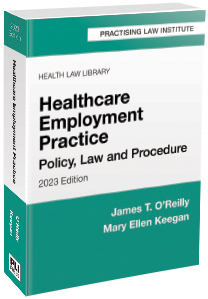
This guidebook presents clearly-written, concise insights into how hospital management teams, healthcare human resources professionals, and the legal practitioners who advise them can navigate the ever-changing regulatory landscape around employment in the healthcare industry.
The treatise’s authors, James T. O’Reilly, Director of the Concentration in Health Services Management at the UC College of Medicine, and Mary Ellen Keegan, former in-house counsel for GE’s Aviation Division who has since negotiated favorably for MDs in disputes with insurance companies and healthcare organizations, offer actionable practices gleaned from their experiences working with physicians and public health regulatory issues.
Featuring sample contractual clauses, this resource discusses how doctors, stakeholders, and their lawyers can leverage astute planning and careful drafting to overcome emerging employment and transactional issues. In addition, the authors include tailored discussions on regulatory and transactional issues unique to physicians, registered nurses, and non-credentialed healthcare employees.
Healthcare Employment Practice includes:
Step-by-step, term-by-term guidance on physician employment contracts, with an emphasis on the problems presented by restrictive covenants, and a full sample Physician Employment Agreement (see Chapter 9, Chapter 10, and Appendix B);
A fifty-state survey of noncompete statutes and selected case law (see Appendix A – fully updated for 2023);
Labor and employment law as it affects healthcare industry employees in the areas of Collective Bargaining and Overtime Pay (see Chapter 14 and Chapter 19), Strikes and Lockouts (see Chapter 17), Safety Rules (see Chapter 20), and Conflict Resolution (see Chapter 21);
Issues presented by telemedicine (see Chapter 27);
Stark and anti-kickback law compliance (see Chapter 26);
Employment discrimination in healthcare: physician whistleblower, discrimination, harassment, and retaliation claims (see Chapter 22).
PLI PLUS offers unlimited electronic access to more than 4,500 downloadable, searchable, and editable legal forms ready for use in your practice. To showcase this unique content type, we’ve selected one form per month and made it available for anyone to download for free – no subscription required.