We add content to PLI PLUS every month to ensure our subscribers have access to the most up-to-date and relevant secondary source legal documents. Renowned legal experts regularly update our acclaimed Treatises, Course Handbooks, Answer Books, Transcripts, and Forms to reflect recent changes and developments in the law.
Regularly updated, Langer on Practical International Tax Planning gives you the latest news on the legal, tax, business, financial, social, political, technological, geographical, and regional factors to consider when developing and implementing customized planning strategies for clients. It is an invaluable tool for tax and estate planners, tax attorneys, accountants, and sophisticated investors.
This new release updates the treatise with up-to-date practical information and analysis to help preserve your clients’ assets.
Highlights include:
New section 36:6.1[E] explores a 2002 revenue procedure providing the exclusive steps for requesting a determination under section 4672(a)(2) that a substance be added to, or removed from, the “list of taxable substances” under section 4672(a).
New section 42:1.6[D][7][c] discusses whether a taxpayer is entitled to treat as DPGR gross receipts derived from providing customers access to computer software for the customers’ direct use.
New Chapter 88 explains that in 2022 the Fifth Circuit addressed whether agreements entered into by Exxon (with Qatar and Malaysia) were mineral leases, or mineral “sales.” The court noted that the answer was “worth” a billion dollars.
Miscellaneous revisions are found throughout the other chapters published in this release.
We add content to PLI PLUS every month to ensure our subscribers have access to the most up-to-date and relevant secondary source legal documents. Renowned legal experts regularly update our acclaimed Treatises, Course Handbooks, Answer Books, Transcripts, and Forms to reflect recent changes and developments in the law.
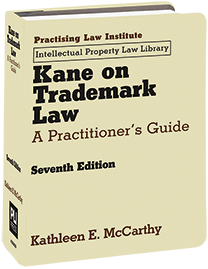
Kane on Trademark Law deals with trademark law on the whole, providing court-tested practical suggestions on how to quickly spot potential conflicts and save time on searches, overcome common descriptiveness rejections, amend registrations, and prepare witnesses for depositions.
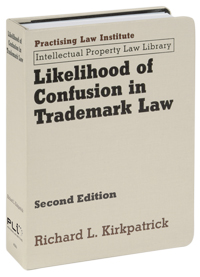
Likelihood of Confusion in Trademark Law focuses specifically on a major factor for determining whether a trademark has been infringed – the probability that consumers will mistake the alleged infringing mark for the original. It illuminates the pivotal multiple-factor test, providing a strong grasp of the key elements used by the courts to determine if likelihood of confusion exists.
Trademark selection:Chapter 2 now incorporates the USPTO’s new examination guidelines related to genericness rejections (see section 2:1.2) and decisions from the Federal Circuit regarding the registration of .SUCKS (see section 2:5.3) and book titles and characters as trademarks (see section 2:8).
Proving a statutory cause of action: Coverage of Meenaxi Enterprise, Inc. v. Coca-Cola Co., regarding the elements the claimant must prove to maintain a statutory cause of action under the Lanham Act for activities solely conducted outside the United States (see sections 19:4.5[D] and 22:5).
New color illustration of trademark and trade dress infringement cases: An illustration from Sabhnani v. Mirage Brands, LLC (Perfumes & Cologne, see Appendix A49) has been added to Appendix A.
Consumers and their degree of care: New commentary in section 6:2 analyzes how empirical research into actual consumer behavior compares with old assumptions and new constructs of consumer behavior.
The recent increase in federal enforcement of consumer financial services laws and regulations makes it a priority for companies to take stock of their current financial products, to identify potential risks, and to enhance consumer satisfaction efforts. Fortunately, the treatise Financial Product Fundamentals: Law, Business, Compliance (Second Edition) aids in that process by providing attorneys, compliance personnel, and business professionals with legal, regulatory, and procedural guidance regarding the various financial products, accompanied by many helpful charts, tables, and other graphics.
Chapter 22, Real Estate Mortgage Investment Conduits (REMICs). Discusses REMIC tax administration, which includes filing income tax returns, filing information returns, providing information statements, and representing the REMIC before the IRS and courts (see section 22:7.5). New Appendix 22C traces important developments in the REMICs space.
Chapter 24, Exchange-Traded Notes and Similar Structured Notes. Extensively updated chapter provides an overview of ETNs; describes the threshold legal issues; summarizes the registration, disclosure, and listing requirements; highlights the issues that arise when creating, selling, and investing in these products; and discusses additional issues with respect to other types of structured notes that are similar to ETNs but not listed or traded on a securities exchange.
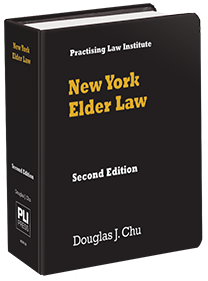
PLI Press is proud to announce the publication of the new edition of New York Elder Law.
This authoritative book assists lawyers, social workers, health care personnel, gerontologists, retirement planners, and the like advocate for seniors and address common concerns, including ensuring control over one’s financial affairs and paying for and determining the scope of long-term medical care. The discussions focus on the most common, and often most confusing, subject areas: Medicare, Medi-gap Insurance, Medicaid Eligibility, Medicaid Home Care, Nursing Home Rights, Powers of Attorney, and Health Care Decision Making. The treatise contains numerous time-saving checklists to help readers stay current with rapidly changing laws.
Some of the highlights from the new edition include:
Chapter 3, Medicaid for the Elderly, Blind, or Disabled addresses postponed changes to the state’s Medicaid Program, specifically the Medicaid home care application process (see §3:8.1). In addition, the chapter contains new information about the application requirements for those seeking to be considered a Medicaid applicant in “immediate need” for home care services (see §3:6.2[C]) and a new exception for undocumented immigrants age 65 or older (see §3:6.9[D]).
NewChapter 5, Nursing Homes focuses on resident rights and operator obligations. It guides the reader through the entire nursing home experience, from admission to discharge.
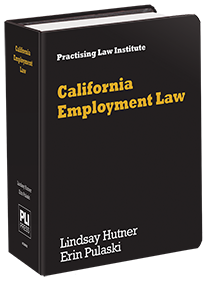
This comprehensive resource delves into the statutes and case law governing the employer-employee relationship in California, providing practical guidance on the state, local, and federal rules and regulations. The treatise analyzes key provisions of the California Fair Employment and Housing Act (“FEHA”), the California Labor Code and Wage Orders, and state leave laws.
In addition, it provides extensive coverage of local leave and wage ordinances. It highlights the significant differences between California employment law and federal laws, including the Fair Labor Standards Act (“FLSA”), the Civil Rights Act of 1964, the Americans with Disabilities Act (“ADA”), the Age Discrimination in Employment Act, and the Family and Medical Leave Act (“FMLA”).
Notably, the book covers the following important areas:
Employment relationship essentials, including mutual rights and duties, duration, and termination (see Chapter 1)
We add content to PLI PLUS every month to ensure our subscribers have access to the most up-to-date and relevant secondary source legal documents. Renowned legal experts regularly update our acclaimed Treatises, Course Handbooks, Answer Books, Transcripts, and Forms to reflect recent changes and developments in the law.
Proskauer on Privacy: A Guide to Privacy and Data Security Law in the Information Age is a comprehensive reference on the laws governing every area where data privacy and security is potentially at risk. The treatise guides entities in developing compliance programs that satisfy federal and state standards, ensure data privacy and security, prevent cybercrime, and avoid fines, penalties, litigation, damages, and negative publicity. It also examines international regulation of privacy and data security.
Some of the recent developments discussed in this new release include:
Chapter 14, International Privacy Laws: As predicted by the March 2022 PLI Chronicle article, Data Security and Privacy Predictions for 2022: 6 Issues to Watch, China has “leverage[d] new privacy and cyber security laws” this year. As such, this chapter has been updated to include coverage of China’s first comprehensive national-level personal information protection law, the Personal Information Protection Law of the PRC (see §14:10.3[B]). It also provides developments on Oman’s Personal Data Privacy Law (effective February 9, 2023; see §14:10.5[B]); and new coverage of Qatar’s data protection regime (see §14:10.5[C]). Updates are provided on all other covered jurisdictions as well.
Chapter 18, Location Privacy: Technology and the Law: Updated with the most recent holdings concerning the collection of location data through smart phones and other mobile devices, automatic vehicle license readers, e-bicycles, and other technologies.