Author Archives: Library Relations

Treatise Update – The Circular 230 Deskbook: Related Penalties, Reportable Transactions, Working Forms

The Circular 230 Deskbook is an essential compliance resource for every tax professional who practices before the IRS.  It helps practitioners comply with complex Circular 230 amendments more easily — and avoid costly penalties and sanctions.  In addition to demonstrating prescribed duties when advising clients in the preparation of tax returns, it offers quick-reference compliance tools.

This thirty-first release of The Circular 230 Deskbook updates the treatise with the latest developments in tax and estate law relating to IRS Circular 230. Highlights from the new release include:

Order a print copy today.

PLI PLUS subscribers can access this title through their subscription.

Treatise Update – Sinclair on Federal Civil Practice (Fifth Edition)

Sinclair on Federal Civil Practice gives quick and authoritative answers for issues arising in federal civil litigation and serves as a guide to the principal rules and tactical considerations guiding lawsuits in the federal courts. This two-volume treatise explains the layout of the court system and the nature of its key personnel, jurisdiction and venue principles, and the sequence of litigation.  It also provides insight into the rationale of the rules by citing the key interpretive cases and offering court-tested practice tips.

Highlights of the new release include:

  • Updates to the Additional Resources and Compendium of Recent Cases (Vol. 1 & Vol. 2): Numerous recent law review articles are added to the Additional Resources section at the end of each chapter, and the chronological circuit-by-circuit Compendium of Recent Cases is updated for each volume.
  • Section 2:8.1[D] Personal jurisdiction / minimum contacts: Discusses a 2021 Supreme Court decision on the issue of whether personal jurisdiction was appropriately exercised over a vehicle manufacturer incorporated in Delaware and headquartered in Michigan for claims that arose from severe injuries and death suffered as a result of accidents in Montana and Minnesota. The vehicles were previously owned, purchased by the plaintiffs at subsequent resales, and brought into Montana and Minnesota from other states.
  • New section 8:2.4 Standard of review for Rule 12 motions: A new section discusses the standards of review for a motion to dismiss under Rule 12(b)(6) and a motion for judgment on the pleadings under Rule 12(c). Federal appellate courts disagree as to whether a different standard of review applies to a motion to dismiss brought under Rule 12(b)(1), which challenges the subject matter jurisdiction to hear the claims at issue.
  • New section 8:2.8 Trial motions: A new section analyzes the motion for judgment on partial findings pursuant to Rule 52(c) and the motion for judgment as a matter of law pursuant to Rule 50(a) or 50(b). While both motions are aimed at expediting trials, they have distinct differences that litigators need to consider, including the type of proceeding (jury or non-jury) in which the motion is available and the applicable standard of review.

Order a print copy today.

PLI PLUS subscribers can access this title through their subscription.
Treatise Update – Mergers, Acquisitions and Tender Offers: Law and Strategies — Corporate, Securities, Taxation, Antitrust, Cross Border

Mergers, Acquisitions and Tender Offers provides battle-tested, real-world advice on the entire M&A process. Packed with best practices, planning tips, checklists, and sample documents/agreements, this treatise offers comprehensive coverage of all aspects of the deal for domestic and cross-border mergers.

Highlights of the new release include:

Order a print copy today.

PLI PLUS subscribers can access this title through their subscription.
Treatise Update: Hillman on Documenting Secured Transactions

As case law exposes costly and needless drafting errors and as courts wrestle with applying a complex law to increasingly intricate deals, Hillman on Documenting Secured Transactions: Effective Drafting and Litigation aims to share best practices in documenting secured transactions within the broad legal framework and to maintain its role as the leading practical guide for attorneys drafting and litigating under Article 9 of the Uniform Commercial Code. 

Updated content from the new release includes:

Order a print copy today.

PLI PLUS subscribers can access this title through their subscription.

Meet Our AALL 2021 Raffle Winner: Annie Mellott

At AALL’s 2021 Virtual Conference in July, PLI raffled off a one-year membership to MasterClass. This year’s winner is Annie Mellott, acquisitions librarian at William M. Rains Library at Loyola Law School in Los Angeles. Annie graciously agreed to be interviewed about her career in law librarianship for this blog.


Tell us a little about yourself. Why did you become a librarian?
I’ve always been drawn to learning and education throughout my own studies. While getting my MA in Religious Studies, I started working in the library. I realized it was a perfect fit for me career wise because it allowed me to be in an educational environment while helping the community of students, faculty, and staff during their own research projects.

What do you like most about your job as acquisitions librarian at Loyola Law School?
I love working in the background of the library to provide everyone with what they need. It feels really useful to be able to make information accessible to our patrons so that they have the smoothest experience possible while at Loyola Law School.

Which PLI publication do you most frequently recommend to students and/or faculty?
Honestly, I don’t do much recommending as an acquisitions librarian! We have the Loyola Immigrant Justice Clinic here and make sure to keep Fragomen on Immigration Fundamentals on standing order so it’s always available for their reference.

What did you think of this year’s conference? What was the highlight for you?
I thought this year’s conference went really well. I’m impressed with the online format working pretty seamlessly and loved the pre-recorded sessions and transcripts that I could revisit. It was also fun visiting the vendors in a safe way this year. I do miss the social and networking opportunities an in person conference allows us, but I’m glad we could convene safely.

Treatise Update – Trade Secrets: A Practitioner’s Guide (Second Edition)

Trade Secrets: A Practitioner’s Guide  discusses all aspects of protecting trade secrets.  It provides sample forms, checklists, and trial testimony from actual cases.  The treatise compares and contrasts trade-secret protection with other forms of intellectual property such as copyright, patents, and trademarks.

This release contains new discussions of the law of trade secrets and related topics. Highlights include:

Chapter 4

  • Secrecy ended by disclosure: Updates to § 4:9.3 include coverage of Attia v. Google LLC, where the Ninth Circuit affirmed dismissal of a claim under the DTSA, finding that disclosure of the subject matter of a trade secret in a published patent application vitiated its trade secret status.
  • Security measures: Updates to § 4:13 include coverage of Inteliclear, LLC v. ETC Global Holdings, Inc., where the Ninth Circuit reversed summary judgment for the defendant in a trade-secret misappropriation case, disagreeing with the district court’s conclusion that insufficient secrecy was pleaded.

Chapter 5

  • Ownership: New § 5:11 focuses on Advanced Fluid Systems, Inc. v. Huber, where the Third Circuit ruled that a contractor on a NASA project that possessed trade secrets but did not own them could bring a misappropriation claim. (Other issues in this case are covered in § 4:13 on security measures and § 13:3.7 on punitive damages.)

Chapter 6

  • Wrongful means: New § 6:12 examines Compulife Software Inc. v. Newman, a case involving a misappropriation-by-use claim in which the Eleventh Circuit ruled, among other things, that a magistrate judge had erred in reasoning that the public availability of quotes on the plaintiff’s site automatically precluded a finding that scraping those quotes constituted misappropriation.

Chapter 10

  • Identifying trade secrets with specificity: Updates to § 10:9.1 include discussion of TLS Management and Marketing Services, LLC v. Rodriguez-Toledo, an appellate decision addressing the plaintiff’s burden of establishing that a trade secret exists and the enforceability of nondisclosure agreements.

Chapter 13

  • Unjust enrichment: Updates to chapter 13 include discussion of Epic Systems Corp. v. Tata Consultancy Services Ltd., where the court of appeals affirmed an award of unjust enrichment damages (see § 13:3.5) and found that the punitive damages award was justified by the evidence but unconstitutional in amount (see § 13:3.7).

Table Authorities and Index

Order a print copy today. PLI PLUS subscribers can access this title through their subscription.

Treatise Update: Hedge Fund Regulation (Second Edition)

Covering one of the most dynamic sectors of the asset management industry, Hedge Fund Regulation (Second Edition) is a comprehensive guide providing insight into the history, investment strategies, structure, management, and market activities of hedge funds.  It addresses current regulatory concerns that impact these innovative investment vehicles, their managers, and investors. 

This seventeenth release to the treatise updates it with the latest considerations in structuring, launching, and operating a hedge fund. Highlights include:

  • Chapter 4, Private Placement. Now discusses the recent adoption of new Rule 152 that contains a single safe harbor simplifying the integration framework for securities offerings under the Securities Act of 1933.
  • Chapter 5, Commodity Pools. Revised in conjunction with other chapter updates.
  • Chapter 6, Marketing the Manager. Significantly updated to address the new Marketing Rule under the Investment Advisers Act of 1940.
  • Chapter 8, Anti-Money Laundering Regulations. Adds a discussion of the Anti-Money Laundering Act of 2020.
  • Chapter 13, Compliance. Revised to reflect revisions to the SEC’s whistleblower program.
  • Chapter 14, Books and Records. Updated with changes resulting from the SEC’s new Marketing Rule and revisions to CFTC Form CPO-PQR.
  • Chapter 18, Commodity Pool Operators and Commodity Trading Advisers. Adds discussion of amendments to CFTC Regulation 3.10(c) that provides a registration exemption for non-U.S. commodity pool operators (CPOs); new NFA Compliance Rule 2-50 requiring registered CPOs to notify the NFA upon the occurrence of certain events affecting a commodity pool operated by the CPO; and a new NFA requirement requiring Registered CPOs and Commodity Trading Advisers to adopt a written supervisory framework for outsourcing the performance of regulatory functions to third parties.
  • Chapter 24, Disclosures of Market Participation. Expanded discussion of Sections 13(d) and 16 under the Securities Exchange Act of 1934 and a new section addressing the CFTC’s Speculative Position Limits.
  • Chapter 26, Derivatives Markets Participants. Revisions including those addressing final CFTC regulations imposing capital requirements on swap dealers and major swap participants that are not subject to the capital requirements of a prudential regulator, and those governing real-time swaps public reporting, swaps regulatory reporting, and swaps data verification.

Order a print copy today.

PLI PLUS subscribers can access this title through their subscription.

PLI Chronicle: Special AALL Edition

Dear Readers,

PLI launched the online journal the PLI Chronicle in September 2020 with a simple mission: to present engaging and timely discussions about the legal industry from a diverse range of perspectives. Chronicle editor Alyse Greer explains, “Since everyone offers value to their fellow industry associates, all legal and accounting professionals are encouraged to submit articles. The publication gives authors a platform to educate others and the freedom to write in their own voices.”

We compiled this “special edition” of the Chronicle from articles published in previous issues as a way to familiarize librarians with this new content type. The selection reflects what we identified as themes running throughout this year’s American Association of Law Libraries (AALL) conference: 1) Diversity, equity, and inclusion in the legal profession; 2) The future of legal technology, education, and research; and 3) Mental health for legal practitioners.

In the articles below, you’ll find wellness tips from an attorney who overcame depression and addiction; a two-part look into the Internet of Things and open source software; musings on the role of curiosity in fostering inclusion and diversity initiatives; and more. You don’t need a subscription to read these articles. Everything published in the Chronicle is available for anyone and everyone to read. All you need is a PLI account, which is both free and easy to set up.

Our hope is that this curated edition will enhance the conference experience and perhaps even inspire some of our colleagues in law libraries to publish with us.

Sincerely,
Jennifer Fiore, J.D., M.A.
Associate Legal Editor, Publishing and PLI Plus

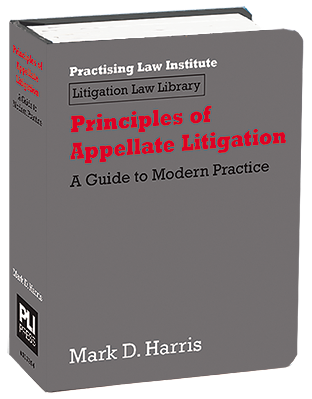
New Treatise! Principles of Appellate Litigation

PLI Press is proud to announce the publication of Principles of Appellate Litigation: A Guide to Modern Practice.

This treatise is an expert guide to appellate litigation as it is practiced today. It covers all aspects of appellate practice, from issue preservation at trial to Supreme Court review, helping readers to: (1) plan an approach for handling an appeal from start to finish, (2) learn specific techniques and strategies for improving their written and oral advocacy, and (3) answer common procedural and technical questions.

For generalist litigators and inexperienced appellate lawyers, this book provides an invaluable introduction to modern appellate practice. For the experienced attorney looking to take his or her skills to the next level, leading appellate advocate Mark D. Harris and a team of expert litigators offer hard-won insights into doctrine, strategy, and technique.

Written in the engaging, thoughtful, and thorough style one would expect from top appellate practitioners, the book also includes practice tips, checklists, and excerpts from actual briefs analyzing the strategic choices of the authors as well as the mechanics of their written advocacy.

Order a print copy today.

PLI PLUS subscribers can access this title through their subscription.

Treatise Update – Commercial Ground Leases

Commercial Ground Leases (Third Edition) is a definitive guide to drafting, negotiating, and finalizing equitable, error-free leasing documents that address the needs of both landlord and tenant. It features adaptable, time-saving agreement language and contains numerous appendices, including forms of letter of intent, leasehold mortgagee protection clauses, intercreditor agreements, a complete ground lease with many alternative clauses, and more.

Highlights from the latest update (Release #15) include:

  • Chapter 1, The Truth About Ground Leases. New discussion covers the landlord as partner, including the considerations for tenant/developers and equity sources and institutional mortgage lenders. See section 1:8.
  • Chapter 1A, Preliminary Agreements and Letters of Intent. Discussion of a well-drafted letter of intent, which should include all the material points to which the parties have agreed and any significant deal points that are potential deal breakers or processes to resolve them. See section 1A:2.2.
  • Chapter 6, Leasehold Financing. New discussion of mezzanine financing, which has become a feature of commercial real estate for a variety of purposes, including budget shortfalls and short-term needs. See section 6:2.4.
  • Chapter 7, Bankruptcy. Updated to include discussion of Mission Product Holdings, Inc. v. Tempnology, LLC, 139 S. Ct. 1652 (2019), in which the U.S. Supreme Court held, “Rejection of a contract—any contract—in bankruptcy operates not as a rescission but as a breach” and “leaves intact the rights the counterparty has received under the contract.” See section 7:5.4.

Order a print copy today.

PLI PLUS subscribers can access this title through their subscription.