Category Archives: New Title!

3 Elements of an FDA Recall Strategy

James P. Ellison and Anne K. Walsh’s FDA Deskbook: A Compliance and Enforcement Guide provides an in-depth discussion on recalls.

A firm conducting a recall must develop a recall strategy taking into account the results of the Health Hazard Evaluation (HHE), ease in identifying the product, the degree to which the product’s deficiency is obvious to the consumer or user, the degree to which the product remains unused in the marketplace, and the continued availability of essential products. FDA will review and approve the recall strategy of a recalling firm. The elements of a recall strategy are:

  1. Depth of Recall The depth of recall pertains to the level in the distribution chain to which the recall will be extended. This will depend on the product’s degree of hazard and extent of its distribution. For example, the recall could extend all the way to the consumer or user level, it could stop at the retail level, or it may not need to go beyond the wholesale level.
  2. Public Warning A public warning is intended to alert the public that “a product being recalled presents a serious hazard to health.” It is only used in urgent situations for which other means of preventing use of the product appear inadequate. FDA will usually issue the warning in consultation with the recalling firm. If the firm issues its own warning, it should submit the warning to FDA for review and comment prior to distribution, along with a plan for distribution. The recall strategy should indicate whether a public warning is needed and how it will be issued, for example, via general or specialized news media.
  3. Effectiveness Checks Effectiveness checks are required to confirm that all consignees at the specified recall depth received the notification. Consignees may be contacted by whatever means deemed appropriate by the recalling firm, including by letter, telephone calls, or a combination. It is recommended that a firm conduct at least the initial effectiveness check in writing, and may then follow up via telephone if no response is received. When a phone call is made, the firm should document the call and that documentation should be retained in the recall record. The recall strategy will specify the methods to be used and the level of effectiveness checks that will be conducted. Depending on the product involved and the health hazard presented by the product, a firm may be required to contact 100% of consignees, or may not be required to conduct an effectiveness check at all.


TO LEARN MORE ABOUT THE FDA, READ:

FDA Deskbook: A Compliance and Enforcement Guide Edited by James P. Ellison and Anne K. Walsh (Hyman, Phelps & McNamara, P.C.)

Subcribe to Discover PLUS?  Read it here — ›

New Answer Book! Privacy Law Answer Book

Privacy Law Answer BookPLI’s new Privacy Law Answer Book answers key questions related to the evolving collection, use, and storage of consumers’ personal information.

The Q&A-formatted guide makes clear sense of the patchwork of federal, state and international laws and regulations, with expert guidance on privacy policies, COPPA, financial privacy, medical privacy, and more.

Edited by Jeremy Feigelson (Debevoise & Plimpton LLP), the Answer Book will help readers keep clients and companies one step ahead of the data privacy challenges of tomorrow.

This essential new title is available on PLI Discover PLUS, our online research database. If you’d like to order a print copy, please email the PLI Library Help Desk or call 877-900-5291.


New Treatise! A Starter Guide to Doing Business in the United States

Doing Business in the United States

A Starter Guide to Doing Business in the United States is a new “must read” for non-U.S. businesses, foreign attorneys, law firm associates and new entrepreneurs. Edited by Woon-Wah Siu (Pillsbury Winthrop Shaw Pittman LLP) the Starter Guide covers the main legal and regulatory issues to be considered before entering the U.S. market, including:

  • Choice of a business entity—describing the requirements for a corporation, LLC, partnership, and sole proprietorship
  • Federal securities law—discusses the major statutes, provisions and regulations controlling the creation and exchange of business interests; the chapter includes what is required to qualify as a Foreign Private Issuer
  • Buying a company: the M&A process—highlighting each step of the process and the differences between buying a U.S. company and a non-U.S. company
  • Employment considerations—providing general guidance on the issues and statutes that arise when hiring employees in the U.S.
  • Equity incentives for U.S. employees—comparing the permissible types of equity incentives and the related, relevant tax and accounting treatment of such incentives
  • Immigration law—describing the requirements for the various types of employment-related visas and other business-related provisions
  • U.S. international trade law—exploring, in the book’s most extensive chapter, the many major statutes and international agreements that regulate importing into, exporting out of, or investing in the United States
  • Protecting intellectual property—describing the kinds of protections in the U.S. and how to derive maximum value from your IP through licensing, and how to assert or defend your IP in litigation
  • Environmental law—describing the requirements mandated by major federal and state statutes and regulations, as well as providing suggestions on successful compliance strategies
  • Taxation—describing the many kinds of taxes affecting trade and business, and focusing on the distinctions between how U.S. persons versus non-U.S. persons, as well as U.S. source versus non-U.S. source income, are treated
  • Litigation before courts and agencies, mediation and arbitration—providing a general discussion of the structure of the court systems in the United States as applied to civil cases, the terminology and procedure generally used in U.S. courts, enforcement of court judgments, and specialized tribunals, arbitration and mediation.

The Starter Guide also includes concepts in U.S. commercial real estate transactions, regulation of the energy sector, products liability law, and business insurance. This new guide also provides useful charts, tables, best practices and highlighted tips.

This essential new title is available on PLI Discover PLUS, our online research database. If you’d like to order a print copy, please email the PLI Library Help Desk or call 877-900-5291.

New Treatise! FDA Deskbook: A Compliance and Enforcement Guide

FDA DeskbookFDA Deskbook: A Compliance and Enforcement Guide provides a comprehensive description of the complexities of compliance under The Federal Food, Drug, and Cosmetic Act (FDC Act) and practical suggestions on how FDA-regulated entities can avoid being the subject of an enforcement action by the federal government.  This new title fully explains the legal framework created by the FDC Act and subsequent statutes, regulations, guidance and policies governing the food and drug industry.

Written by attorneys at Hyman, Phelps & McNamara, P.C., the largest dedicated food and drug law firm in the U.S., the FDA Deskbook incorporates more than a century of cumulative experience from positions at FDA, the U.S. Department of Justice, the Drug Enforcement Administration, U.S. Attorney’s Offices, and regulated industry.  The result is this essential guidebook, which aims to assist industry stakeholders by providing a wide-ranging review of compliance and enforcement under the FDC Act and related laws.

The FDA Deskbook first details the ins-and-outs of FDA’s administrative actions (such as warning letters, import alerts, and recalls) and civil and criminal enforcement authorities.  The FDA Deskbook then walks the reader through individual chapters highlighting specific issues affecting the cross-section of FDA regulation:

  • drugs, including OTC, prescription, and compounded drugs, and controlled substances
  • medical devices, including in vitro diagnostic devices
  • food and dietary supplements
  • tobacco
  • animal products
  • cosmetics

Importantly, the FDA Deskbook contains chapters focused on today’s hot button issues, such as advertising and promotion, fraud and abuse, and good manufacturing practices.  The FDA Deskbook proposes best practice tips, including how to deal with FDA inspections, alternatives to conducting internal investigations, and potential defense strategies for use in enforcement proceedings.

The FDA Deskbook provides a thorough discussion of the current landscape necessary for FDA-regulated entities to achieve compliance and avoid enforcement action.

This essential new title is available on PLI Discover PLUS, our online research database. If you’d like to order a print copy, please email the PLI Library Help Desk or call 877-900-5291.

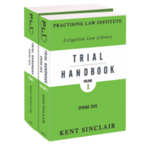
Trial Handbook Spring 2016 Edition Now Available

The STrial Handbook Spring 2016pring 2016 edition of The Trial Handbook is now available in print and on PLI Discover PLUS, our online research database!

Trial Handbook is the one-stop resource you can trust in the planning, trial, and post-trial stages of litigation. Designed for quick reference in the courtroom, Trial Handbook is keyed to the Federal Rules of Evidence and focuses on the presentation of proof and the evidentiary problems faced by counsel.

Packed with practical checklists, charts, outlines, sample jury selection questions, Trial Handbook gives you the knowledge and tools to:

  • Develop solid trial briefs and strong case plans
  • Prepare lay and expert witnesses and organize your exhibits more effectively
  • Master voir dire to maximize your chances of getting the most sympathetic jurors
  • Make a clear record at trial to aid jurors’ understanding of your case
  • Build a rapport and your credibility with the jury throughout the trial
  • Use opening statements to put your cases, clients, and proof in the most favorable light
  • Give summations that blend evidence and issues to paint a thoroughly persuasive picture
  • Exploit discovery materials at trial to get an additional edge
  • Lay the proper foundation for various forms of evidence
  • Capitalize on the powerful probative impact of visual aids at trial
  • Apply proven direct examination and cross-examination techniques
  • Use pretrial, trial, and post-trial motions to gain strategic advantages
  • Draft clear, legally sound jury instructions that subtly sway judges

At the heart of Trial Handbook is its unique Evidence Guide, now also included as a laminated fold-out, which clearly explains the meaning, purpose, operation, and history of every rule, including how each rule applies to other cases and how leading cases construe a particular rule.

Volume 2, the Case Authority, includes thousands of case summaries of decisions under the rules, arming you with the latest evidentiary resources to help you prevail at trial.

Interested in our other Litigation resources?  Check out our Litigation Research Center below!

Card


New Answer Book! Private Clients Legal & Tax Planning Answer Book 2016

Private Clients Answer Book

Private Clients Legal & Tax Planning Answer Book 2016 provides practical guidance for estate planning for individuals.

This new Q&A resource addresses complex client questions related to the benefit and protection of the client’s assets, dispositions to current and future family members, the uses of trusts and other vehicles, and current and future charitable donations.

Authored and edited by G. Warren Whitaker and a team of experts from Day Pitney LLP, this new Answer Book discusses the different ways in which assets can be owned and transferred; best practices in executing wills and trusts; clear guidance on estate, gift and generation-skipping transfer taxes; and answers on retirement accounts, charitable giving, and family and marital issues.

Stockpiled with highlighted practice tips, Private Clients Legal & Tax Planning Answer Book 2016 also provides guidance on issues related to incapacitation, international concerns, and managing the estate planning team (attorneys, accountants, trust officer, etc.)

If you’d like to order Private Clients Legal & Tax Planning Answer Book 2016 or view it on PLI Discover PLUS, please email the PLI Library Help Desk or call 877-900-5291.

Interested in our other Tax resources?  Check out our Tax Research Center below!

The Daily Record Highlights PLI’s Cybersecurity: A Practical Guide to the Law of Cyber Risk

PCybersecurityLI’s Cybersecurity: A Practical Guide to the Law of Cyber Risk  was recently mentioned in The Daily Record, which you can view here.  The Treatise is available for purchase here and is also accessible online on our digital research platform, PLI Discover PLUS. Interested in learning more about this book or PLI Discover PLUS? Contact PLI’s Library Relations team at PLI Library Relations or call 877-900-5291.

Daily Record Article on Cybersecurity: A Practical Guide to the Law of Cyber Risk  

Practising Law Institute, the New York-based nonprofit that specializes in continuing legal education, announced the publication Wednesday of what it describes as the firs major legal treatise on the law of cyber risk.

PLI says the new work, Cybersecurity: A Practical Guide to the Law of Cyber Risk, reflects a new reality.

“Managing cyber risks, once the near-exclusive realm of IT professionals, is now also borne by attorneys, senior executives, and directors,” PLI said in a press release. “This new guide provides the practical steps that can be taken to understand and mitigate today’s cyber risks and build the most resilient response capabilities possible.”

The editors are Edward R. McNicholas and Vivek K. Mohan of Sidley Austin LLP’s Privacy, Data Security and Information Law practice group. Both are based in Washington, D.C.

PLI says the book provides a comprehensive discussion of the complex quilt of federal and state statutes, executive orders, regulations and contractual norms, as well as the ambiguous tort duties that can apply.

The book, which costs $395, includes practice tools developed during the hundreds of breaches that the authors have weathered with their clients.


New Treatise! Cybersecurity: A Practical Guide to the Law of Cyber Risk

Titles_7622_Cybersecurity_20150818122326

The many recent sophisticated cyber threats—from hacktivists and empowered insiders to organized criminals and state-sponsored cyber attacks—means that the task of managing cyber risks, once the near-exclusive realm of IT professionals, is now also borne by attorneys, senior executives, and directors. PLI’s new Cybersecurity: A Practical Guide to the Law of Cyber Risk provides the practical steps that can be taken to help your clients understand and mitigate today’s cyber risk and to build the most resilient response capabilities possible.

Cybersecurity: A Practical Guide to the Law of Cyber Risk provides a comprehensive discussion of the complex quilt of federal and state statutes, Executive Orders, regulations, contractual norms, and ambiguous tort duties that can apply to this crucial new area of the law. For example, it describes in detail:

  • The leading regulatory role the Federal Trade Commission has played, acting on its authority to regulate “unfair” or “deceptive” trade practices;
  • The guidance issued by the SEC interpreting existing disclosure rules to require registrants to disclose cybersecurity risks under certain circumstances;
  • The varying roles of other regulators in sector-specific regulation, such as healthcare, energy, and transportation; and
  • The impact of preexisting statutes, such as the Computer Fraud and Abuse Act and the Electronic Communications Privacy Act, on current cybersecurity issues.

In addition, the authors of Cybersecurity: A Practical Guide to the Law of Cyber Risk have supplemented these more traditional sources of law with industry practices and the most important sources of soft law:

  • An explanation of the National Institute of Standards and Technology (NIST) Cybersecurity Framework and information sharing environments from a former Department of Homeland Security official,
  • The views of the U.S. Secret Service on partnering with federal law enforcement and effective information-sharing,
  • The guidance of leading consultants about the appropriate steps to prepare for cybersecurity incidents,
  • The perspective of a leading insurance company on the evolving role of insurance in protecting companies from the financial losses associated with a successful cyber breach, and
  • The views of one of the most sophisticated incident response organizations on the proper elements of effective incident response.

Throughout the book, Cybersecurity: A Practical Guide to the Law of Cyber Risk includes practice tools developed during the hundreds of breaches that the authors have weathered with their clients. These valuable practice aids include checklists, an overview of the legal consequences of a breach, and a tabletop exercise.

If you’d like to order Cybersecurity: A Practical Guide to the Law of Cyber Risk, please email the PLI Library Help Desk or call 877-900-5291.


New Titles Added From January 2014 – July 2015

Discover PLUS is PLI’s eBook library, which provides unlimited access to Treatises, Course Handbooks, and Answer Books, in addition to Legal Forms and Program Transcripts. To reflect recent changes and the latest in legal developments, Discover PLUS is updated continuously with supplements and new editions as well as completely new titles. This is a list of the new titles added from January 2014 – July 2015.

New Titles 2014 – 2015