Category Archives: Treatise Update

Treatise Update – Mergers, Acquisitions and Tender Offers: Law and Strategies — Corporate, Securities, Taxation, Antitrust, Cross Border

Mergers, Acquisitions and Tender Offers provides battle-tested, real-world advice on the entire M&A process. Packed with best practices, planning tips, checklists, and sample documents/agreements, this treatise offers comprehensive coverage of all aspects of the deal for domestic and cross-border mergers.

Highlights of the new release include:

Order a print copy today.

PLI PLUS subscribers can access this title through their subscription.
Treatise Update: Hillman on Documenting Secured Transactions

As case law exposes costly and needless drafting errors and as courts wrestle with applying a complex law to increasingly intricate deals, Hillman on Documenting Secured Transactions: Effective Drafting and Litigation aims to share best practices in documenting secured transactions within the broad legal framework and to maintain its role as the leading practical guide for attorneys drafting and litigating under Article 9 of the Uniform Commercial Code. 

Updated content from the new release includes:

Order a print copy today.

PLI PLUS subscribers can access this title through their subscription.

Treatise Update – Trade Secrets: A Practitioner’s Guide (Second Edition)

Trade Secrets: A Practitioner’s Guide  discusses all aspects of protecting trade secrets.  It provides sample forms, checklists, and trial testimony from actual cases.  The treatise compares and contrasts trade-secret protection with other forms of intellectual property such as copyright, patents, and trademarks.

This release contains new discussions of the law of trade secrets and related topics. Highlights include:

Chapter 4

  • Secrecy ended by disclosure: Updates to § 4:9.3 include coverage of Attia v. Google LLC, where the Ninth Circuit affirmed dismissal of a claim under the DTSA, finding that disclosure of the subject matter of a trade secret in a published patent application vitiated its trade secret status.
  • Security measures: Updates to § 4:13 include coverage of Inteliclear, LLC v. ETC Global Holdings, Inc., where the Ninth Circuit reversed summary judgment for the defendant in a trade-secret misappropriation case, disagreeing with the district court’s conclusion that insufficient secrecy was pleaded.

Chapter 5

  • Ownership: New § 5:11 focuses on Advanced Fluid Systems, Inc. v. Huber, where the Third Circuit ruled that a contractor on a NASA project that possessed trade secrets but did not own them could bring a misappropriation claim. (Other issues in this case are covered in § 4:13 on security measures and § 13:3.7 on punitive damages.)

Chapter 6

  • Wrongful means: New § 6:12 examines Compulife Software Inc. v. Newman, a case involving a misappropriation-by-use claim in which the Eleventh Circuit ruled, among other things, that a magistrate judge had erred in reasoning that the public availability of quotes on the plaintiff’s site automatically precluded a finding that scraping those quotes constituted misappropriation.

Chapter 10

  • Identifying trade secrets with specificity: Updates to § 10:9.1 include discussion of TLS Management and Marketing Services, LLC v. Rodriguez-Toledo, an appellate decision addressing the plaintiff’s burden of establishing that a trade secret exists and the enforceability of nondisclosure agreements.

Chapter 13

  • Unjust enrichment: Updates to chapter 13 include discussion of Epic Systems Corp. v. Tata Consultancy Services Ltd., where the court of appeals affirmed an award of unjust enrichment damages (see § 13:3.5) and found that the punitive damages award was justified by the evidence but unconstitutional in amount (see § 13:3.7).

Table Authorities and Index

Order a print copy today. PLI PLUS subscribers can access this title through their subscription.

Treatise Update: Hedge Fund Regulation (Second Edition)

Covering one of the most dynamic sectors of the asset management industry, Hedge Fund Regulation (Second Edition) is a comprehensive guide providing insight into the history, investment strategies, structure, management, and market activities of hedge funds.  It addresses current regulatory concerns that impact these innovative investment vehicles, their managers, and investors. 

This seventeenth release to the treatise updates it with the latest considerations in structuring, launching, and operating a hedge fund. Highlights include:

  • Chapter 4, Private Placement. Now discusses the recent adoption of new Rule 152 that contains a single safe harbor simplifying the integration framework for securities offerings under the Securities Act of 1933.
  • Chapter 5, Commodity Pools. Revised in conjunction with other chapter updates.
  • Chapter 6, Marketing the Manager. Significantly updated to address the new Marketing Rule under the Investment Advisers Act of 1940.
  • Chapter 8, Anti-Money Laundering Regulations. Adds a discussion of the Anti-Money Laundering Act of 2020.
  • Chapter 13, Compliance. Revised to reflect revisions to the SEC’s whistleblower program.
  • Chapter 14, Books and Records. Updated with changes resulting from the SEC’s new Marketing Rule and revisions to CFTC Form CPO-PQR.
  • Chapter 18, Commodity Pool Operators and Commodity Trading Advisers. Adds discussion of amendments to CFTC Regulation 3.10(c) that provides a registration exemption for non-U.S. commodity pool operators (CPOs); new NFA Compliance Rule 2-50 requiring registered CPOs to notify the NFA upon the occurrence of certain events affecting a commodity pool operated by the CPO; and a new NFA requirement requiring Registered CPOs and Commodity Trading Advisers to adopt a written supervisory framework for outsourcing the performance of regulatory functions to third parties.
  • Chapter 24, Disclosures of Market Participation. Expanded discussion of Sections 13(d) and 16 under the Securities Exchange Act of 1934 and a new section addressing the CFTC’s Speculative Position Limits.
  • Chapter 26, Derivatives Markets Participants. Revisions including those addressing final CFTC regulations imposing capital requirements on swap dealers and major swap participants that are not subject to the capital requirements of a prudential regulator, and those governing real-time swaps public reporting, swaps regulatory reporting, and swaps data verification.

Order a print copy today.

PLI PLUS subscribers can access this title through their subscription.

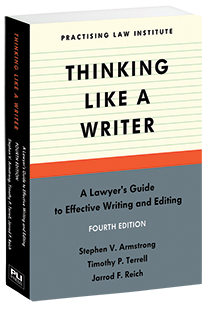
New Edition! Thinking Like a Writer: A Lawyer’s Guide to Effective Writing and Editing

PLI Press is proud to announce the publication of Thinking Like a Writer: A Lawyer’s Guide to Effective Writing and Editing (Fourth Edition).

A longtime favorite among PLI customers, this book provides practical advice to help lawyers strengthen their writing skills by “thinking like a writer” as effectively as they already think like a lawyer. It highlights guiding principles for writing clearly about complicated material and establishing credibility with demanding readers, and then turns those principles into specific techniques that apply to many types of documents and audiences.

  • Part I introduces the approach and principles that can guide lawyers in “thinking like a writer.”
  • Part II applies the guiding principles to a document’s organization.
  • Part III applies guiding principles to specific types of legal writing: letters, memoranda, and emails; briefs; and judicial opinions.
  • Part IV applies the principles to the smaller scale of paragraphs and sentences.
  • Part V applies the principles to the editing process, for both self-editing and editing the work of others.

Throughout, chapters include before-and-after examples to demonstrate how writing and editing can be improved by following the advice offered in the book.

Order a print copy today.

PLI PLUS subscribers can access this title through their subscription.

Treatise Update: Proskauer on Privacy

Proskauer on Privacy: A Guide to Privacy and Data Security Law in the Information Age provides essential guidance to organizations on how to develop compliance programs, ensure data privacy and security, prevent cybercrime, and avoid or minimize fines, penalties, litigation, damages, and negative publicity.

Updated content from the new release includes:

  • Chapter 3, Medical Privacy, notes proposed changes to the HIPAA Privacy Rule to support individuals’ engagement in their care, remove barriers to coordinated care, and reduce regulatory burdens on the health care industry.
  • Chapter 9, Workplace Privacy, updates discussion of privacy concerns regarding COVID-19 infections; cannabis screening of employees and potential hires; use of biometrics; and recent NLRB rulings.
  • Chapter 13, Canadian Privacy Law, adds discussion of the statutory tort of invasion of privacy enacted in British Columbia, Saskatchewan, Manitoba, and Newfoundland; proposed amendments to PIPEDA under Bill C-11, which takes some lead from the GDPR; and proposed amendments to Quebec’s PIPA.
  • Chapter 17, Data Breach Litigation, incorporates summaries of recent significant data breach litigation, and expands circuit-specific discussions of the courts’ approaches to various issues including standing, causes of action, and damages.

Order a print copy today.

PLI PLUS subscribers can access this title through their subscription.

Treatise Update – Langer on Practical International Tax Planning

Langer on Practical International Tax Planning (Fifth Edition) provides current knowledge and expert advice attorneys need to help clients capitalize on ripe tax havens and financial centers. Stocked with case studies that illustrate sound planning approaches, this book delivers the latest word on the legal, tax, business, financial, social, political, technological, geographical, and regional factors to consider when developing and implementing customized planning strategies for clients.

Highlights from the fourth release of the Fifth Edition include:

  • Revised section on Dual Nationality explains that when a taxpayer works in the United States and another jurisdiction, it presents challenges under the Social Security system, including double taxation, incomplete coverage, or loss of continuity of coverage (see section 11:4.1).
  • Revised section on Foreign Bank Account Reporting (FBAR) Rules discusses how a “willful violation” of the FBAR reporting requirement includes both knowing and reckless violations, even though more is required to sustain a criminal conviction for a willful violation of the same requirement; in sum, “willfulness” includes “recklessness” (see section 30:2.3).
  • New section on Sale or Exchange of Partnership Interest explores regulations issued in November 2020, which (1) retain the ten-year exception as an exception to the determination of deemed sale effectively connected gain and loss; and (2) provide rules for the sourcing of deemed sales gain and loss (see section 34:3.2[E]).
  • New section on Foreign Life Insurance Companies examines the domestic asset/liability percentages and domestic investment yields needed by foreign life insurance companies and foreign property and liability insurance companies to compute their minimum effectively connected net investment income under section 842(b), for tax years beginning after December 31, 2018 (see section 43:2.1[D]).

Order a print copy today.

PLI PLUS subscribers can access this title through their subscription.

Treatise Update: Equipment Leasing– Leveraged Leasing

Equipment Leasing−Leveraged Leasing (Sixth Edition) provides readers with the comprehensive legal, tax, economic, accounting, environmental, and insurance information and advice they need to develop and implement leasing deals that maximize rewards and minimize risks.

The authoritative treatise was recently updated with new content to bring readers up to date on the cutting edge of the industry. Highlights from the new release (Release 1) include:

  • Chapter 29: Doing Business Under State Corporation Laws has been fully updated with the latest cases on suits by unqualified foreign corporations, the effect of subsequent qualification, defense of suits, and monetary penalties, as well as cases on doing business in interstate commerce, leasing personal property, and collecting debts.
  • New Appendix 29A provides state-by-state statutory citations on (1) the penalties imposed upon unqualified corporations that are doing business in the state and (2) the activities that may, or may not, constitute transacting intrastate business so as to require qualification.
  • New Appendix 29C includes state-by-state statutes and case law on LLCs doing business outside their state of formation, have also been updated.
  • Chapter 32: Leasing Outside the United States: Pickle, Loss Trapping, Subpart F, and Foreign Tax Credits has been updated with an extensive discussion of new concepts and statutory sections introduced by the Tax Cuts and Jobs Act (TCJA), including: Global Intangible Low Taxed Income (GILTI), Foreign-Derived Intangible Income (FDII), the base erosion and anti-abuse tax (the “BEAT”), the section 163(j) interest expense deduction limitation, and additional provisions impacting leasing transactions.

Order a print copy today.

PLI PLUS subscribers can access this title through their subscription.

New Edition! Healthcare Employment Practice

PLI Press is proud to announce the publication of Healthcare Employment Practice: Policy, Law and Procedure (2021 Edition).

This clear and concise guidebook responds to the complex issues arising from the increasingly fractured and fractious hospital and healthcare environment with examples and details to save time, reduce errors and improve employee satisfaction. The text explores how the system actually operates, and suggests how lawyers, human resource professionals and hospital management teams can improve their outcomes through astute planning and careful drafting of agreements.

The 2021 edition includes:

  • Step-by-step, term-by-term guidance on physician employment contracts, with an emphasis on the problems presented by restrictive covenants, and a full sample Physician Employment Agreement
  • Labor and employment law as it affects healthcare industry employees
  • Issues presented by telemedicine
  • Stark and anti-kickback law compliance

Order a print copy today.

PLI PLUS subscribers can access this title through their subscription.

Treatise Update – Commercial Ground Leases

Commercial Ground Leases (Third Edition) is a definitive guide to drafting, negotiating, and finalizing equitable, error-free leasing documents that address the needs of both landlord and tenant. It features adaptable, time-saving agreement language and contains numerous appendices, including forms of letter of intent, leasehold mortgagee protection clauses, intercreditor agreements, a complete ground lease with many alternative clauses, and more.

Highlights from the latest update (Release #15) include:

  • Chapter 1, The Truth About Ground Leases. New discussion covers the landlord as partner, including the considerations for tenant/developers and equity sources and institutional mortgage lenders. See section 1:8.
  • Chapter 1A, Preliminary Agreements and Letters of Intent. Discussion of a well-drafted letter of intent, which should include all the material points to which the parties have agreed and any significant deal points that are potential deal breakers or processes to resolve them. See section 1A:2.2.
  • Chapter 6, Leasehold Financing. New discussion of mezzanine financing, which has become a feature of commercial real estate for a variety of purposes, including budget shortfalls and short-term needs. See section 6:2.4.
  • Chapter 7, Bankruptcy. Updated to include discussion of Mission Product Holdings, Inc. v. Tempnology, LLC, 139 S. Ct. 1652 (2019), in which the U.S. Supreme Court held, “Rejection of a contract—any contract—in bankruptcy operates not as a rescission but as a breach” and “leaves intact the rights the counterparty has received under the contract.” See section 7:5.4.

Order a print copy today.

PLI PLUS subscribers can access this title through their subscription.