Category Archives: Commercial

Treatise Update – Advertising and Commercial Speech: A First Amendment Guide (Second Edition)

Written by First Amendment experts, Advertising and Commercial Speech: A First Amendment Guide focuses on how the Supreme Court’s commercial speech doctrine affects advertising in nearly fifty industries and professions including for the services of accountants, doctors and dentists, lawyers, pharmacists, educators, and more.

Among the many topics discussed in this new release are the following:

  • Lanham Act and misappropriation claims: New material in section 9:2 discusses two major post-Ariix decisions from federal courts in San Francisco involving failed lawsuits seeking to leverage the Lanham Act as a basis for challenging Facebook’s efforts to police its website against the spread of online misinformation.
  • Compelled commercial speech—housing: A revised section 12:11 examines a case from the Eastern District of New York involving a challenge by “five small landlords” to an emergency state eviction moratorium law enacted in the middle of the COVID-19 pandemic.
  • Taxation of media: An update to section 13:4.1 covers a case from the Ohio Supreme Court regarding whether a billboard tax violated the First Amendment’s protections for freedom of speech and freedom of the press.
  • Regulation of advertising content: Cases added to chapter 14 include:
  1. Florida proceedings challenging the state’s law that prohibited cruise lines from requiring passengers to provide COVID-19 vaccination or post-infection recovery documentation prior to boarding (see section 14:2); and
  2. Fair housing cases dealing with a Seattle ordinance that precluded landlords from taking adverse action against tenants and prospective tenants based on criminal history and a case in New York involving a law that prohibited landlords from “threatening” residential or commercial tenants based on the tenant’s COVID-19 status (see section 14:17).

In addition, this release includes an updated Table of Cases, Defendant-Plaintiff Table, and Index.

Order a print copy today.

PLI PLUS subscribers can access this title through their subscription.
New Edition! Social Media and the Law

Book Cover Image

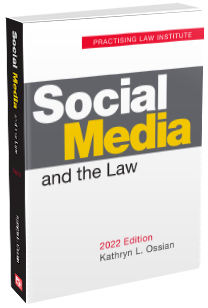
PLI Press is proud to announce the publication of the new edition of Social Media and the Law.

This book can help to minimize the risk of litigation and other legal problems arising from the use of social media platforms by analyzing it in various legal contexts, including privacy, civil litigation, employment, criminal activity and prosecution, intellectual property, defamation, advertising, and regulated industries. Relevant legislation, court opinions, usage trends, and industry responses are discussed. 

Notable developments covered in the new edition are:

  • Use of technology by Human Resources departments (Chapter 6):  Recent statistics on the growing use of AI, big data, and data analytics in employment recruitment are discussed.
  • Deceptive practices (Chapter 8):  A new section discusses two self-regulatory programs operated by the Better Business Bureau that are of relevance to social media advertising: the National Advertising Division and the Children’s Advertising Review Unit, the latter of which issued revised guidelines that became effective on January 1, 2022.
  • Required disclosures in advertising (Chapter 8): In October 2021, the FTC began sending a series of Notices of Penalty Offenses to large numbers of businesses following an April 2021 Supreme Court decision that stripped the FTC of its authority to obtain monetary redress without first engaging in administrative proceedings.
  • Privacy of victims of crime (Chapter 9): A new section discusses the privacy and ethical issues arising from the provision of social media information about victims of crime.

Order a print copy today.

PLI PLUS subscribers can access this title through their subscription.

New Edition! Financial Institutions Answer Book: Law, Governance, Compliance (2018 Edition)

PLI recently published the 2018 edition of Financial Institutions Answer Book, which provides a comprehensive overview of the complex federal requirements regulating financial institutions in the United States in an easily accessible Q&A format.

Every aspect of a financial institution life cycle is covered, from understanding the differences in regulation based on what type of charter is chosen, through ongoing capital and deposit activities requirements and major changes in corporate control, to the cessation of entity activity through merger, acquisition, or entity failure.

Financial Institutions Answer Book describes the requirements under each type of charter for the major areas of financial institution activity, such as:

Reflecting the increased federal concern with fraud, money laundering, and protecting the federal taxpayer from bank defaults, individual chapters are devoted to describing in detail the federal enforcement agencies and their powers, anti-money laundering and other fraud issues, the required examinations and audit process, and recent regulatory approaches to problem banks and failure.

Published in a handy softcover volume, Financial Institutions Answer Book is a source for quick, concise answers for lawyers and other legal professionals, as well as financial institution managers, officers, directors, and anyone else who would like a comprehensive understanding of the legal framework regulating banks and other financial institutions.

This new answer book is available on PLI PLUS, our research database.  If you’d like to order a print copy, please email libraryrelations@pli.edu or call 877.900.5291.

New Title! Legal Guide to the Business of Marijuana

PLI recently published a new title, Legal Guide to the Business of Marijuana.

This title is a new and unique resource for lawyers who represent clients in what has been called the fastest growing industry in the United States. The majority of states have enacted laws legalizing medical marijuana — with nine states to date allowing for recreational use — but marijuana remains illegal under the Federal Controlled Substances Act, giving rise to constitutional challenges to these state laws under the doctrine of preemption. As a result, marijuana enterprises must operate in a legal and regulatory environment of uncertainty, and lawyers representing these enterprises must tread carefully when advising clients.

Written by James T. O’Reilly, a lawyer and public health specialist, Legal Guide to the Business of Marijuana offers critical guidance to help lawyers effectively represent their clients while steering clear of seen and as yet unseen perils implicit in the continued federal-state conflict. The guide provides discussion and analysis of:

• the complex and varying state regulation of medical and non-medical marijuana, including a survey of state cannabis laws, with summaries and citations

federal law, enforcement, and preemption

the various aspects of establishing and managing a marijuana enterprise, including the growing, licensing, labeling, transporting, and distribution of marijuana and related products

• the implications of preemption on employment, taxes, and banking

For lawyers new to representing marijuana clients, the author provides an understanding of the definitions of marijuana and other cannabis products, as well as a review of the policy and political issues that have led to the controversy and uncertainty of the current environment.

This essential new title is available on PLI PLUS, our online research database.  If you’d like to order a print copy, please email libraryrelations@pli.edu or call 877.900.5291.