Category Archives: Technology

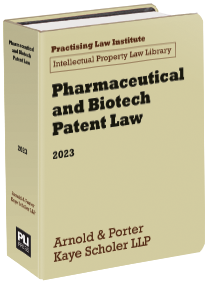
New Edition! Pharmaceutical and Biotech Patent Law (2023)

PLI Press is proud to announce the publication of the new edition of Pharmaceutical and Biotech Patent Law.

This book provides the legal, scientific, and technical information needed to help clients obtain, defend, and challenge patents in these important business areas. It shows readers how to craft problem-free patent applications and includes detailed checklists that help resolve tricky patent issues in the complex pharmaceutical and biotech fields. It is regularly updated to reflect Federal Circuit rulings and other significant court decisions.

Some of the recent developments reflected in this new edition include:

  • Inter Partes Review: Coverage of the PTO guidance for discretionary denials which clarifies when institutions will not be denied under Fintiv (see Section 1:5.3).
  • Patentability of Stereoisomers and New Salts: Discussion of the Federal Circuit’s decision in Mylan Pharmaceuticals Inc. v. Merck Sharp & Dohme Corp. regarding whether Mylan Pharmaceuticals had failed to show that the claims of U.S. Patent No. 7,326,708 were either anticipated or rendered obvious by the asserted prior art (see Sections 7:2.4[A][2] and 7:2.6[C][1]).
  • Cell and Gene Therapy Products: New chapter exploring the patent landscape for cell and gene therapy products and the current disputes related to these products (see Chapter 15).
  • ITC Litigation: New chapter providing recent trends and practice tips on ITC Litigation (see Chapter 16).

Order a print copy today.

PLI PLUS subscribers can access this title through their subscription.

Treatise Update – Technology Transactions:  A Practical Guide to Drafting and Negotiating Commercial Agreements

Technology Transactions enables practitioners to draft, review, and negotiate technology transaction agreements. Readers will encounter a trove of sample forms and best practices for negotiating some of the most common and sophisticated types of technology transactions. The book specifically covers issues relevant to software license, technology escrow, non-disclosure, domain name transaction, and cloud computing agreements. It also discusses the relevant privacy and intellectual property regulations lawyers should consider when drafting transactional documents.

Highlights of the new release include:

  • Chapter 4: A new section discusses the increasing adoption of sovereign cloud solutions and industry-specific clouds (see section 4:2.2[G]).
  • Chapter 5: Updated content discusses ICANN’s proposal of the new WHOIS Disclosure System which would facilitate access to nonpublic registration data associated with generic top-level domains (gTLDs) (see section 5:2.1[A]).
  • Chapter 11: New content discusses the increased use of efforts provisions in commercial agreements, the variants of the clauses that have been introduced, and issues litigated (see section 11:4), including the enforceability of such clauses (see section 11:4.1), efforts hierarchies in determining whether the standard was met (see section 11:4.2), and defining efforts standards (see section 11:4.3).
  • Chapter 19: Updated discussion describes the nine new elements that an information security program must include (see section 19:4.2).
  • Chapter 20: New content previews California’s Age-Appropriate Design Code Act which will take effect in 2024 (see section 20:7).

Order a print copy today.

PLI PLUS subscribers can access this title through their subscription.
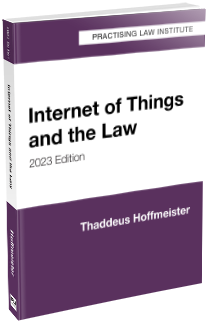
New Edition!  Internet of Things and the Law (2023 Edition)

PLI Press is proud to announce the publication of the new edition of Internet of Things and the Law. 

This book is a starting point for those seeking a deeper understanding of the IoT’s role within the law. After providing a detailed explanation of the IoT and examining its current regulatory framework, the book discusses the current and potential impact of the IoT on privacy, security, contracts, IP, consumer protection litigation, civil discovery, and criminal law and procedure. The book concludes with a chapter on international approaches to the regulation of IoT.

Some of the recent developments reflected in this new edition include:

  • IoT Cybersecurity Improvement Act of 2020: Discussion of one of the few laws enacted thus far directly aimed at regulating the IoT (see section 2:2.10).
  • New Oregon IoT security law: Analysis of the language of Oregon’s IoT security law, specifically as it relates to what constitutes “reasonable security features” (see section 4:4.4[C][3]).
  • Right to Repair legislation: A new section considers the passage by thirty-four states of “right to repair” legislation. It describes what the legislation requires manufacturers to do and lists the scope of consumer protection it provides (see section 6:3.1[B]).
  • Fourth Amendment rights: Added commentary highlights the Ninth Circuit’s recent holding on whether the government’s data preservation request violates the Fourth Amendment (see section 9:4.4).
  • Global privacy and security: Updates on recent developments in Japan, Brazil, Canada, and the European Union, including reporting that courts in Austria, France, and Italy have recently ruled on whether the use of Google Analytics is legal and illuminating what those rulings will mean for Google going forward (see section 10:2.2).

Order a print copy today.

PLI PLUS subscribers can access this title through their subscription.