Category Archives: PLI

Treatise Update – Holtzschue on Real Estate Contracts and Closings:  A Step-by-Step Guide to Buying and Selling Real Estate (3rd Edition)

Holtzschue on Real Estate Contracts and Closings is an invaluable resource for attorneys and general practitioners who handle real estate deals as well as an important reference for brokers, title insurers, and inspectors.  It distills more than thirty years of transactional experience into one plain-English treatise that clearly explains governing law and customary industry practices.  The book provides useful legal, technical, and strategic guidance and checklists for sellers’ and purchasers’ attorneys preparing them to execute dispute-free residential deals quickly and easily.

This new release offers the latest information crucial to your practice.  Highlights include:

In addition, the Table of Authorities and Index have been updated to reflect the latest revisions.

Order a print copy today.

PLI PLUS subscribers can access this title through their subscription.

New Edition! COVID-19 and Other Pandemics: Business and Legal Challenges (2022)

PLI Press is proud to announce the publication of the new edition of COVID-19 and Other Pandemics: Business and Legal Challenges.

Originally published in 2020, the book was featured on Above the Law which cited it as “[t]he first publication to address the complex, evolving [legal] issues” arising from the pandemic.  The treatise has since been fully updated to keep pace with the rapidly evolving situation surrounding COVID-19. Maintaining its results-oriented approach, the book combines practical advice, the latest scientific research, and guidance from key government agencies to provide readers with the answers they need on workplace liability and best practices; employment and labor issues; contracts and frustration defenses; and more.

Some of the highlights from the new edition include:

  • Governors’ Authority: Updated answers regarding whether 1) governors possess the power to shut down business to reduce COVID-19 spread (see §3.1); 2) governors have the authority to issue emergency health orders (see §6:3); and 3) governors may ban gatherings during the time of the health emergency (see §8:1).
  • OSHA’s Emergency Temporary Standard: Added discussion of OSHA’s Emergency Temporary Standard and what it covers (see Ch. 4, §8:5, and §14:8).
  • COVID-19 Statistics: Updated to reflect U.S. COVID-19 cases as of May 2022 and Global Health Statistics as of early 2022 (see Ch. 1).

To download a complimentary chapter from the original publication of COVID-19 and Other Pandemics: Business and Legal Challenges, click here.

Order a print copy today.

PLI PLUS subscribers can access this title through their subscription.

Treatise Update – Business Taxation Deskbook: Corporations, Partnerships, Subchapter S, and International

Business Taxation Deskbook is a guide to a wide range of domestic and international business tax issues under the federal income tax law as it exists subject to the Internal Revenue Code after the enactment of the Tax Cuts and Jobs Act of 2017 (TCAJA). The book provides a brief introduction to state law issues in business taxation. It also addresses the life cycle of the three principal business entities (that is, C corporations, partnerships, and S corporations), and inbound and outbound cross border transactions.

Highlights of Release #2 include:

  • New § 1:19 – provides a brief introduction to the taxation of cryptocurrencies.
  • New § 1:21 – discusses some of the Biden administration’s business-related tax proposals.
  • New § 1:22 – briefly introduces the OECD’s Pillars One and Two for avoiding abuse in the international tax system.
  • New § 5:4.1[D][3] – explains a federal district court decision holding that temporary regulations implementing section 245A were invalid because they did not meet the APAs notice and comment requirements.
  • New § 8:6 – addresses a potential change in the definition of control both for purposes of section 351 and the reorganization provisions.
  • New § 21:4 – introduces the OECD’s Pillars One and Two, which are designed, inter alia, to prevent a parent company from avoiding tax on income earned by its foreign subsidiaries.

Order a print copy today.

PLI PLUS subscribers can access this title through their subscription.

New Editions! SEC Compliance and Disclosure Series

PLI Press is proud to announce the publication of the new editions of the three books in the SEC Compliance and Disclosure Series.

The titles in the series are step-by-step guides delivering clear explanations, comprehensive information, and essential practice tips.

Master the 8-K offers updated direction on filing the SEC’s Current Report on Form 8-K. Master the 10-K and 10-Q gives instructions and analysis to ensure accurate and timely filings. Master the Proxy Statement advises companies on year-end disclosures and preparing proxy materials. The series includes sample language, detailed appendices, key regulations, and related forms and checklists.

Some of the highlights from the recently published editions include:

  • The latest guidance alerting users to the potential upcoming new Form 8-K Item for “cyberse­curity incidents” (see Master the 8-K Introduction and Item 1.05);
  • Discussion of the revisions to the redaction process relating to confidential information in exhibits that removed the old “competitive harm” requirement (see Master the 8-K §GP:8);
  • Instruction to users about potential Form 8-K disclosure revisions that could result from the Commission’s proposed amendments relative to SPACs and “de-SPAC” transactions (see Master the 8-K Item 2.01);
  • Explanation of the new requirement to soon submit (on EDGAR) the “glossy” annual report to shareholders required by Rule 14a-3(b) (see Master the 10-K and 10-Q §GP:5.2);
  • Notification on the addition of Item 9C to Form 10-K—“Disclosure Regarding Foreign Jurisdictions that Prevent Inspections” (see Master the 10-K and 10-Q §GP:2 and §3:9);
  • Communication about the adoption of rules allowing for electronic signatures on SEC filings (see Master the 10-K and 10-Q §GP3:3)
  • Announcement of changes to the rules regarding the furnishing of proxy voting advice (see Master the Proxy Statement General Principles and Appendix 1);
  • Information about the universal proxy rule, which is now effective for contested director elec­tions taking place after August 31, 2022 (see Master the Proxy Statement §21:1);
  • The new exhibit requirement when a fee is required in connection with fil­ing proxy materials (see Master the Proxy Statement §GP2:2).

Order print copies of Master the 8-K, Master the 10-K and 10Q, and Master the Proxy Statement today. 

PLI PLUS subscribers can access these titles through their subscription.

What’s New on PLI PLUS

We add content to PLI PLUS every month to ensure our subscribers have access to the most up-to-date and relevant secondary source legal documents. Renowned legal experts regularly update our acclaimed Treatises, Course Handbooks, Answer Books, Transcripts, and Forms to reflect recent changes and developments in the law.

Click here to see what we added in September 2022!

Meet Our AALL 2022 Raffle Winner: Tom Kimbrough

At the 2022 AALL Annual Conference in Denver, Colorado, PLI raffled off a gift certificate to Spa Finder. We are pleased to announce this year’s winner is Tom Kimbrough, Associate Director for Collection Development at Underwood Law Library at Southern Methodist University’s Dedman School of Law. In keeping with tradition, Tom kindly agreed to be interviewed for this blog. Read on to learn more about Tom’s work at Southern Methodist University, his start in international law, the article that changed his life/career, and more.

Tell us a little about yourself. Why did you become a librarian?

Prior to becoming a law librarian, I spent eleven years as a transactional lawyer at four different law firms in three countries, including as a senior associate in the Mergers & Acquisitions and Korea practice groups at the Hong Kong office of Baker & McKenzie and as an associate in the Corporate Finance, China, and Korea practice groups at the Beijing office of Skadden, Arps, Slate, Meagher & Flom.  I regularly worked on projects in China, Korea, Singapore, Malaysia, Thailand, Indonesia, Philippines, Vietnam, and Guam.  That fun pretty much ended once my second child came along and I basically had a choice of whether to try to save my law career or save my marriage/family life.  The precise moment of truth came in December 2003 when the partner I worked for the most told me I needed to relocate to New Delhi for four-to-six months for a big new project (representing Samsung Electronics in a new mobile phone supply network contract with an Indian counterparty).  My reply was to submit my resignation.

I had no idea what I would do next until I stumbled across (“googled across?”) Mary Whisner’s wonderful article “Choosing Law Librarianship: Thoughts for People Contemplating a Career Move,” which changed my life.  I moved from Hong Kong to Seattle/Mukilteo, spent a year as a volunteer working with Lettice Parker at the Snohomish County Law Library in Everett, and then enrolled in the University of Washington’s law librarianship program.  After graduating from UW, I was offered a job as a Foreign & International Reference Law Librarian at Southern Methodist University in Dallas and now, sixteen years later, I am still very happily at the SMU Underwood Law Library as the Associate Director for Collection Development.

What do you like most about your job as Associate Director for Collection Development at SMU’s Underwood Law Library?

I enjoy the diverse combination of teaching students, doing research projects for faculty, and selecting new materials (print and electronic) for our law library’s collection.  This mix of various responsibilities keeps the work fresh and exciting.  And I am very fortunate to work with an extremely talented and kind group of colleagues who get along fantastically and thoroughly respect each other’s abilities and expertise.  It is by far the most harmonious work environment I have ever experienced, and I hope to go on for another decade at least.

Which PLI publication do you most frequently recommend to students and/or faculty?

I teach a course on International & Foreign Legal Research (three credits) in the SMU Law School.  I spend one class session discussing the legal systems of four very different non-U.S. jurisdictions (P.R. China, Iran, Kenya, and North Korea) from a comparative perspective.  When I discuss China I often refer my students to the interesting and useful panel discussion provided in PLI’s Doing Business in and With China 2021, which I enthusiastically recommend to my students as providing valuable information on many legal and practical issues facing lawyers who advise clients with projects in China.  Because this excellent resource is available on the PLI PLUS platform to which the SMU Law Library subscribes, it is easy for my students to access it.

What did you think of this year’s conference? What was the highlight for you?

I greatly enjoyed and learned from this year’s AALL conference in Denver.  For me the highlight was AALL Program H-4 “Shameless Self-Promotion for Law Librarians: How to Get Visible, Benefit Your Career, and Impact Your Profession (While Having Fun).”  I am currently trying to promote, especially to law students and young lawyers, my recently-published law journal article “Law Firm Dynamics: Don’t Hate the Player, Hate the Game,” 75 SMU L. Rev. F. 241 (2022). I believe that my article provides useful advice to lawyers working in, or planning to work in, law firms, and I greatly appreciated the suggestions that the panelists at this AALL program provided me to try to enhance the visibility of my article.  If you know any law students or young lawyers, please consider forwarding the link to my article to them. 🙂

New Edition! Internal Revenue Service Practice and Procedure Deskbook (Eighth Edition)

PLI Press is proud to announce the publication of the new edition of the Internal Revenue Service Practice and Procedure Deskbook.

The eighth edition contains guidance for representing a client undergoing a civil or criminal tax examination. It presents an overall discussion of IRS procedures and practical and strategic considerations. The Deskbook is an indispensable resource for any individual or entity appearing before the IRS including lawyers, accountants, in-house tax directors, and tax counsel.

Some of the highlights from the new edition include:

  • Informal guidance to reject research credit claims as nonprocessible to the extent claims do not meet the “sufficiency standard” with respect to five different items of information (see section 8:1.2);
  • A recommendation that Congress should extend the lookback period when the filing deadline is postponed by the IRS due to a disaster declaration, to the period of the postponement plus three years, plus any extension of time for filing the return (see section 8:1.9[B]);
  • An explanation that many taxpayers preparing their 2021 returns are now grappling with the 80 percent limit under section 172(a) for the first time (see section 8:3); and
  • A discussion of whether a partnership may recover litigation costs paid by its partners (see section 18.7.1).

Order a print copy today.

PLI PLUS subscribers can access this title through their subscription.

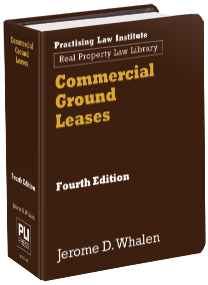
Treatise Update – Commercial Ground Leases (Fourth Edition)

Commercial Ground Leases is a definitive guide to drafting, negotiating, and finalizing equitable, error-free leasing documents that address the needs of both landlord and tenant. It features adaptable, time-saving agreement language and contains numerous appendices, including forms of letter of intent, leasehold mortgagee protection clauses, intercreditor agreements, fee and leasehold deed of trust provisions, estoppel certificate and guaranty, and a complete ground lease with many alternative clauses.

Highlights of the new release include:

  • Chapter 1: Updated discussion covers the landowner’s and the tenant/lender’s differing views on the basis for a percentage rent formula (see section 1:4.5).
  • Chapter 4: Updated discussion reviews the Lever House in the context of unused development rights (see section 4:5.3).
  • Chapter 10: Updated discussion reviews setting the duration of term when there is a second or third use of a building (or the underlying land) (see section 10:7.1).
  • Chapter 13: Provides a new typical maintenance clause (see section 13:5).
  • New Appendix Y: A provision creating a replacement reserve for the replacement of furniture, fixtures, equipment, and operating systems during the last twenty years of the lease term, or upon the exercise of the last tenant option to extend the term, or a number of years to be specified after completion of construction of the project.
  • New Appendix Z: A form of completion guaranty that covers completion of shell and core construction, exclusive of tenant improvements, and including ground lease rental that arises under the lease due to delays in completion of construction.
  • Chapters 3, 5, 6, 8, 12, 16, 19, and 20 have also been updated with the latest developments.

In addition, the Tables of Authorities and the Index have been updated.

Order a print copy today.

PLI PLUS subscribers can access this title through their subscription.