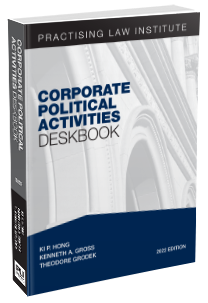
The Deskbook serves as a practical manual for attorneys who advise corporations about involvement in the political process. It provides a thorough grounding in the law of federal and state campaign finance, pay-to-play, lobbying, and gift compliance, along with examples of best practices that can help corporations successfully interact with United States federal, state, and local governments and officials.
The new edition reflects the most current state of the law and includes, for easy reference, updated charts on state and local pay-to-play rules, federal and state lobby laws, and state contribution laws.
Among the developments discussed in the 2022 Edition are:
Foreign National Prohibition – Update added about the 2021 SEC ruling regarding whether the ban on foreign national involvement in the financing of any U.S. election extends to include spending relative to ballot initiatives (see Section 1:2.2).
FARA Rulemaking – A new section calls attention to the DOJ’s December 2021 advanced notice of proposed rulemaking which solicited comments relevant to an anticipated comprehensive update on the implementing regulations under the Foreign Agents Registration Act (FARA) (see Section 7:5).
Jurisdictions with Pay-to-Play Rules –A revised table of jurisdictions with pay-to-play rules includes additional cities in Massachusetts, Ohio, Pennsylvania, and Texas (see Section 5:2, Table 5-1).
We add content to PLI PLUS every month to ensure our subscribers have access to the most up-to-date and relevant secondary source legal documents. Renowned legal experts regularly update our acclaimed Treatises, Course Handbooks, Answer Books, Transcripts, and Forms to reflect recent changes and developments in the law.
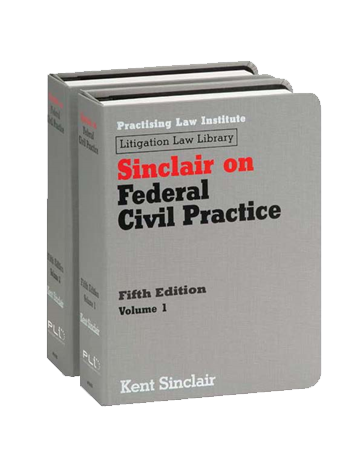
Sinclair on Federal Civil Practice gives quick and authoritative answers for issues arising in federal civil litigation and serves as a guide to the principal rules and tactical considerations guiding lawsuits in the federal courts. This two-volume treatise explains the layout of the court system and the nature of its key personnel, jurisdiction and venue principles, and the sequence of litigation. It also provides insight into the rationale of the rules by citing the key interpretive cases and offering court-tested practice tips.
Highlights of the new release include:
Chapter 15: Significant expansion of discussion regarding jury instructions, including the respective roles of the judge and counsel; due process limits on jury discretion; the plain error standard; objections to instructions; timing of instructions, requests and actions on requests; jury instruction drafting principles; and review of preserved and unpreserved instruction errors.
Chapter 18: In-depth analysis of the harmless error rule, including of Supreme Court jurisprudence on the issue and the Court’s differentiation between three classes of errors that can have an adverse impact on a litigant’s substantial rights during trial: (1) non-constitutional errors; (2) “trial errors”; and (3) “structural defects.”
Chapter 19: Discussion of recent amendments to Rule 3 of the Federal Rules of Appellate Procedure addressing how an appeal of right is taken, and specifically affecting the content of the notice of appeal that is required, with important clarifications regarding the scope of the judgment or appealable order designated in the notice of appeal.
In addition, numerous recent law review articles are added to the Additional Resources section of many chapters, and the chronological circuit-by-circuit Compendium of Recent Cases (Vol. 1 & Vol. 2) is updated.
Corporate Legal Departments: Practicing Law in a Corporation provides invaluable guidance on a wide range of responsibilities and dilemmas in-house attorneys face. It advises on matters such as detecting and preventing internal legal problems, developing corporate business plans, pursuing new business opportunities, using cost-effective litigation strategies, and managing corporate crises. The treatise features a unique In-House Counsel’s Handbook covering some of the key areas of corporate law and compliance.
Highlights from this expanded and updated release include:
Technology management: A new section discusses the role technology plays in promoting remote communications, data privacy, and cyber security, especially in the COVID-19 era, and whether current technology fully supports legal entity management (see section 6:4).
Organization: A new section illustrates four types of reporting lines that are critical for promoting communication and transparency between the general counsel and the chief executive officer as well as the board of directors (see section 2:8).
Privileged communications: A memo from the Department of Justice in a recent case involving Google explains the need to properly educate in-house counsel and nonlawyer employees on the practice of copying counsel on requests for legal advice where no advice is requested in order to shield business advice in the cloak of legal advice offered by counsel (see revisions in sections 12:1 and 14:15.11).
In-House Counsel’s Handbook: This release includes extensive updates to Appendix A, which is designed to help in-house lawyers understand pertinent points in key areas of their practice.
Fragomen on Immigration Fundamentals provides in-depth coverage of the rules, policies, and procedures related to key facets of immigration law in the United States. Throughout, the authors supplement analysis of recent cases, policies, and rules with practical guidance for both general practitioners and experienced immigration attorneys.
Some of the important recent developments discussed in this release include:
PERM Recruitment: §2:2.4[D][6] discusses how an August 2021 DOJ settlement agreement in a U.S. worker discrimination lawsuit against Facebook impacts government enforcement of the PERM program.
COVID-19:§2:10.3[A][3] and §3:4.1[C] reveal a new COVID-19 related requirement that green card applicants must satisfy in order to be deemed eligible for permanent residence. The new requirement is included in the routine medical examinations for both adjustment of status applicants in the United States and immigrant visa applicants applying at U.S. embassies and consulates abroad.
Work authorization for spouses: §5:6.3[B] and 10:3.4[N] cover a November 2021 announcement by the USCIS regarding the work authorization process for certain E, L-2, and H-4 spouses in response to a lawsuit that challenged the lengthy processing delays of EAD applications for dependents.
T nonimmigrants: In October 2021, USCIS issued comprehensive guidance in its Policy Manual regarding the adjudication of T nonimmigrant status applications for victims of severe forms of trafficking in persons (see §5:28.1[A]).
H-2B changing employers: §10:3.4[M] explains how a provision of a January 2022 DHS rule providing a cap increase for FY 2022 gives greater job flexibility to H-2B workers already in the United States.
Earlier this month, the PLI librarians traveled to Denver, Colorado, to attend the 2022 AALL Annual Meeting & Conference. Here are some of the highlights from our trip.
At the Colorado Convention Center, where this year’s conference was held, we were greeted by a Big Blue Bear.
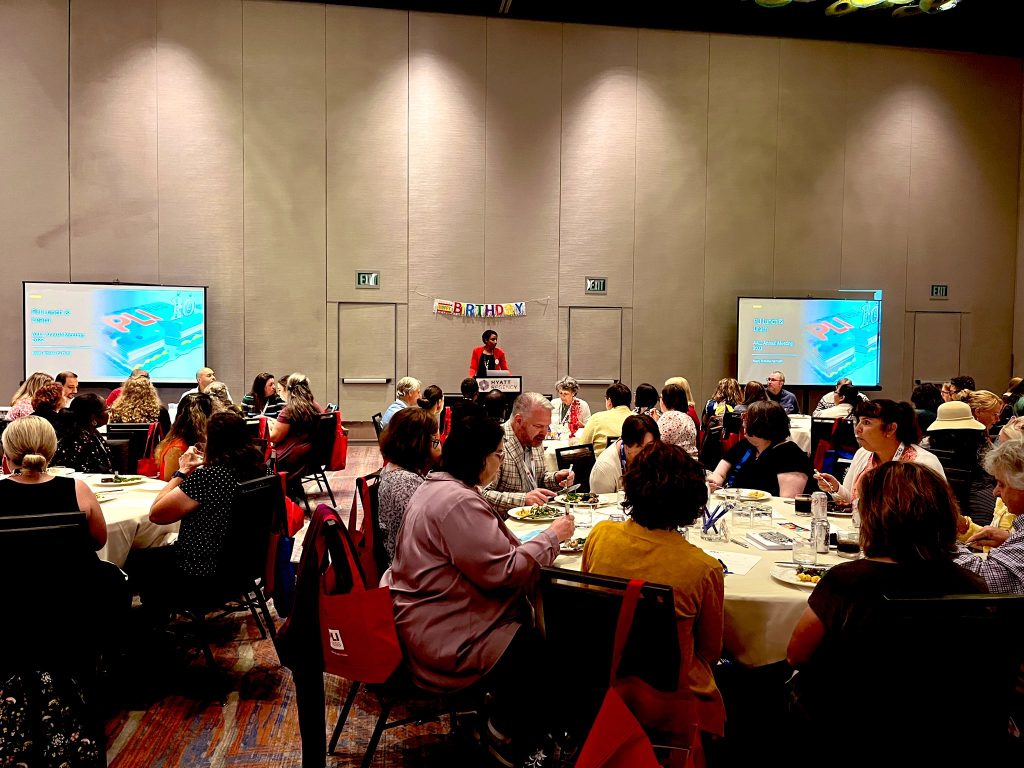
PLI’s president, Sharon L. Crane, speaking at the luncheon we hosted to celebrate the PLI PLUS platform’s 10th anniversary. Alexa Robertson, senior director of legal info serv & electronic publishing, also spoke at the event, followed by Kay Mitchell, associate director of library relations, who gave a live demonstration of the newly designed PLI PLUS platform.
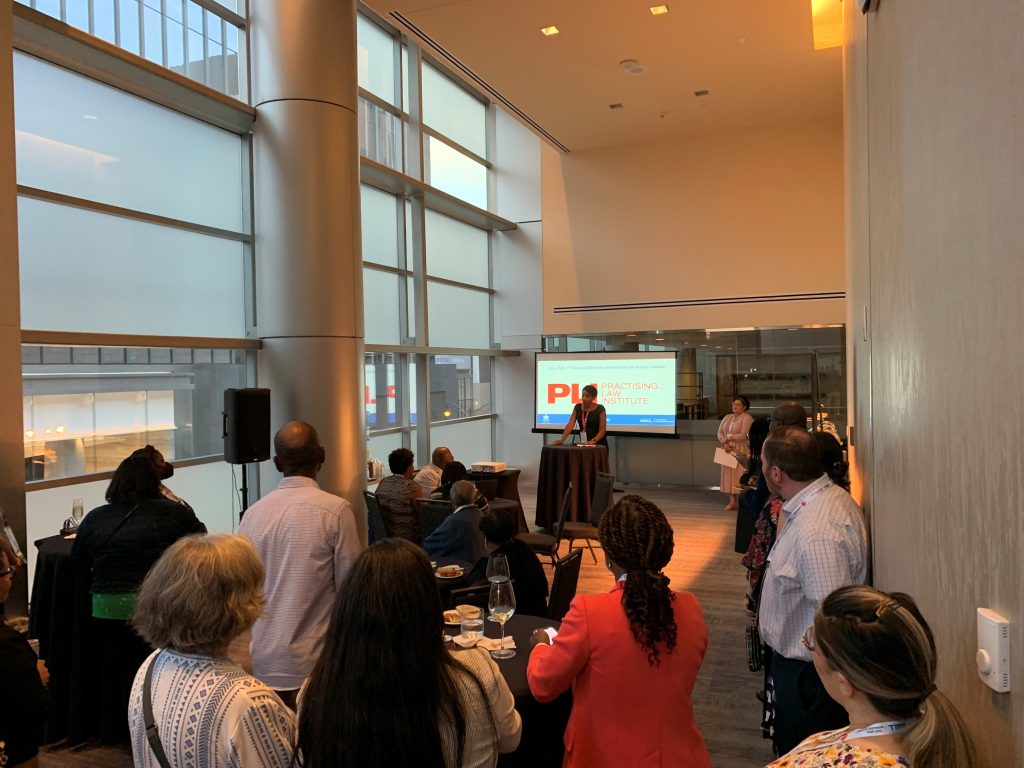
PLI was proud to sponsor the inaugural Diversity Reception for Social Justice hosted by the Black Law Librarians SIS.
PLI President Sharon Crane speaking to attendees of the inaugural Diversity Reception for Social Justice, hosted by the Black Law Librarians SIS.
Karen Oesterle, PLI’s associate director of legal research development, poses at the conference’s photo booth.
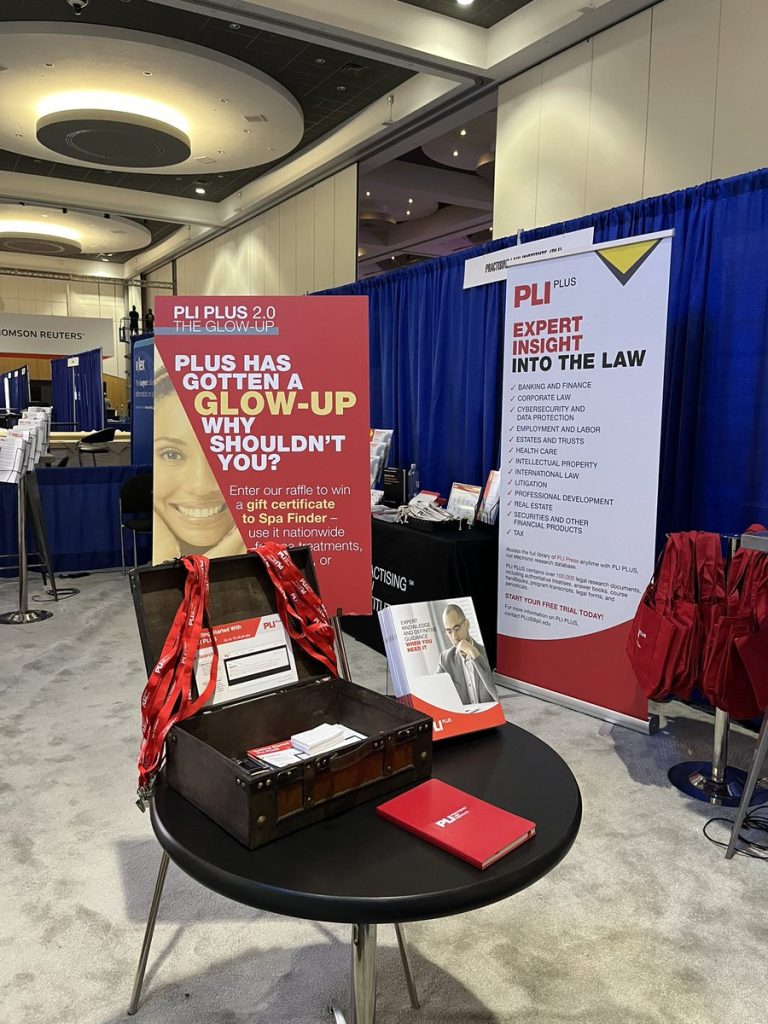
Thank you to everyone who stopped by our booth. It was great to see you! Visit our Training Center for digital versions of all the flyers and booklets from our booth.
We add content to PLI PLUS every month to ensure our subscribers have access to the most up-to-date and relevant secondary source legal documents. Renowned legal experts regularly update our acclaimed Treatises, Course Handbooks, Answer Books, Transcripts, and Forms to reflect recent changes and developments in the law.
This book is both a reference guide to the Department of Labor’s regulations and informal guidance and a resource for the Department’s views on ERISA fiduciary responsibilities as expressed in litigation. As much of the Department’s enforcement and litigation has focused on pension plans, so does this book, along with an overview of health plan investigations, enforcement, and litigation. It also discusses the Department’s criminal enforcement program and the impact of the fiduciary rule on the financial services industry and related litigation.
Some of the changes to the 2022 edition include:
Missing participant investigations: A new section discusses EBSA’s Terminated Vested Participant or missing participant national project and the Fiduciary Investigations Program (see §6:1.6[B]).
Mental health parity enforcement and Nondiscriminatory wellness programs: New sections discuss a) federal statutes that require parity in employer-sponsored group health plans’ coverage for mental health and substance use disorders with coverage for medical conditions (see §7:4); and b) an area of EBSA’s enforcement activities focused on compliance with the Department’s regulations for nondiscriminatory wellness programs (see §7:7).
Dudenhoeffer “more harm than good” standard: An expanded discussion is provided of Retirement Plans Committee of IBM v. Jander, a case involving whether a prudent ESOP fiduciary could conclude that disclosing confidential information when disclosure is not required by the securities laws would do “more harm than good” (see §10:3.2[A]).
ESG and ETI investments: A new section discusses the evolution of the Department’s approach to whether non-pecuniary factors can be considered in making investment decisions for pension plans (see §15:1.3).