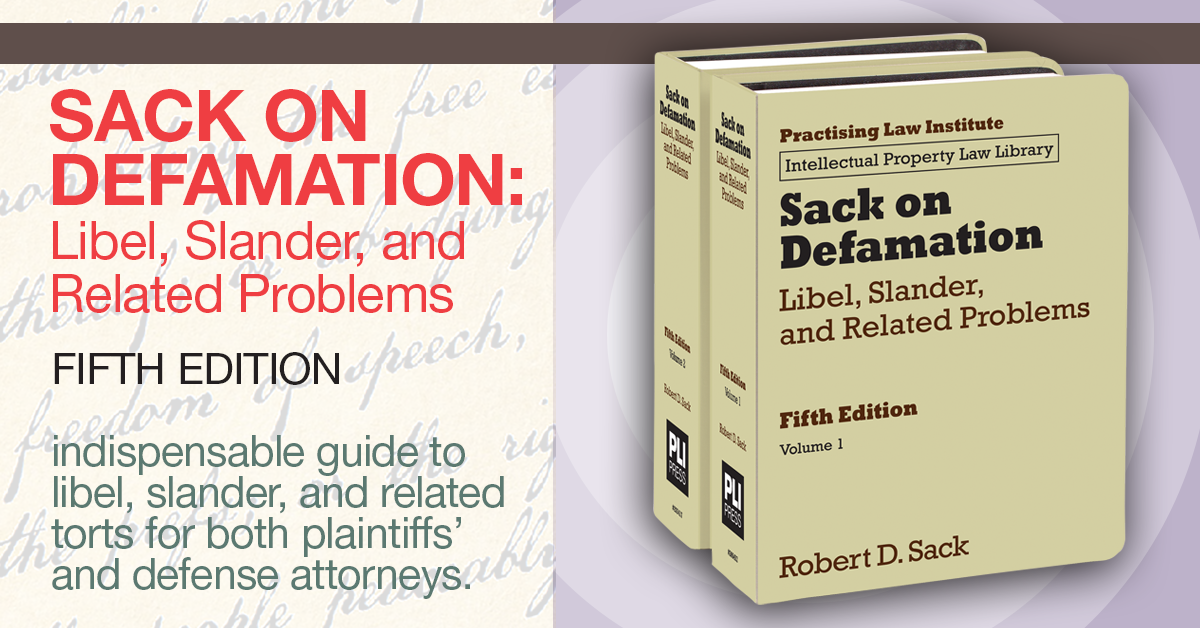
 Written by a U.S. Court of Appeals judge and cited by courts throughout the United States–including by the U.S. Supreme Court–Sack on Defamation delivers definitive legal, strategic, and tactical insight into libel, slander, and other defamation-related causes of action for both plaintiffs’ and defense attorneys.
Highlights of the new release include:
• Context of allegedly defamatory statement: In McKee v. Cosby, the
plaintiff accused the defendant of defaming her in a letter by using her
published statements out of context. But the First Circuit, applying
Massachusetts law, concluded to the contrary, noting that the quotations
were “immediately followed by a hyperlink to the source article, allowing
readers to put [the plaintiff’s quoted] statements into proper context.”
• Defamation of groups and group members: In Elias v. Rolling Stone
LLC, the Second Circuit, applying New York law, held that it was error
to dismiss a defamation cause of action brought by a group of fifty-three
members of a college fraternity, based on a false published statement
by the defendant that some nine of the fraternity’s then members had
committed or participated in a rape at their fraternity house.
• Hepps doctrine—matters of public concern: The Texas Supreme Court,
in Brady v. Klentzman, has “recognized that even if the general subject
matter of a publication may be a matter of legitimate public concern,
some of the details may not be. But if a ‘logical nexus’ exists between
these details ‘and the general subject matter’ of the article, then they are
reasonably included as a matter of public concern.”
• Opinion—emojis and emoticons: Digital media may well give rise to
a new context in which to decide whether a statement is fact or opinion.
One can guess that emojis and emoticons will, by their nature, ordinarily
be treated as nonactionable opinion or commentary. See § 4:3.1[A], at
note 121.1.
• Public officials: Persons held to be public officials include the director of
budget and finance for a public school system; a former town clerk who,
as such, “had the primary responsibility for organizing and issuing the
payroll for the town”; and the deputy manager of a U.S. shuttle projects
office partially responsible for overseeing the development and operation
of the propulsion systems for the ill-fated Challenger shuttle.
• “Actual malice”—fictionalization: In Lovingood v. Discovery
Communications, Inc., a federal district court in Alabama found no
“actual malice” where a BBC docudrama broadcast under license by the
defendant contained an invented scene defamatory of the public-figure
plaintiff; “there is no evidence from which jurors could reasonably infer
that the . . . defendants had reason to doubt the accuracy of the scenes
in the . . . film or that the defendants’ failure to do more to investigate
the accuracy of the two scenes at issue evidences ‘an intent to avoid the
truth.’”
• Absolute privilege—statements to federal authorities: Statements to
federal officials may also be entitled to absolute privilege. For example,
in Mangold v. Analytic Services, Inc., a divided panel of the Fourth Circuit
held that statements made by a government contractor in the course of
the investigation of an Air Force colonel’s dealings with the contractor
were absolutely privileged. The court saw the privilege as analogous
to immunity for testimony in court, before a grand jury, and to public
prosecutors.
• Qualified privilege—charges of child sexual abuse: In Connecticut, by
statute, charges of child sexual abuse made to the Department of Children
and Families are entitled to qualified immunity.
• Damages: Although the courts continue to monitor and sometimes limit
damage awards, there are still large libel verdicts that survive appellate
review, as a number of multi-million-dollar cases demonstrate.
• Jurisdiction—New York long-arm statute: New York’s long-arm
statute includes exceptions that limit its application in defamation cases;
this favorable treatment of defendants in defamation cases has been held
by the Second Circuit, in a thorough opinion by Judge Walker, to be
constitutional, abridging neither the plaintiff’s First Amendment right to
petition nor his or her Fourteenth Amendment rights to equal protection
(Friedman v. Bloomberg L.P.).
• Texas Defamation Mitigation Act: In addition to its anti-SLAPP statute,
Texas has enacted the Defamation Mitigation Act, which requires a
prospective plaintiff to make a request of the prospective defendant for a
correction, clarification, or retraction of offending allegedly defamatory
material before bringing a defamation action, unless the defendant has
made such a correction, clarification, or retraction without such a request.
• Anti-SLAPP laws—Massachusetts, Maine: Recent cases interpret and
apply the anti-SLAPP statutes of Massachusetts (Blanchard v. Steward
Carney Hospital, Inc.) and Maine (Gaudette v. Mainely Media, LLC),
which are both aimed at protecting the constitutional right to petition,
rather than freedom of speech or of the press generally.
The updated treatise is available on PLI PLUS, our online research database. If you’d like to order a print copy, please email libraryrelations@pli.edu or call 877.900.5291.
 PLI recently published the 2018 edition of
  PLI recently updated
 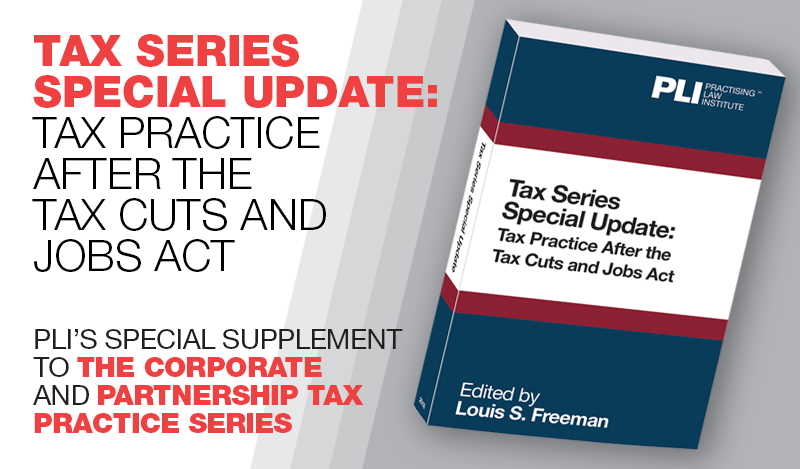 Following the passage of the Tax Cuts and Jobs Act, we felt it was important to provide you with a resource analyzing some of the domestic and international implications of the tax reform package. The result is the
  Trial Handbook