Category Archives: PLI Press

Treatise Update: Post-Grant Proceedings Before the Patent Trial and Appeal Board

Post-Grant Proceedings Before the Patent Trial and Appeal Board guides readers through the process of initiating a post-grant proceeding, taking discovery, seeking sanctions, proposing and opposing claim amendments, effectively advocating at the oral hearing, appealing to the Federal Circuit, and handling a wide array of issues involving co-pending district court litigation.

Updates from Release #10 include:

  • In Chapter 2, the section on Claim construction discusses changes to the PTAB standard for petitions filed after November 13, 2018, from the broadest reasonable interpretation standard to the Phillips v. AWH Corp. standard used in civil actions and at the International Trade Commission. See § 2:5, at note 57.
  • In Chapter 3, a section on Standing—real party in interest discusses Applications in Internet Time, LLC v. RPX Corp., in which the Federal Circuit held that “the focus of the real-party-in-interest inquiry is on the patentability of the claims challenged in the IPR petition, bearing in mind who will benefit from having those claims canceled or invalidated.” See § 3:2.3[A], at note 46.
  • In Chapter 3, the section called Joinder discusses the first case to be taken up by the PTAB’s Precedential Opinion Panel, which determined that, under appropriate and limited circumstances, a petitioner may join its own previously instituted IPR to request joinder and institution of new issues (Proppant Express Investments, LLC v. Oren Technology, LLC). See § 3:6, at note 193.
  • In Chapter 8, Amendments to claims discusses the notice of proposed rulemaking put forth by the USPTO on October 21, 2019. See § 8:3.1, at note 99.
  • In Chapter 8, under the section Inter partes review—timelines, a new figure 8-1 depicts the anticipated trial flow of an inter partes review proceeding, depending on whether or not a second, revised motion to amend is filed by the patent owner. See § 8:3.1.
  • Chapter 14, Appeals to the Federal Circuit includes updated information on the number of PTO appeals filed in the CAFC. See § 14:1, at note 2.

Order your print copy today.

PLI PLUS subscribers can access this title through their subscription.
Treatise Update: Reinsurance Law

Reinsurance Law examines the intricacies of U.S. reinsurance law in the 21st century, giving readers a practical grasp of the purpose, benefits, markets, and costs of reinsurance; the features, operation, and risk-and-return characteristics of the full range of reinsurance products; state, federal, and international regulation of reinsurance; and a full understanding of resolving disputes in the industry. Enhanced with time-saving checklists and numerous sample clauses and sample agreements, this practical treatise covers federal and state law, industry standards, customs, practice—including the Utmost Good Faith and Follow-the-Fortunes doctrines—and relevant case law in clear, straightforward terms.

Highlights from Release #14 of Reinsurance Law include:

  • Chapter 3: A section on Implied Follow-the-Fortunes Provision addresses whether the follow-the-fortunes doctrine is implied in facultative reinsurance certificates when there is no express working to that effect (see section 3:3).
  • Chapter 3: A section on Reinsurer’s Obligation Regarding Supplemental Benefits Outside of the Applicable Limits of Liability discusses the Second Circuit decision in Utica Mutual Insurance Co. v. Clearwater Insurance Co., holding that the contracts required payment of expenses in addition to the stated liability limits in the facultative contracts. The ruling was based on form language in the contracts and the absence of language stating that the reinsurer’s liability would be “subject to” the stated limits of liability (see section 3:4).
  • Chapter 6: A section on Vacating or Modifying the Award explains how before an arbitrator is officially engaged to perform an arbitration, to ensure the parties’ acceptance of the arbitrator is informed, potential arbitrators must disclose their ownership interests, if any, and the arbitration organizations with whom they are affiliated in connection with the arbitration and those organizations’ nontrivial business dealings with the parties to the arbitration (see section 6:9.2).

Order your print copy today.

PLI PLUS subscribers can access this title through their subscription.
Treatise Update: Stocker on Drawing Wills and Trusts

Stocker on Drawing Wills and Trusts (Fourteenth Edition) is a vital planning tool for estates, trusts, and tax planning specialists and any general practitioner involved in crafting wills, trusts or other estate planning documents.

For more than 50 years, attorneys and estate planners have relied on this essential treatise to provide high-quality, comprehensive, field-tested drafting guidance that ensures wills, trusts and other estate planning documents fully express clients’ wishes without provoking costly legal challenges.

Enhanced by hundreds of labor-saving sample forms and clauses, this title provides guidance on how to help clients capitalize on the full range of tax-saving and non-tax opportunities.

Highlights of Release #4 include:

  • Chapter 5: Estate Tax and Planning for the Applicable Credit Amount is updated to discuss the inflation adjusted numbers issued by the Service for 2020, and provides updated figures for transfer tax rates, exemption amounts, and the total (federal and state) estate tax top rate.
  • Chapter 6, Section 4.3[F]: Gift Tax on QTIP Property is updated to explain that a major pitfall for QTIP planning is the surviving spouse’s gifting of a QTIP income interest.
  • Chapter 10, Section 10: Income Tax Planning for Other Considerations is expanded to examine changes to the Kiddie Tax for taxable years 2018–2025, during which the child’s unearned income will be taxed at the ordinary and capital gains rates applicable to trusts and estates.

Order your print copy today.

PLI PLUS subscribers can access this title through their subscription.

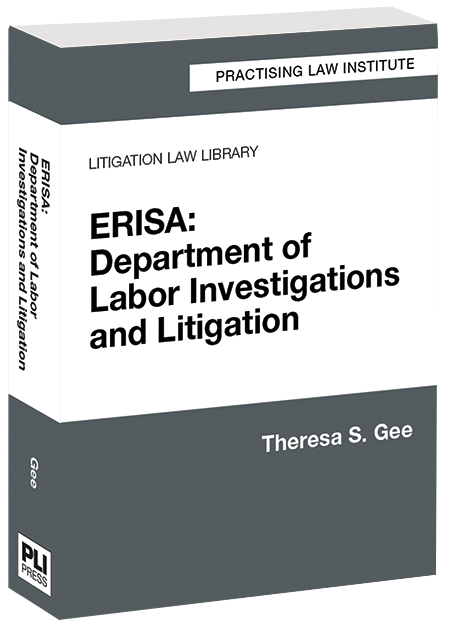
New Title! ERISA: Department of Labor Investigations and Litigation

PLI Press is excited to announce the publication of ERISA: Department of Labor Investigations and Litigation, a new treatise focusing on the Department of Labor’s civil enforcement authority and litigation under the Employee Retirement Income Security Act (ERISA).

This new publication has two primary functions: (1) to serve as a reference guide to the Department’s regulations and informal guidance, and (2) to be a resource for the Department’s views on ERISA fiduciary responsibilities as expressed in litigation by highlighting key cases.

The book examines cases brought by the Department directly as the plaintiff or amicus and how its views have been received by the courts. Cases involving private litigants generally are not discussed but are briefly mentioned if they are particularly significant, such as Supreme Court decisions or key lower court opinions. The primary exception concerns the Department’s amicus curiae briefs, which are filed in private party litigation and touch on significant or novel issues before the Supreme Court and circuit courts across the country.

As much of the Department’s enforcement and litigation has focused on pension plans, so does this book, along with an overview of health plan investigations, enforcement, and litigation, including under ERISA Part 7 and the Affordable Care Act. There is also a short discussion of the Department’s criminal enforcement program, as well as a discussion of the impact of the fiduciary, or conflict of interest, rule on the financial services industry and related litigation.

Order your print copy today.

PLI PLUS subscribers can access this title through their subscription.

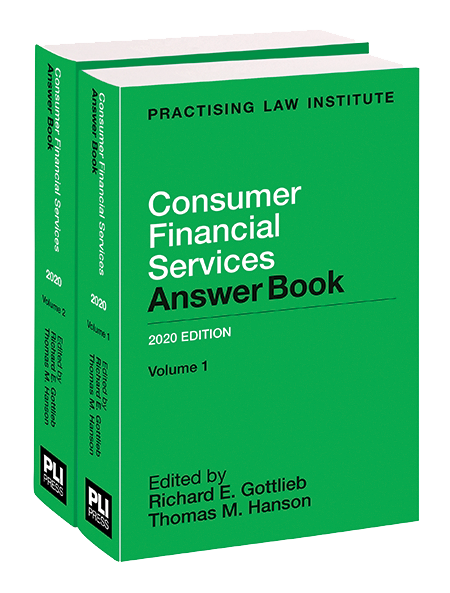
New Edition! Consumer Financial Services Answer Book

Consumer Financial Services Answer Book (2020 Edition), written in a clear and accessible Q&A format, provides financial service lawyers and compliance professionals with the practical guidance needed to fully understand and comply with the various laws governing consumer financial services.

This comprehensive guide includes contributions from the well-regarded consumer financial services teams at three law firms—Manatt, Phelps & Phillips, LLP; McGlinchey Stafford; and Dykema Gosset PLLC—as well as from other prominent practitioners.

Highlights from the 2020 edition:

  • Comprehensive coverage of key governing statutes and regulations, including the all-important Title X of the Dodd-Frank Wall Street Reform and Consumer Protection Act, as well as the core federal laws affecting consumer lending, such as the Truth in Lending Act, the Fair Credit Reporting Act, the Equal Credit Opportunity Act, the Fair Credit Billing Act, and the Fair Debt Collection Practices Act.
  • A chapter on CFPB enforcement answers questions about the Bureau of Consumer Financial Protection, explaining the structure of the Office of Enforcement, the scope of its authority, the procedures it follows in enforcement investigations and action, and the nature of its enforcement activity to date.
  • Detailed discussions of the Electronic Signatures in Global and National Commerce Act (ESIGN), the Telephone Consumer Protection Act, and the laws governing unfair and deceptive acts and practices.
  • Chapters dedicated to a variety of specific consumer finance industries, including mortgage lending and servicing, automotive finance, the credit card industry, military lending and loan relief, and short-term lending.

Order your print copy today. 

PLI PLUS subscribers can access this title through their subscription. 

What’s New in PLI PLUS

We add content to PLI PLUS every month to ensure our subscribers have access to the most up-to-date and relevant secondary source legal documents.  Renowned legal experts regularly update our acclaimed treatises, Course Handbooks, Answer Books, transcripts and forms to reflect recent changes and developments in the law.

Click here to see what we added in February!

Treatise Update: International Tax & Estate Planning

International Tax & Estate Planning: A Practical Guide for Multinational Investors (Third Edition) presents the clear and practical approach of a person who deals with private wealth, its management and its disposition. In it, one of the nation’s leading multinational investment authorities shows you how to: capitalize on tax-advantaged strategies, protect investments against government expropriation, nationalization, or other extraordinary events, draft problem-free wills and trust documents that secure clients’ interests, and avoid errors in an era of increased regulatory oversight, conflicts of law, and greater demands for financial disclosure.

This title is an indispensable resource for lawyers, private bankers (both investment and commercial), corporate personnel of multinational corporations, accountants, and investment advisers.

This latest release updates the text with the practical information that enables multinational investors (and those who advise them) to protect investments, minimize taxation, maintain confidentiality, and assure proper disposition of assets upon an investor’s death.

A completely revised Chapter 5: Sovereign Risks, Expropriation, and the Act of State Doctrine, explores topics including: what constitutes just compensation; the Foreign Account Tax Compliance Act and Common Reporting Standard; sanctions imposed by the United States on Iran, Russia, North Korea, Venezuela, and Cuba; and questions that can be used to determine whether a constructive taking has occurred.

This essential treatise is available on PLI PLUS. If you would like to order a print copy, please contact libraryrelations@pli.edu.

Treatise Update! Directors’ and Officers’ Liability: Current Law, Recent Developments, Emerging Issues (Third Edition)

Directors’ and Officers’ Liability provides a cutting edge, straightforward explanation of the obligations of directors and officers of public companies, the penalties that they face if they fail to meet their obligations, and the protections that are offered them under the law or by agreement. This treatise for corporate counsel, private practitioners, and for directors and officers themselves guides readers through the essentials of the current law, recent developments, and emerging issues of directors’ and officers’ liability.  This title covers the sources of law governing the duties of directors and officers; the key facets of board committees; the duties of directors and officers under state corporate law and federal and state securities laws; private civil actions and public enforcement; exculpation, indemnity, and insurance; cybersecurity; contested mergers and acquisitions; Securities Act suits filed in state court; special issues in pharma and biotech; and more.

The highlights for the latest release for Directors’ and Officers’ Liability  include:

  • Emerging Issues: A Revival of Caremark Claims. Two recent decisions, one issued by the Delaware Supreme Court in June 2019 and another issued by the Delaware Court of Chancery in October 2019, herald what might be a new era of shareholders asserting Caremark claims, breach of the duty of loyalty by a failure of oversight, and those claims surviving motions to dismiss. See new section 8:7 and section 3:3.14 for a review of Caremark and analysis of Marchand v. Barnhill and In re Clovis Oncology, Inc. Derivative Litigation.
  • Federal Forum Exclusive Venue Provisions for Securities Act Claims. In Sciabacucchi v. Salzberg, the Delaware Court of Chancery held that company charter provisions stating that federal courts shall be the exclusive forum for Securities Act class action claims are invalid. See new section 1:4.2 for a history and analysis of jurisdiction over securities class actions under the PSLRA, SLUSA, and the latest Delaware cases.

This essential treatise is available on PLI PLUS.  If you would like to order a print copy, please contact libraryrelations@pli.edu.

What’s New in PLI PLUS

We add content to PLI PLUS every month to ensure our subscribers have access to the most up-to-date and relevant secondary source legal documents.  Renowned legal experts regularly update our acclaimed treatises, Course Handbooks, Answer Books, transcripts and forms to reflect recent changes and developments in the law.

Click here to see what we added in January!

Treatise Update: Initial Public Offerings: A Practical Guide to Going Public (Second Edition)

Providing expert guidance on how to create a winning IPO, Initial Public Offerings: A Practical Guide to Going Public (Second Edition), is packed with best practices, planning tips, checklists and sample documents to help implements its guidance.  Numerous developments—originating from the SEC, FINRA, Congress, and the private sector—continue to shape the IPO landscape. Completely revised and expanded, this latest release (release #7) addresses key changes in legal requirements and market practices of critical interest to IPO companies, lawyers, and market professionals alike.

The latest release for Initial Public Offerings updates many chapters, some of which include:

Among the new developments covered in this release are:

  • Updated IPO market statistics and outlook, including IPO company metrics (see §§ 1:5 and 21:2 to 21:6, Figures 1-3 to 1-8, and Appendix 20C).
  • Pre-IPO fundraising, including updated discussion of initial coin offerings (see § 2:8.1[I]) and updated market statistics on the use of various other financing techniques (see § 2:8).
  • ­Equity compensation, including updated market data on the terms and size of stock incentive plans (see § 2:6.3[B]) and employee stock purchase plans (see § 4:7); and updated discussion of the tax deferral opportunity presented by section 83(i) of the Internal Revenue Code (see§ 8:4.4).
  • Updated discussion of estate planning for pre-IPO company executives (see § 8:5).
  • EGC considerations, including updated adoption rates (by company industry) for key items of relief available to EGCs (see Table 10-2).
  • Quiet period updates, including the SEC’s proposal to allow any company to engage in “test-the-waters” communications with eligible institutional investors in connection with any registered securities offering (see §§ 11:2.2[E] and 18:8.1) and new examples of quiet-period concerns in IPOs and direct listings (see § 11:3.3[B]).
  • Form S-1 preparation, including updated discussion of disclosure requirements and illustrative SEC comments (see § 13:2.1), updated prospectus data (see § 13:2.2), and a description of the SEC’s new streamlined procedures for obtaining confidential treatment of eligible portions of material contracts (see §§ 13:2.4 and 16:7).
  • SEC review, including a summary of the realignment of Corp Fin’s disclosure review program (see § 17:2.2) and updated statistics on the nature and timing of SEC comments on Form S-1 filings (see § 17:3.7, Table 17-3, and Table 17-4).
  • Public company reporting developments, including updated disclosure requirements and proposed changes to the tests for accelerated filer and large accelerated filer status (see §§ 22:2.1, 22:2.2, and 22:2.3), and recent and proposed rule amendments as part of the SEC staff’s ongoing disclosure effectiveness initiative (see § 22:2.5).

This essential treatise is available on PLI PLUS.  If you would like to order a print copy, please contact libraryrelations@pli.edu