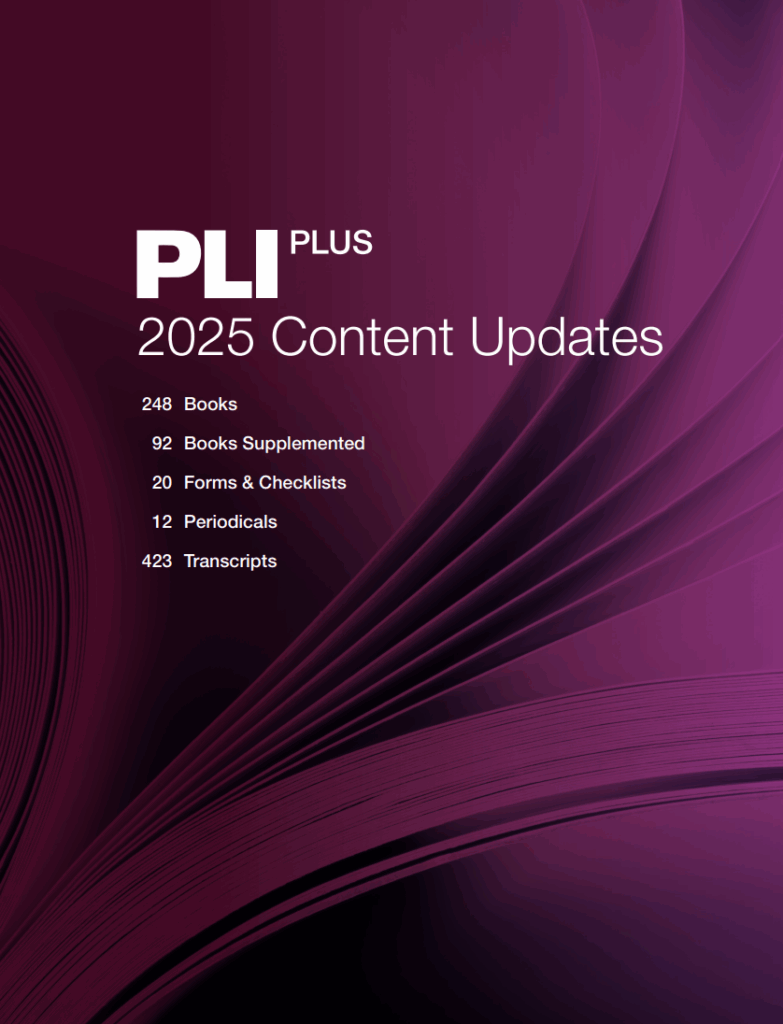
Click the image below for a full roundup of all the titles (with links!) added to PLI PLUS in 2025.
Category Archives: PLI Press
Book Update: Fintech, Regtech, and the Financial Services Industry

Fintech, Regtech, and the Financial Services Industry analyzes the developments taking place within the financial services industry and spotlights the opportunities they bring to the marketplace, while also highlighting the emerging regulatory framework. This newly supplemented treatise follows the development of fintech, regtech, and suptech, discussing revolutionary innovations within the financial services industry as a whole.
Highlights include:
- Chapter 2, Fintech Jurisdictional Issues, details the joint statements by the SEC and CFTC about streamlining oversight as markets converge and launching initiatives for cross-agency crypto trading; it also covers the “GENIUS” Act enacted into law on July 18, 2025
- Chapter 3A, Artificial Intelligence in the Securities Industry,highlights key U.S. regulatory developments on AI, such as the FINRA Regulatory Notice 24-09, the March 2025 roundtable on AI, the 2025 FINRA Annual Regulatory Oversight Report, and the December 2024 U.S. Department of Treasury report covering AI risks and opportunities
- Chapter 5, Regulation of Digital Advisers, analyzes the SEC’s Internet Adviser Exemption under Investment Advisers Act Rule 203A-2(e), which allows advisers offering services through digital platforms to register federally, even lacking sufficient assets (Section 5:4.1)
- Chapter 8, Financial Technology Platforms, examines the Latham & Watkins No-Action Letter from March 12, 2025, which confirms issuers under Rule 506(c) may use investor self-certification for accredited status when investing equal to or above a minimum amount (Section 8:2.1[B])
- Chapter 8B, Blockchain and Digital Assets, provides extensive updates to the chapter, including coverage of regulatory developments on digital asset securities and the GENIUS Act (Section 8B:6.1 and 8B:7.3[A])
- Chapter 12A, Privacy Laws Applicable to Fintech Companies, outlines new discussion of the Personal Financial Data Rights final rule, also known as the “Open Banking Rule”, issued by the Consumer Financial Protection Bureau on October 22, 2024, as well as updated coverage of state comprehensive privacy laws (Section 12A:7 and 12A:8.2)
- Chapter 14, Regulation SCI and Trends in IT and Cybersecurity Regulation, Compliance, and Enforcement, discusses the SEC’s May 2024 Regulations S-P Amendments and provides an update on the 2024 Intercontinental Exchange settlement for Regulation SCI violations (Section 14:3.6[A][1] and 14:5.2[I])
- Chapter 15, Big Data and Artificial Intelligence: Legal and Compliance Considerations for Investment Managers, covers evolving AI regulations, including the current administration’s AI action plan, the EU AI Act, state laws, and voluntary guidance from NIST and ISO (Section 15:5.5[A], 15:5.5[D], 15:5.5[H] and 15:5.5[I])
- Chapter 21, Financial Services Firms’ Use of Data Analytics and Technology in Compliance, provides an updated analysis of regulators’ expectations for compliance technology with SEC and FINRA enforcement actions and a review of the developing jurisdictional regulatory landscape for AI in financial services. This chapter also provides guidance on AI compliance opportunities and risks, expanding the previous best practices discussion to include recordkeeping challenges, third-party vendors, and outlines a phased approach to deploying AI tools (Section 21:2.2, 21:2.3, 21:3.6, 21:3.7, 21:3.8)
- Chapter 22, Regulators’ Use of Data Analytics, includes a new discussion outlining the trajectory of the SEC’s position on deploying AI tools in its regulatory mission (Section 22:3.6)
- The Table of Authorities and Index have been updated
Order a print copy today.
Corporate Valuation in Mergers and Acquisitions

Corporate Valuation in Mergers and Acquisitions, by the incomparable Sam Thompson, provides foundational perspectives regarding legal, finance, accounting, and economic aspects of valuation in merger and acquisition (M&A) transactions. This newly supplemented treatise (December 2025) serves as a guide for lawyers examining the roles of investment bankers, valuation experts, and the courts in valuing targets.
Highlights of this second release include:
- A new chapter, Chapter 21, A Brief Introduction to Cryptocurrency and the Valuation of Cryptocurrency in M&A and Related Transactions.
- A new chapter, Chapter 22, A Brief Introduction to the Impact of Artificial Intelligence (AI) in Valuation of Companies Engaged in M&A, introduces valuation-related AI and its emerging issues.
- An analysis of the newly issued “International Valuation Standards Council’s 2025, International Valuation Standards” (Section 1:13)
- An updated section introducing “Professor Damodaran’s Discussion of the Hurdle Rate in a February 2025 ‘Musings on Markets’ Post” (Section 11:9.5)
- A new section titled “A Brief Introduction to the Impact of Tariffs on Valuation” (Section 20:11)
Order a print copy today.
Book Update: Fragomen on Immigration Fundamentals: A Guide to Law and Practice (Fifth Edition)

Fragomen on Immigration Fundamentals: A Guide to Law and Practice (Fifth Edition) provides readers with in-depth coverage relating to the rules, policies, and procedures of immigration law in the United States. This treatise features guidance for both general practitioners and seasoned immigration attorneys, supplemented with legal analysis of recent cases, policies, and rules.
Highlights include:
- Chapter 1, The Basic Immigration Structure, covers a range of recent executive actions that the Trump administration has issued to address border security (Section 1:3.6)
- Chapter 2, Employment-Based Immigration, includes an update on the June 2025 proclamation limiting visa and travel restrictions for the nationals of nineteen countries (Section 2:10.5[D][6])
- Chapter 3, Family-Sponsored Immigration, provides an update regarding the USCIS’s decision to return to an earlier policy determining children’s age-out protections (Section 3:3.4[A])
- Chapter 5, Nonimmigrants, features the June 2025 State Department cable requiring enhanced screening and vetting of social media for visa applicants of F and M students, as well as J exchange visitors. It also covers ICE’s termination of SEVIS records for thousands of students during the spring of 2025 (Section 5:1.2[D] and 5:8.4[D])
- Chapter 12, Citizenship, details the Supreme Court’s recent partial stay of 3 district court nationwide injunctions which blocked implementation of an executive order that limits birthright citizenship for certain children born in the United States after February 19, 2025. This chapter also covers the Court’s ruling on the legality of nationwide injunctions in general. (Section 12:2.1[C])
Order a print copy today.
Don’t Miss PLI’s End of Year Sale!

Browse our collection today and save big now through the end of December!

Copyright Law: A Practitioner’s Guide (Second Edition)

Copyright Law: A Practitioner’s Guide (Second Edition) serves as a crucial reference guide for general practitioners, in-house counsel, and any other professionals who may require quick and effective answers to copyright questions. This treatise provides a current analysis of court cases and a methodical approach to copyright law.
Highlights of the new edition include:
- Clarification of the copyrightability of AI-generated content pursuant to the Copyright Office’s 2025 report (Section 2:7.5)
- Examination of three separate district court rulings in Delaware and California regarding an AI developer’s use of copyrighted material and whether it was deemed fair use (Section 8:1)
- A ruling by the Second Circuit on a nonprofit organization’s distribution of books online and its eschewal of fair use (Section 8:4.2[A])
- A finding by a California district court that the sale of a social media platform’s public data and its preemption by the Copyright Act (Section 11:3.4[C])
- Coverage of the “simple measures” test by the Fifth Circuit in a case upholding the liability of an internet service provider in failing to halt infringement (Section 11:8.3[B])
- Updates to the Table of Authorities and Index
Order a print copy today.
Don’t Miss PLI’s End of Year Sale!

Browse our collection today and save big now through the end of December!
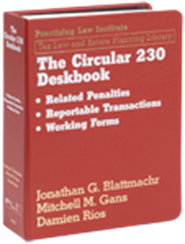
Book Update: The Circular 230 Deskbook: Related Penalties, Reportable Transactions, Working Forms

The Circular 230 Deskbook is an essential compliance resource for every tax professional who practices before the IRS, helping practitioners comply with complex Circular 230 amendments more easily — and avoid costly penalties and sanctions. This 39th release to The Circular 230 Deskbook updates the practice guide with the latest developments in tax and estate law relating to IRS Circular 230.
Highlights of Release #39 include the following:
- Chapter 1, Deference: When the Court Must Yield to the Government’s Interpretation, discusses the “change-in-position doctrine”; the effect of Loper Bright on the invocation of stare decisis and the power of section 7805 to delegate discretion; and other continuing issues arising from the overturning of Chevron.
- Updated Appendix AA, Table of Authorities, and Index.
Order a print copy today.
PLI PLUS subscribers can access this title through their subscription.

Book Update: Commercial Ground Leases (Fourth Edition)

Commercial Ground Leases is a practical guide for creating fair and accurate lease agreements between landlords and tenants. It explains key topics such as lease terms, property use, and occupancy rights. This seventh release of Commercial Ground Leases is updated with the latest developments in the law and practice of ground leases.
Highlights of Release #7 include:
- Chapter 1, The Truth About Ground Leases, includes new material on duty of care and duty of loyalty (Section 1:3.5).
- Chapter 4, Reappraisal of Ground Rents, includes a new case study on “highest and best use” and financial feasibility, in which the Seattle Public Schools leased the site of a former school for a shopping mall (Section 4:1.3).
- Chapter 9, Bankruptcy, includes new material on letters of credit (LOCs) (Section 9:3.2[B]).
- Chapter 19, Default and Redemption, Section 19:1 has been renamed “Default: A User’s Guide,” and has been expanded to cover the practical aspects of default from the perspective of a leasehold lender, a landlord, and a tenant.
- Chapter 24, Arbitration and Mediation, includes new material on MAI appraisers (Section 24:3).
- The Table of Authorities and the Index have been updated.
Order a print copy today.
PLI PLUS subscribers can access this title through their subscription.

New Title: Artificial Intelligence & Intellectual Property

PLI Press is proud to announce the publication the brand-new treatise Artificial Intelligence & Intellectual Property.
Over the past decade, artificial intelligence (AI) technologies have rapidly evolved from experimental curiosities to pivotal drivers of innovation, creativity, and economic growth. In fields ranging from healthcare to entertainment, AI systems are generating outputs that challenge traditional notions of authorship, inventorship, ownership, and liability. Today, legal practitioners, scholars, businesses, and governments worldwide are grappling with profound questions: Does AI-generated work qualify for copyright protection? Can an algorithm be considered an “inventor” under patent law? How do we protect data when AI systems rely on massive datasets? Who is held responsible when AI-based decisions infringe on IP rights or cause tangible harm?
Artificial Intelligence & Intellectual Property provides an authoritative, yet accessible, resource for those navigating these uncharted legal waters. AI & IP explores the intersection of AI and every branch of intellectual property, offering insights that can guide future legal reasoning, policy making, and practical decision making.
A team of experts addresses a wide range of topics, including:
- Copyright and AI
- Patents and AI
- Trade Secrets and AI
- Trademarks and AI
- Privacy Regulations Applied to AI Technologies
- Right of Publicity and Personality with AI
- AI and Defamation
- Liability Issues Arising with the Use of AI
- Ethical Considerations and AI
- The Future of AI and IP Law
Each chapter can stand alone for a focused dive into its specific area, but taken together, they form a cohesive examination of the ethical, legal, and practical dilemmas that AI brings.
Order a print copy today.
PLI PLUS subscribers can access this title through their subscription.