Business Taxation Deskbook is a guide to the fundamental principles governing the federal income tax treatment of domestic and international business transactions involving the organization, operation, and disposition of the four principal forms of business entity.
The Deskbook includes important coverage of the dramatic changes for businesses made by the Tax Cuts and Jobs Act of 2017 (TCAJA). It also looks at the federal income tax treatment of both inbound and outbound cross-border transactions and provides a basic introduction to state law issues in business taxation.
This book is designed to provide an introduction to the basic principles of business taxation and not to be the “last word” on any of these highly complex topics.
Net Leases and
Sale – Leasebacks: A Guide to Legal, Tax and Accounting Strategies covers
every aspect of the ownership, financing, documentation, taxation, and
accounting for net leases and sale-leasebacks, focusing on those areas where
the treatment of net leases and sale-leasebacks differs from the treatment of
other forms of real estate investment.
Authored by specialist Ken
Miller, this softbound guide, which assumes some basic understanding of the law
and practice of real estate acquisitions, provides a detailed discussion of the
important concepts underlying real estate investment transactions, as well as a
clause-by-clause explanation of the mandatory and optional provisions of a net
lease investment agreement.
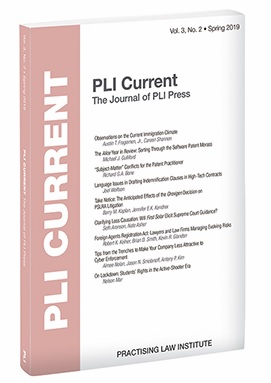
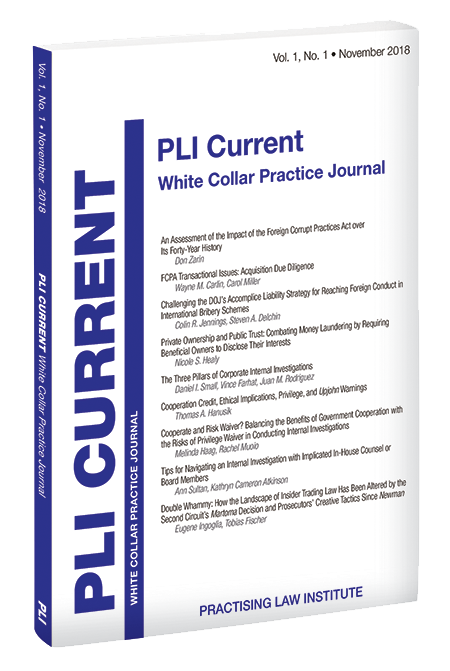
PLI Press publishes two journals–PLI Current: The Journal of PLI Press and PLI Current: White Collar Practice Journal. This page contains descriptions of each of these journals, as well as information on journal subscriptions.
PLI Current: The Journal of PLI Press is published quarterly and is available in print and online.
PLI Current: The Journal of PLI Press is a quarterly legal journal published by PLI Press and dedicated to providing timely and relevant analysis, insight, and commentary on topics of interest to practicing attorneys and others in the legal profession across a range of practice and interest areas. This journal contains original articles authored by practicing attorneys, including PLI authors and program faculty, as well as judges, scholars, and other professionals in the legal field with expertise in a given practice area or areas.
Print subscriptions include four issues for $300.00. Orders can be placed at www.pli.edu/PLICurrent. Online subscriptions include four issues per year as well as access to all back issues. Orders can be placed by emailing PLUS@pli.edu.
********
PLI Current: White Collar Practice Journal is published at least twice annually and is available in print and online.
PLI Current: White Collar Practice Journal is a legal journal that focuses on white collar/financial crimes and related matters. This journal contains original articles authored by practicing attorneys, including PLI authors and program faculty, as well as judges, scholars, and other professionals in the legal field with expertise in a given practice area or areas.
Print subscriptions include two issues for $249.00 per year. Orders can be placed at www.pli.edu/PLICurrentWC. Online subscriptions include two issues per year as well as access to all back issues. Orders can be placed by emailing PLUS@pli.edu.
For information on purchasing individual print issues, discounts for students and educational institutions, enterprise-wide subscriptions, and any other inquiries, email PLUS@pli.edu.
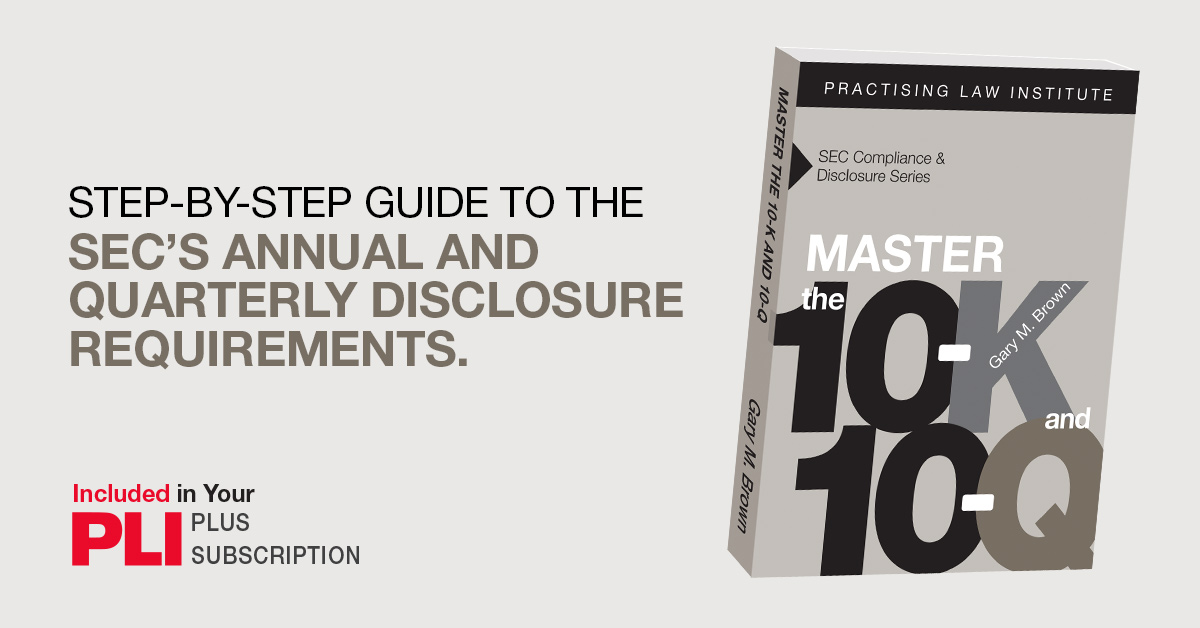
The second in our SEC Compliance & Disclosure Series, Master the 10-K
and 10-Q is your guide to preparing and filing the SEC’s annual Form 10-K
and quarterly Form 10-Q, as required by the Exchange Act of 1934. Like its
counterpart Master
the 8-K, this step-by-step guide draws on the expertise of author Gary M.
Brown to deliver clear coverage that highlights areas in which your company can
implement or refine its disclosure controls and procedures in order to ensure
accurate and timely filings. Key topics include:
Filing procedures and deadlines
Signature and certification requirements
Filing extensions
The impact of late filings
The “furnished” versus “filed” distinction
Technical aspects of incorporation by reference
Special rules for asset-backed issuers
Exhibit requirements
This standalone guide provides detailed analysis of both
forms, as well as their related potential disclosure items, and is enhanced
with compliance practice pointers and more than a dozen appendices containing
related forms, regulations, and SEC guidance – everything you need to Master the 10-K
and 10-Q.
Friedman on Leases
is widely regarded as the leading authority on commercial real estate leasing,
recognized for its unsurpassed
comprehensive and practical instruction, as well as its extensive
and balanced coverage of the
full range of tenant and landlord concerns. The updated Friedman on
Leases, Sixth Edition continues to deliver not only the foundational
knowledge required by novice practitioners, but also analysis of and insight
into the most current and relevant developments facing seasoned practitioners
in the commercial real estate field.
Highlights of this Release #6
include the following:
Sample Provisions; Determination of Cancellation Fee. New sample provision to determine the Cancellation Fee. (See Chapter 22. Option to Cancel Lease section 22:5.5)
Case Developments. Includes the latest developments in the following areas:
Interruption of Services. If a tenant can establish that the interruption of services has caused a constructive eviction of tenant, most courts have allowed tenants to plead constructive eviction as a defense to a non-payment of rent action (see Chapter 12. Landlord’s Services section 12:2);
Tenant’s Retention of Possession After End of Lease: Liability for Damages. A tenant may be found to have retained constructive possession of the premises, giving rise to a holdover tenancy, by failing to remove fixtures or improvements as required to restore the premises (see Chapter 18. Termination of Lease section 18:2);
Effect of Bankruptcy on Landlord’s Remedies for Default; Claims for Damages. In finding that the damages cap in section 502(b)(6) does not apply to damages for waste, trespass, or nuisance, the Ninth Circuit Court of Appeals proposed a test to resolve the question of application of the cap, which test has been adapted by some jurisdictions (see Chapter 20. Tenant Bankruptcy section 20:6.3); and
Mechanics’ Lien. The New York Court of Appeals held that consent for purposes of the Lien Law can be inferred from lease terms, and no express consent or privity between landlord and contractor is required (see Chapter 23. Alterations and Improvements by Tenant section 23:9).
This essential treatise is
available on PLI PLUS. If you would like to
order a print copy, please contact libraryrelations@pli.edu.
Legal Guide to the
Business of Marijuana is a unique resource for lawyers who represent
clients in what has been called the fastest growing industry in the United
States. Many states now allow medical and/or recreational use of marijuana, but
it remains illegal under the federal Controlled Substances Act. As a result,
marijuana enterprises must operate in a legal and regulatory environment of
uncertainty and rapid change, and lawyers representing these enterprises must
tread carefully when advising clients.
Written by James T. O’Reilly, a lawyer and public health
specialist, Legal
Guide to the Business of Marijuana offers critical guidance to help lawyers
effectively represent their clients while steering clear of seen and as yet
unseen perils implicit in the continued federal-state conflict. Highlights of
the 2019 Edition include:
Discussion and summary of the new laws in Michigan, Missouri, Oklahoma and Utah, the latest states to enact some form of legalization.
Coverage of the Agriculture Improvement Act of 2018 (the “2018 Farm Bill”), which legalized production of hemp nationwide while also retaining the regulatory power of the FDA over CBD products derived from hemp.
Updated state-by-state Appendix of cannabis-related statutes, regulation, and court cases
This essential treatise is available on PLI PLUS. If you would like to order a print copy,
please contact libraryrelations@pli.edu.
Covering on the of most dynamic and rapidly changing sectors of the asset management industry, Hedge Fund Regulation (Second Edition) is designed to provide comprehensive understanding of hedge funds. It provides a single source that examines all aspects of these innovative investment vehicles and addresses current regulatory concerns that impact hedge funds, their managers and investors. Hedge Fund Regulation is updated regularly by its author to keep current with regulatory and enforcement developments. The latest release addresses current issues in structuring, launching, and operating a hedge fund.
Highlights of Release #13 include: • Chapter 9, Privacy Regulations. Revises discussion on the management of cybersecurity risks by commodity pool operators and commodity trading advisors to reflect recent updated guidance from the National Futures Association. See section 9:6.2. • Chapter 14, Books and Records. Discussion of recent SEC Risk Alert highlighting practices that can assist an investment adviser in meeting its obligations under the SEC’s Books and Records Rule and Compliance Rule with respect to the increasing use of electronic communications. See section 14:2. • Chapter 18, Commodity Pool Operators and Commodity Trading Advisers. New section 18:5.2, Internal Controls System, covering the NFA requirement for commodity pool operators to implement an internal controls system designed to protect operators to implement an internal controls system designed to protect customer funds, maintain accurate financial books and records, and assure compliance with NFA and CFTC requirements. • Chapter 23, Broker-Dealer Status and Relationships. Revised section 23:4, Best Execution, to include discussion of recently adopted revisions to Exchange Act Rules 600 and 606 regarding broker-dealer disclosure obligations on their handling of institutional orders and its implications for investment adviser best execution analysis. • Chapter 24, Disclosures of Market Participation. Revisions to discussion of Hart-Scott-Rodino Act (HSR Act) compliance, including updated HSR Act thresholds. See section 24:7.
This treatise is available on PLI PLUS. If you would like to order a print copy, please contact libraryrelations@pli.edu.
Holtzchue on Real Estate Contracts and Closings: A Step-by-Step Guide to Buying and Selling Real Estate (Third Edition) provides thorough legal, technical, strategic guidance to help implement dispute-free residential and commercial deals more quickly and easily. Featuring checklists, highlighted practice tips, and dozens of useful forms, this treatise is a valuable step-by-step “how to” guide that ensures practitioners can successfully prepare for a sale or purchase of real estate.
Release #21 includes new and updated cases and other authority throughout the text, including in the following important areas:
Attorney Malpractice: New section collects malpractice cases (see Front Matter at “Ethics and Professional Responsibility,” section [10]).
Acceptable Title and Title Insurance: Where the N.Y. Appellate Division reversed annulment of Insurance Regulation 208, which prohibited title insurance corporations and title agents from providing any marketing payments or entertainments to attorneys, but affirmed annulment of regulations on closer fees and ancillary fee caps.
Closing Date and Place: Recent cases where the contract expressly states that time is of the essence (see section 2:2.9).
Condition of Premises and Caveat Emptor: Recent cases on affirmative representation on mold and Property Condition Disclosure Statement regarding water damage (see section 2:2.11[A][2]).
NYSBA Ethics Opinions: NYSBA Ethics Opinion 1161, opining that when a lawyer prepares a contract of sale, the lawyer may not disclose the contract to the broker who requested a copy without the client’s informed consent (see section 1:1.2).
This treatise is available on PLI PLUS. If you would like to order a print copy, please contact libraryrelations@pli.edu.
Each edition of Employment Law Yearbook provides a comprehensive overview of the most important developments in employment law over the past year, including critical case decisions, legislative changes, government agency actions, and other events of interest to employers, employment and HR professionals, corporate attorneys, and employee advocates. Employment Law Yearbook 2019 details and analyzes recent legal developments, including:
California test for determining independent contractor status: The California Supreme Court has adopted a new test—the “ABC test”—to determine whether workers are to be classified as employees or independent contractors. Under this test, articulated in Dynamex Operations West v. Superior Court, workers are presumptively considered employees, but the employer may demonstrate a worker is more appropriately classified as an independent contractor if it proves all of several articulated factors. Chapter 1, Wage-and-Hour Issues, section 1:2.3[A], Independent Contractors.
Noncompete agreements: In August 2018, Massachusetts enacted a law that places limitations on noncompete agreements entered into on or after October 1, 2018. The law also adopts the Uniform Trade Secrets Act. Chapter 9, Guarding Trade Secrets, Section 9:3.1, Background.
New standard for evaluating facially neutral policies: In Boeing Co., the NLRB overturned the Lutheran Heritage “reasonably construe” standard and adopted a new balancing standard for evaluating facially neutral policies that potentially interfere with the exercise of section 7 rights. The NLRB delineated three categories of work rules based on the new standard. Chapter 11, Employee Blogging and Social Media, section 11:4.1[B][1], The New Standard of Reasonableness.
This treatise is available on PLI PLUS. If you would like to order a print copy, please contact libraryrelations@pli.edu.