Category Archives: PLI Press
Treatise Update! How to Write a Patent Application
PLI recently updated the acclaimed How to Write a Patent Application.
Stocked with drafting checklists and sample drafting language, documents, and drawings, the third edition of How to Write a Patent Application walks you step by step through the entire process of preparing patent applications.
In this release, the author expands and updates your treatise with
practical information on the following topics and more:
- Micro entity status: One commentator has suggested that micro entity status should never be claimed, because the costs will outweigh the benefits.
- Expanded Collaborative Search Pilot Program: This release describes the basic requirements to quality for the program, which results in an expedited first office action, but no further expedited examination.
- Patent agents: The Texas Supreme Court has recognized a patent agent–client privilege, although not all communications are protected (In re Silver).
- Patentable subject matter—preemption: In Return Mail, Inc. v. U.S. Postal Service, the Federal Circuit noted that the issue of whether a claim completely preempts others from entering the field plays a part in analysis of whether the invention is patentable subject matter. The absence of preemption supports a determination that a claim is patent eligible, but the absence of preemption does not necessarily save a claim.
- Indefiniteness—claims that are in two statutory classes: Claims that cover two statutory classes, such as a claim that covers both an apparatus and a method of using that apparatus, can be indefinite. However, using functional language to define the properties of an apparatus does not render the claims indefinite. According to the Federal Circuit, a claim that requires specific actions performed by the user rather than capabilities of the system is indefinite under 35 U.S.C. § 112 (MasterMine Software, Inc. v. Microsoft Corp.).
- Writing the specification—background section: The author contraststwo separate philosophies as to what should be included in the background section: One is to include substantially nothing; the other is to make a sales pitch.
- Design patent applications—cross-references: If appropriate, a design patent application can include a cross-reference section to related applications. The cross-reference section should also include any priority claim such as to previously filed design applications or even utility applications. However, a claim to a nonprovisional utility application cannot include a claim to priority of a provisional application from which the intermediate application claims priority.
- Software patent applications—writing a specification defining subject matter eligibility: To avoid a subject matter rejection under Alice Corp Pty. Ltd. v. CLS Bank International, it is desirable that the claims contain limitations that satisfy subject matter eligibility requirements, with support for the claims in the specification. Accordingly, the author offers six drafting suggestions for the specification.
- Biotechnology patent applications—presentation of nucleotide and amino acid sequences: Patent Office rules standardize the disclosure of nucleotide and amino acid sequences in biotechnology patent applications. The rules facilitate the examination and printing of detailed sequence information and do not alter the substantive requirements of the patent statute. Among other things, these rules require that all patent applications containing an unbranched sequence of four or more amino acids, or an unbranched sequence of ten or more nucleotides, contain a sequence listing. The sequence listing must be submitted in paper or compact disc form, as well as submitted in a computer-readable form (CRF) using standardized symbols and format. The rules are part of an international effort to facilitate the electronic transfer of sequence information for universal use.
- Foreign patent applications—broadening claims: Practitioners should be aware that, in Europe, once an application has been filed, it is very difficult to broaden a claim. Thus a claim directed to elements A, B, and C may not be broadened to include just A and B, even if the specification specifically reports such an option. Accordingly, it is desirable in a first filing in many foreign countries, including in the European Patent Office, to include very broad claims.
The updated treatise is available on PLI PLUS, our research database. If you’d like to order a print copy, please email libraryrelations@pli.edu or call 877.900.5291.

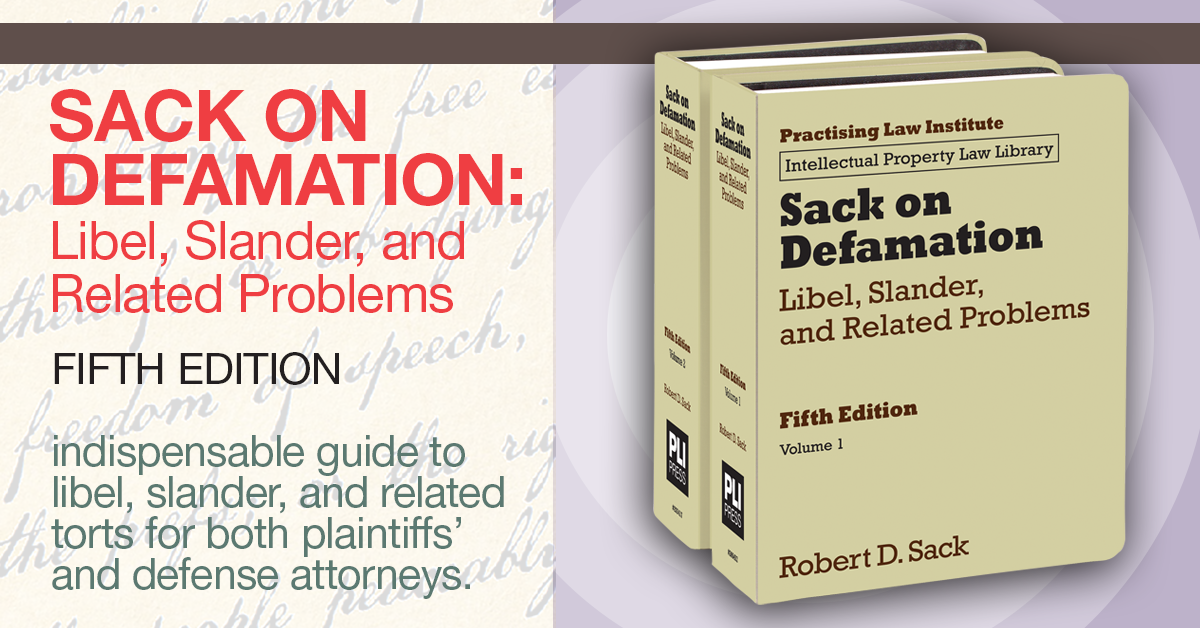
Treatise Update! Sack on Defamation
Written by a U.S. Court of Appeals judge and cited by courts throughout the United States–including by the U.S. Supreme Court–Sack on Defamation delivers definitive legal, strategic, and tactical insight into libel, slander, and other defamation-related causes of action for both plaintiffs’ and defense attorneys.
Highlights of the new release include:
• Context of allegedly defamatory statement: In McKee v. Cosby, the
plaintiff accused the defendant of defaming her in a letter by using her
published statements out of context. But the First Circuit, applying
Massachusetts law, concluded to the contrary, noting that the quotations
were “immediately followed by a hyperlink to the source article, allowing
readers to put [the plaintiff’s quoted] statements into proper context.”
• Defamation of groups and group members: In Elias v. Rolling Stone
LLC, the Second Circuit, applying New York law, held that it was error
to dismiss a defamation cause of action brought by a group of fifty-three
members of a college fraternity, based on a false published statement
by the defendant that some nine of the fraternity’s then members had
committed or participated in a rape at their fraternity house.
• Hepps doctrine—matters of public concern: The Texas Supreme Court,
in Brady v. Klentzman, has “recognized that even if the general subject
matter of a publication may be a matter of legitimate public concern,
some of the details may not be. But if a ‘logical nexus’ exists between
these details ‘and the general subject matter’ of the article, then they are
reasonably included as a matter of public concern.”
• Opinion—emojis and emoticons: Digital media may well give rise to
a new context in which to decide whether a statement is fact or opinion.
One can guess that emojis and emoticons will, by their nature, ordinarily
be treated as nonactionable opinion or commentary. See § 4:3.1[A], at
note 121.1.
• Public officials: Persons held to be public officials include the director of
budget and finance for a public school system; a former town clerk who,
as such, “had the primary responsibility for organizing and issuing the
payroll for the town”; and the deputy manager of a U.S. shuttle projects
office partially responsible for overseeing the development and operation
of the propulsion systems for the ill-fated Challenger shuttle.
• “Actual malice”—fictionalization: In Lovingood v. Discovery
Communications, Inc., a federal district court in Alabama found no
“actual malice” where a BBC docudrama broadcast under license by the
defendant contained an invented scene defamatory of the public-figure
plaintiff; “there is no evidence from which jurors could reasonably infer
that the . . . defendants had reason to doubt the accuracy of the scenes
in the . . . film or that the defendants’ failure to do more to investigate
the accuracy of the two scenes at issue evidences ‘an intent to avoid the
truth.’”
• Absolute privilege—statements to federal authorities: Statements to
federal officials may also be entitled to absolute privilege. For example,
in Mangold v. Analytic Services, Inc., a divided panel of the Fourth Circuit
held that statements made by a government contractor in the course of
the investigation of an Air Force colonel’s dealings with the contractor
were absolutely privileged. The court saw the privilege as analogous
to immunity for testimony in court, before a grand jury, and to public
prosecutors.
• Qualified privilege—charges of child sexual abuse: In Connecticut, by
statute, charges of child sexual abuse made to the Department of Children
and Families are entitled to qualified immunity.
• Damages: Although the courts continue to monitor and sometimes limit
damage awards, there are still large libel verdicts that survive appellate
review, as a number of multi-million-dollar cases demonstrate.
• Jurisdiction—New York long-arm statute: New York’s long-arm
statute includes exceptions that limit its application in defamation cases;
this favorable treatment of defendants in defamation cases has been held
by the Second Circuit, in a thorough opinion by Judge Walker, to be
constitutional, abridging neither the plaintiff’s First Amendment right to
petition nor his or her Fourteenth Amendment rights to equal protection
(Friedman v. Bloomberg L.P.).
• Texas Defamation Mitigation Act: In addition to its anti-SLAPP statute,
Texas has enacted the Defamation Mitigation Act, which requires a
prospective plaintiff to make a request of the prospective defendant for a
correction, clarification, or retraction of offending allegedly defamatory
material before bringing a defamation action, unless the defendant has
made such a correction, clarification, or retraction without such a request.
• Anti-SLAPP laws—Massachusetts, Maine: Recent cases interpret and
apply the anti-SLAPP statutes of Massachusetts (Blanchard v. Steward
Carney Hospital, Inc.) and Maine (Gaudette v. Mainely Media, LLC),
which are both aimed at protecting the constitutional right to petition,
rather than freedom of speech or of the press generally.
The updated treatise is available on PLI PLUS, our online research database. If you’d like to order a print copy, please email libraryrelations@pli.edu or call 877.900.5291.
New Title! Legal Guide to the Business of Marijuana
PLI recently published a new title, Legal Guide to the Business of Marijuana.
This title is a new and unique resource for lawyers who represent clients in what has been called the fastest growing industry in the United States. The majority of states have enacted laws legalizing medical marijuana — with nine states to date allowing for recreational use — but marijuana remains illegal under the Federal Controlled Substances Act, giving rise to constitutional challenges to these state laws under the doctrine of preemption. As a result, marijuana enterprises must operate in a legal and regulatory environment of uncertainty, and lawyers representing these enterprises must tread carefully when advising clients.
Written by James T. O’Reilly, a lawyer and public health specialist, Legal Guide to the Business of Marijuana offers critical guidance to help lawyers effectively represent their clients while steering clear of seen and as yet unseen perils implicit in the continued federal-state conflict. The guide provides discussion and analysis of:
• the complex and varying state regulation of medical and non-medical marijuana, including a survey of state cannabis laws, with summaries and citations
• federal law, enforcement, and preemption
• the various aspects of establishing and managing a marijuana enterprise, including the growing, licensing, labeling, transporting, and distribution of marijuana and related products
• the implications of preemption on employment, taxes, and banking
For lawyers new to representing marijuana clients, the author provides an understanding of the definitions of marijuana and other cannabis products, as well as a review of the policy and political issues that have led to the controversy and uncertainty of the current environment.
This essential new title is available on PLI PLUS, our online research database. If you’d like to order a print copy, please email libraryrelations@pli.edu or call 877.900.5291.

New Edition! Transfer Pricing Answer Book (2018 Edition)
PLI recently published the 2018 edition of Transfer Pricing Answer Book.
The phenomena of increasingly global business enterprises with valuable intangible property expose companies to transfer pricing enforcement by different countries around the world. Many of these countries are increasingly aggressive in enforcing their local transfer pricing rules, as they attempt to protect their tax revenue base. To avoid double taxation of the same income in this environment, companies often are required to deal with the highly specialized, bilateral treaty-based competent authority process developed to prevent double taxation at a time when trade mainly involved only two established countries. Even more challenging today, companies and tax authorities increasingly are faced with the potential for multiple taxation of the same income, as supply chains cross many borders and as the tax authorities of emerging countries become players in the global taxation process, and the resulting stresses, strains, and limitations of the bilateral treaty-based competent authority process have become more apparent.
In light of the high-dollar risks presented by the increased enforcement efforts of tax authorities worldwide, the complexity of the ever-changing, inherently uncertain transfer pricing standards, and the continually evolving business models of businesses adapting to the constantly changing global economy, companies need practical guidance to permit them to develop and defend their transfer pricing strategies.
Transfer Pricing Answer Book gives companies such guidance by discussing all aspects of transfer pricing, from initially planning a transfer pricing strategy, to alternative ways to defend the strategy from attack by two or more tax authorities, to resolving a case before competent authorities, to bringing a transfer pricing case to court. It also provides an overview of the IRS’s approach to transfer pricing enforcement. The book’s non-technical discussion is presented in a question-and-answer format that will appeal to readers regardless of their prior level of experience or familiarity with taxes in general and transfer pricing in particular.
Transfer Pricing Answer Book is an invaluable resource for company executives and their advisors who are seeking to better understand this important area of tax law–one that has become an important economic facet of so many businesses.
The new edition is available on PLI PLUS, our research database. If you’d like to order a print copy, please email libraryrelations@pli.edu or call 877.900.5291.

Treatise Update! Public Company Deskbook
PLI recently updated Public Company Deskbook: Complying with Federal Governance & Disclosure Requirements, which provides expert counsel on how to deal effectively with the overlapping legislative, regulatory and private initiatives to reform public company governance and disclosure practices over the past decade.
Highlights of Release #7 include:
• New Chapter 5G1 addressing the latest SEC guidance on
cybersecurity disclosure and related issues, including in respect of
disclosure controls and procedures and insider trading risks.
• Updates to Chapter 2K to reflect the proposed Nasdaq rule change
relating to shareholder approval of issuances over 20%.
• Updates to Chapter 3A to reflect adoption of the new audit standard
requiring discussion of “critical audit matters” in the auditor’s
report.
• Updates to Chapter 4B to reflect the 2017 tax reform legislation
amendments to section 162(m) of the Internal Revenue Code.
• Updates to Chapter 4F to address the latest SEC guidance on pay
ratio calculation and disclosure.
• Updates to Chapter 5F to reflect the revised NYSE requirements
relating to timely disclosure at the end of the trading day.
• Updates to Chapter 6B to reflect the U.S. Supreme Court’s recent
decision limiting Dodd-Frank Act whistleblower protections to
persons who actually communicated their tips to the SEC.
The updated treatise is available on PLI PLUS, our online research database. If you’d like to order a print copy, please email libraryrelations@pli.edu or call 877.900.5291.
Tax Series Special Update! Tax Practice After the Tax Cuts and Jobs Act
Following the passage of the Tax Cuts and Jobs Act, we felt it was important to provide you with a resource analyzing some of the domestic and international implications of the tax reform package. The result is the Tax Series Special Update, which contains new, original articles covering topics including:
• The impact of the Tax Cuts and Jobs Act on choice of entity
• Observations on M&A consequences
• Structuring and negotiating cross-border acquisitions
• Section 965 transition and repatriation tax on foreign based earnings
• New Section 245A DRD for foreign-source portion of dividends from specified foreign corporations
• Global intangible low-taxed income (“GILTI”)
• Foreign derived intangible income (”FDII”)
• Base erosion and anti-abuse tax (“BEAT”)
The Tax Series Special Update is available on PLI PLUS, our online research database. If you’d like to order a print copy, please email libraryrelations@pli.edu or call 877.900.5291.
Trial Handbook (Spring 2018) Now Available!
Trial Handbook is the one-stop resource you can trust for the planning, trial, and post-trial stages of litigation. Designed for quick reference in the courtroom, Trial Handbook is keyed to the Federal Rules of Evidence and focuses on the presentation of proof and the evidentiary problems faced by counsel.
Packed with practical checklists, charts, outlines, and sample jury selection questions, Trial Handbook gives you the knowledge and tools to:
- Develop solid trial briefs and strong case plans
- Prepare lay and expert witnesses and organize your exhibits more effectively
- Master voir dire to maximize your chances of getting the most sympathetic jurors
- Make a clear record at trial to aid jurors’ understanding of your case
- Build a rapport and your credibility with the jury throughout the trial
- Use opening statements to put your cases, clients, and proof in the most favorable light
- Give summations that blend evidence and issues to paint a thoroughly persuasive picture
- Exploit discovery materials at trial to get an additional edge
- Lay the proper foundation for various forms of evidence
- Capitalize on the powerful probative impact of visual aids at trial
- Apply proven direct examination and cross-examination techniques
- Use pretrial, trial, and post-trial motions to gain strategic advantages
- Draft clear, legally sound jury instructions that subtly sway judges
New to the Spring 2018 Edition are a discussion of the amendment limiting the “ancient documents” exception to the hearsay rule and a discussion of the amendments to Rule 902 that allow certain electronic evidence to be authenticated by a written pre-trial certification of a qualified person.
At the heart of Trial Handbook is its unique Evidence Guide, also included as a laminated fold-out, which clearly explains the meaning, purpose, operation, and history of every rule, including how each rule applies to other cases and how leading cases construe a particular rule.
This essential title is available on PLI PLUS, our online research database. If you’d like to order a print copy, please email libraryrelations@pli.edu or call 877-900-5291.
Treatise Update! The Corporate Tax Practice Series
We have recently updated our treatise The Corporate Tax Practice Series.
With contributions from more than 435 of the world’s leading tax practitioners, including former Internal Revenue Service and Department of Treasury officials, this 31-volume set is the definitive resource on corporate tax.
The 2017 edition of The Corporate Tax Practice Series contains 100 articles that have been updated to reflect the latest developments in topics ranging from LLC incentive compensation to modifying debt and its consequences. We’ve also added 31 new articles that have not
previously appeared in the series that tackle issues including:
• A financial and income tax analysis of earnouts
• S corporation acquisition techniques
• Misclassification of employees and Section 530 relief
• Significant modification of debt instruments
The updated treatise is available on PLI PLUS, our research database. If you’d like to order a print copy, please email libraryrelations@pli.edu or call 877.900.5291.
PLI Current: The Journal of PLI Press
We are pleased to announce that the Spring 2018 issue of PLI Current: The Journal of PLI PLUS is available on PLI PLUS! Each issue of PLI Current features original articles that cover new and emerging developments impacting the law and the legal profession. In every issue you’ll find expert insights, commentary, and analysis from leading practitioners, including PLI authors and faculty members.
Articles in this Spring 2018 issue include:
- The Myth of “Chain Migration”: Only Closest Relatives Need Apply, Austin T. Fragomen, Careen Shannon (Fragomen, Del Rey, Bernsen & Loewy, LLP)
- Should Social Media Platforms Be Accountable for “Facilitating” Terrorist Attacks?, Kathryn L. Ossian (Ossian Law, PC)
- Cyber Insurance Gone Wrong: Insurance Mistakes That Have Cost Risk Managers Their Jobs, Thomas H. Bentz, Jr. (Holland & Knight)
- GDPR Ante Portas: Compliance Priorities for the Impending EU Data Protection Regulation, Lothar Determann (Baker & McKenzie LLP)
PLI Current is available through your PLI PLUS subscription.
Not a PLI PLUS subscriber? Click here to sign up for a FREE digital version of PLI Current. The journal is also available here for purchase in print.
