Category Archives: PLI Press

Treatise Update! Social Media and the Law

We have recently updated our treatise Social Media and the Law, which helps you understand the legal environment and mitigate the risks of using social media platforms.

Social Media and the Law provides broad coverage of social media in a variety of legal contexts, including privacy, civil litigation, employment, criminal activity and prosecution, intellectual property, brand protection, defamation, advertising, and regulated industries. This release highlights recent new legislation, cases, and usage trends, as well as industry responses, by companies such as Facebook, Twitter, YouTube, and Google, to abuses of their services.

Several new sections have been added in this release, enhancing the comprehensiveness of the book:
Section 8:5, Consumer Review Fairness Act: This Act prohibits
non-disparagement clauses in consumer transactions, which some
companies had included to obligate customers to refrain from posting
negative reviews of the company, and to give the company the right to
impose a financial penalty for any violation of the clause.
Section 9:2.8, Revenge Porn: Thirty-eight states and the District of
Columbia have criminalized the practice of posting online revealing or
sexually explicit images or videos of a person, typically by a former
sexual partner, without the consent of the subject and in order to cause
the person distress or embarrassment.
Section 9:2.9, Performance Crimes: The posting of videos and live
streaming of criminal activities has escalated recently and become the
focus of great concern. The manner in which social media platforms
address such activities will be closely watched.
Section 9:2.10, Sex Trafficking: Human trafficking is prohibited
by both federal and state laws. The U.S. Senate Commerce Committee
has also recently approved a bill entitled Stop Enabling Sex Traffickers
Act of 2017 which would allow criminal and civil actions against websites
for “knowingly assisting, supporting or facilitating” sex trafficking
through the site.

In addition, throughout the book are updates on the many developments in this field that occurred in the last year or so, such as:
• Activity by the FTC against social media influencers for failing
to properly disclose associations with companies whose products
or services they endorse.
FINRA’s new guidance on social networking websites and business
communications of regulated industries, allowing firms to
engage in native advertising that complies with FINRA Rule
2210, provided that unsolicited third-party comments posted on
a social network are not regarded by FINRA as communications
of the broker-dealer.
Placement of social media advertisements by Russian-linked
firms with the aim to influence the 2016 presidential election,
and Facebook’s new approach to combat the effects of fake news.
Recent class action employment lawsuits alleging violation of
Illinois’s biometric privacy law, largely based on the use of fingerprint-operated
time clocks.
The FTC’s actions against TaxSlayer and Uber for security
breaches and inadequate customer privacy measures.
• Approval by the Uniform Law Commission of a model uniform
employee password protection statute, Employee and Student
Online Privacy Protection Act (ESOPPA), which has already
been introduced in three states.
Recent amendments to Federal Rule of Evidence 902 that provide
additional guidance for parties seeking to authenticate social media
evidence.
Impact of President Trump’s “tweetstorms”

The updated treatise is available on PLI PLUS, our online research database.  If you’d like to order a print copy, please email libraryrelations@pli.edu or call 877.900.5291.

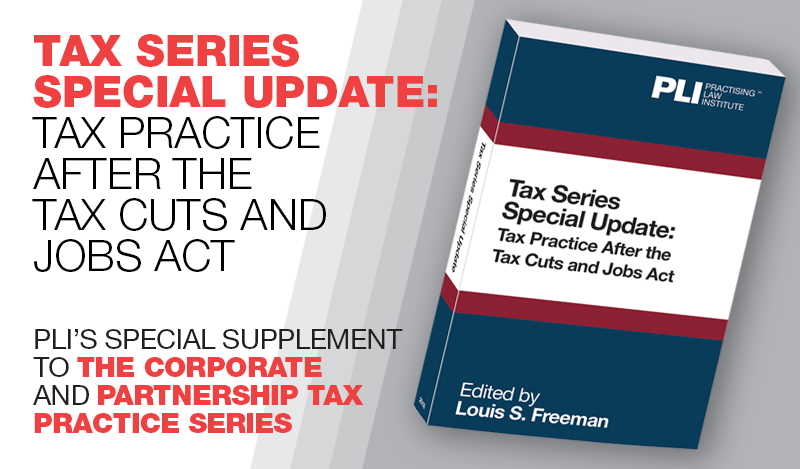
New Publication! Business-Related Provisions of the 2017 Tax Cuts and Jobs Act

PLI has recently made available a new publication, Business-Related Provisions of the 2017 Tax Cuts and Jobs Act.

This Special Alert discusses the impact of many of the complex provisions of the 2017 Tax Cuts and Jobs Act (“TCAJA”) on domestic and international business operations of C corporations, S corporations, and partnerships. It is organized in ten sections and covers:

  1. Introduction
  2. The individual “Rate Structure Changes” for both ordinary income and capital gains
  3. The corporate rate structure changes, including the individual tax on dividends and the dividends received deduction
  4. New Section 199A, which provides for a deduction for certain flow-through business income of sole proprietorships, partnerships, and S corporations
  5. A “First Take” on the impact of the TCAJA on the choice of form decision for domestic operations: C corporation, or flow-through entity
  6. The new limitation on the deduction for business interest
  7. The treatment under the TCAJA of carried interest, that is, profits interest earned by certain hedge fund and private equity managers
  8. Several significant changes impacting both individuals and corporations: (1) the depreciation rules, (2) the Section 179 deduction, (3) changes to the net operating loss deduction, (4) the limitation on excess business losses of an individual, and (5) changes to the like kind exchange provision, Section 1031
  9. Several changes in the international tax arena, including (1) the adoption of a territorial system, (2) the tax on the elimination of the deferral benefit, (3) the taxation of foreign high return amounts, (4) the anti-base erosion rules, and (5) restrictions on income shifting through transfers of intangibles
  10. A “First Take” on the TCAJA’s impact on the domestic M&A, that is, (1) taxable asset acquisitions, (2) taxable stock acquisitions, and (3) acquisitive reorganizations.

Business-Related Provisions of the 2017 Tax Cuts and Jobs Act is available on PLI PLUS, our online research database.  If you’d like to order a print copy, please email libraryrelations@pli.edu or call 877.900.5291.

Treatise Update! The Circular 230 Deskbook: Related Penalties, Reportable Transactions, Working Forms

We have recently updated our Treatise, The Circular 230 Deskbook, which helps tax practitioners comply with complex Circular 230 amendments more easily — and avoid costly penalties and sanctions.

This new version includes the following:
Revised section 1:2, Chevron Deference, examining SIH Partners
LLLP v. Commissioner
, in which the court clarified the distinction
between a legislative rule and an interpretive rule for purposes of
the Administrative Procedure Act.
New section 4:13.8[D][10], Supervisor’s Approval, explaining that
a section 6751 penalty can be assessed only if it is approved by
the immediate supervisor of the individual making such determination
or such higher-level official as the Secretary may designate.
• Updated Appendix L, IRS Form 706; Appendix M, IRS Schedule M-3
(Form 1120);
and Appendix N, IRS Form 2848.

The Circular 230 Deskbook is an essential compliance tool for every tax professional who practices before the IRS.

The updated Treatise is available on PLI PLUS, our online research database.  If you’d like to order a print copy, please email libraryrelations@pli.edu or call 877.900.5291.


Treatise Update! Commercial Ground Leases

Including adaptable time-saving sample agreement language, Commercial Ground Leases is a definitive guide to drafting, negotiating, and finalizing equitable, error-free leasing documents that address the needs of both landlord and tenant. It covers the full range of relevant commercial ground leasing issues, including:

Appendices include forms of letter of intent, leasehold mortgagee protection clauses, intercreditor agreements, fee and leasehold deed of trust provisions, estoppel certificate and guaranty, and a complete ground lease with many alternative clauses.

New to this release is Chapter 2A, Reappraisal of Ground Rents, which provides an expanded discussion of ground rent reappraisals, with coverage of the various appraisal methods.

The updated Treatise is available on PLI PLUS, our online research database.  If you’d like to order a print copy, please email libraryrelations@pli.edu or call 877.900.5291.


The Current: The Journal of PLI Press (Winter 2018)

We are pleased to announce that the Winter 2018 issue of PLI’s journal, The Current: The Journal of PLI PLUS  is available on PLI PLUS! Each issue of The Current features original articles that cover new and emerging developments impacting the law and the legal profession. In every issue you’ll find expert insights, commentary, and analysis from leading practitioners, including PLI authors and faculty members.

Articles in this Winter 2018 issue include:

The Current  is available through your PLI PLUS subscription.

Not a PLI PLUS subscriber? Click here to sign up for a FREE digital version of The Current. The journal is also available here for purchase in print.

New Update! Technology Transactions

Release # 3 is now available for Technology Transactions: A Practical Guide to Drafting and Negotiating Commercial Agreements.

This indispensable guide empowers practitioners to draft, review, and negotiate technology transaction agreements and covers areas of knowledge that should inform this process, such as the DMCA, state transactions laws, and numerous privacy considerations. The types of agreements covered include:

This release includes brand-new chapters on employee agreements and open source software, and new discussions of the “shared responsibility” cloud model and cloud adoption efforts by public agencies.

The updated Treatise is available on PLI PLUS, our online research database.  If you’d like to order a print copy, please email libraryrelations@pli.edu or call 877.900.5291.

PLI PLUS: Content Added in 2017

PLI PLUS continually grows: new books are published; Treatises are updated; Forms are added; and new programs generate our Course Handbooks and Transcripts.

Here’s a listing of the content added or updated to PLI PLUS in 2017. It can be used as a reference guide for librarians, attorneys, researchers and other subscribers.

In 2017, we added or updated the following:

  • 19 Answer Books
  • 218 Course Handbooks
  • 438 Archived Course Handbooks
  • 80 Forms
  • 2 New Editions of our Journal
  • 307 Transcripts
  • 18 Treatises
  • 64 Treatises – Supplemented

(null)

(null)

New Edition! ERISA Benefits Litigation Answer Book (2018 Edition)

ERISA Benefits Litigation Answer BookPLI recently published a new edition of ERISA Benefits Litigation Answer Book, which provides a comprehensive overview, in question and answer format, of the various causes of action the Employee Retirement Income Security Act provides to remedy violations of the statute, enforce the terms of a benefit plan, or provide other relief to a plan, its participants or its fiduciaries.

Written by a team of authors with many years of ERISA litigation experience, and filled with practical illustrations and tips, ERISA Benefits Litigation Answer Book describes the legal requirements of, defenses to, and unique aspects of litigation involving: stock drops, ESOPs, cash balance plans, prohibited transactions, 401(K) fees, recovery of benefits due under a plan, multi-employer plans, managed care plans, and discrimination and interference with benefits rights. Also covered are chapters discussing litigation of claims arising under federal common law, affirmative defenses to ERISA claims, and limitations on actions under ERISA.

The new edition is available on PLI PLUS, our research database.  If you’d like to order a print copy, please email libraryrelations@pli.edu or call 877.900.5291.