Category Archives: Treatise

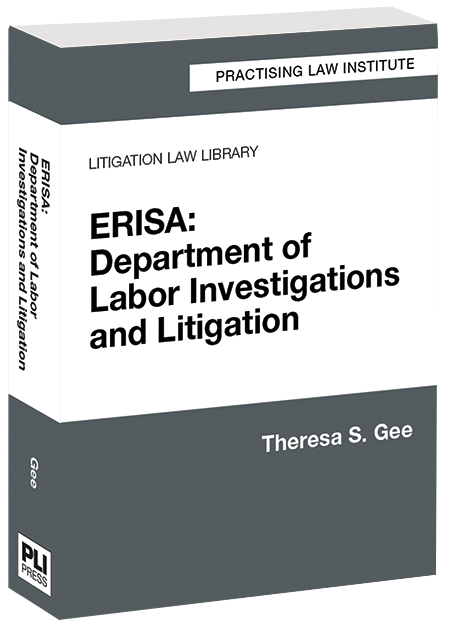
New Title! ERISA: Department of Labor Investigations and Litigation

PLI Press is excited to announce the publication of ERISA: Department of Labor Investigations and Litigation, a new treatise focusing on the Department of Labor’s civil enforcement authority and litigation under the Employee Retirement Income Security Act (ERISA).

This new publication has two primary functions: (1) to serve as a reference guide to the Department’s regulations and informal guidance, and (2) to be a resource for the Department’s views on ERISA fiduciary responsibilities as expressed in litigation by highlighting key cases.

The book examines cases brought by the Department directly as the plaintiff or amicus and how its views have been received by the courts. Cases involving private litigants generally are not discussed but are briefly mentioned if they are particularly significant, such as Supreme Court decisions or key lower court opinions. The primary exception concerns the Department’s amicus curiae briefs, which are filed in private party litigation and touch on significant or novel issues before the Supreme Court and circuit courts across the country.

As much of the Department’s enforcement and litigation has focused on pension plans, so does this book, along with an overview of health plan investigations, enforcement, and litigation, including under ERISA Part 7 and the Affordable Care Act. There is also a short discussion of the Department’s criminal enforcement program, as well as a discussion of the impact of the fiduciary, or conflict of interest, rule on the financial services industry and related litigation.

Order your print copy today.

PLI PLUS subscribers can access this title through their subscription.

Treatise Update: International Tax & Estate Planning

International Tax & Estate Planning: A Practical Guide for Multinational Investors (Third Edition) presents the clear and practical approach of a person who deals with private wealth, its management and its disposition. In it, one of the nation’s leading multinational investment authorities shows you how to: capitalize on tax-advantaged strategies, protect investments against government expropriation, nationalization, or other extraordinary events, draft problem-free wills and trust documents that secure clients’ interests, and avoid errors in an era of increased regulatory oversight, conflicts of law, and greater demands for financial disclosure.

This title is an indispensable resource for lawyers, private bankers (both investment and commercial), corporate personnel of multinational corporations, accountants, and investment advisers.

This latest release updates the text with the practical information that enables multinational investors (and those who advise them) to protect investments, minimize taxation, maintain confidentiality, and assure proper disposition of assets upon an investor’s death.

A completely revised Chapter 5: Sovereign Risks, Expropriation, and the Act of State Doctrine, explores topics including: what constitutes just compensation; the Foreign Account Tax Compliance Act and Common Reporting Standard; sanctions imposed by the United States on Iran, Russia, North Korea, Venezuela, and Cuba; and questions that can be used to determine whether a constructive taking has occurred.

This essential treatise is available on PLI PLUS. If you would like to order a print copy, please contact libraryrelations@pli.edu.

Treatise Update! Directors’ and Officers’ Liability: Current Law, Recent Developments, Emerging Issues (Third Edition)

Directors’ and Officers’ Liability provides a cutting edge, straightforward explanation of the obligations of directors and officers of public companies, the penalties that they face if they fail to meet their obligations, and the protections that are offered them under the law or by agreement. This treatise for corporate counsel, private practitioners, and for directors and officers themselves guides readers through the essentials of the current law, recent developments, and emerging issues of directors’ and officers’ liability.  This title covers the sources of law governing the duties of directors and officers; the key facets of board committees; the duties of directors and officers under state corporate law and federal and state securities laws; private civil actions and public enforcement; exculpation, indemnity, and insurance; cybersecurity; contested mergers and acquisitions; Securities Act suits filed in state court; special issues in pharma and biotech; and more.

The highlights for the latest release for Directors’ and Officers’ Liability  include:

  • Emerging Issues: A Revival of Caremark Claims. Two recent decisions, one issued by the Delaware Supreme Court in June 2019 and another issued by the Delaware Court of Chancery in October 2019, herald what might be a new era of shareholders asserting Caremark claims, breach of the duty of loyalty by a failure of oversight, and those claims surviving motions to dismiss. See new section 8:7 and section 3:3.14 for a review of Caremark and analysis of Marchand v. Barnhill and In re Clovis Oncology, Inc. Derivative Litigation.
  • Federal Forum Exclusive Venue Provisions for Securities Act Claims. In Sciabacucchi v. Salzberg, the Delaware Court of Chancery held that company charter provisions stating that federal courts shall be the exclusive forum for Securities Act class action claims are invalid. See new section 1:4.2 for a history and analysis of jurisdiction over securities class actions under the PSLRA, SLUSA, and the latest Delaware cases.

This essential treatise is available on PLI PLUS.  If you would like to order a print copy, please contact libraryrelations@pli.edu.

Treatise Update: Initial Public Offerings: A Practical Guide to Going Public (Second Edition)

Providing expert guidance on how to create a winning IPO, Initial Public Offerings: A Practical Guide to Going Public (Second Edition), is packed with best practices, planning tips, checklists and sample documents to help implements its guidance.  Numerous developments—originating from the SEC, FINRA, Congress, and the private sector—continue to shape the IPO landscape. Completely revised and expanded, this latest release (release #7) addresses key changes in legal requirements and market practices of critical interest to IPO companies, lawyers, and market professionals alike.

The latest release for Initial Public Offerings updates many chapters, some of which include:

Among the new developments covered in this release are:

  • Updated IPO market statistics and outlook, including IPO company metrics (see §§ 1:5 and 21:2 to 21:6, Figures 1-3 to 1-8, and Appendix 20C).
  • Pre-IPO fundraising, including updated discussion of initial coin offerings (see § 2:8.1[I]) and updated market statistics on the use of various other financing techniques (see § 2:8).
  • ­Equity compensation, including updated market data on the terms and size of stock incentive plans (see § 2:6.3[B]) and employee stock purchase plans (see § 4:7); and updated discussion of the tax deferral opportunity presented by section 83(i) of the Internal Revenue Code (see§ 8:4.4).
  • Updated discussion of estate planning for pre-IPO company executives (see § 8:5).
  • EGC considerations, including updated adoption rates (by company industry) for key items of relief available to EGCs (see Table 10-2).
  • Quiet period updates, including the SEC’s proposal to allow any company to engage in “test-the-waters” communications with eligible institutional investors in connection with any registered securities offering (see §§ 11:2.2[E] and 18:8.1) and new examples of quiet-period concerns in IPOs and direct listings (see § 11:3.3[B]).
  • Form S-1 preparation, including updated discussion of disclosure requirements and illustrative SEC comments (see § 13:2.1), updated prospectus data (see § 13:2.2), and a description of the SEC’s new streamlined procedures for obtaining confidential treatment of eligible portions of material contracts (see §§ 13:2.4 and 16:7).
  • SEC review, including a summary of the realignment of Corp Fin’s disclosure review program (see § 17:2.2) and updated statistics on the nature and timing of SEC comments on Form S-1 filings (see § 17:3.7, Table 17-3, and Table 17-4).
  • Public company reporting developments, including updated disclosure requirements and proposed changes to the tests for accelerated filer and large accelerated filer status (see §§ 22:2.1, 22:2.2, and 22:2.3), and recent and proposed rule amendments as part of the SEC staff’s ongoing disclosure effectiveness initiative (see § 22:2.5).

This essential treatise is available on PLI PLUS.  If you would like to order a print copy, please contact libraryrelations@pli.edu

Treatise Update: Friedman on Leases

Friedman on Leases (Sixth Edition) clarifies and analyzes the full range of lease provisions and conceivable landlord-tenant situations to give you unsurpassed practical instruction on how to negotiate and draft airtight agreements that protect your clients’ rights and minimize their liability exposure.

Friedman on Leases includes numerous case decisions with commentary and valuable sample lease clauses and agreements that help practitioners to: draft, negotiate, and amend every essential document involved in commercial leasing, modify lease provisions for the full variety of landlord-tenant arrangements, anticipate and resolve problematic transaction developments, and also avoid drafting errors, including omissions, ambiguities, and fatal terminology. 

The latest update to Friedman on Leases (Sixth Edition) continues to provide balanced coverage of tenant and landlord concerns and updates the treatise with the most current legal, regulatory, and compliance requirements and developments. Highlights of Release #8 include:

  • Chapter 2, The Parties. Updated to include situations where a tenant constitutes a partnership, consisting of two or more parties who are partners under applicable state law (see section 2:1.5).
  • Chapter 3, The Premises. Updated to include a New York Appellate Division holding that a tenant’s right to “use and enjoyment” is implied, especially if the space is leased for a specific expressed purpose (see
  • section 3:2.2).
  • Chapter 5, Rent. Provides a new sample “most favored nation” provision in an office lease (see section 5:7).
  • Chapter 7, Assignment, Subletting, and Mortgaging by Tenant. Updated to include a Nebraska Supreme Court case that reviewed whether taking possession and paying rent satisfy the statute of frauds so as to make the possessor liable on the lease as an assuming party (see section 7:5.1[C][1][a]).

This treatise is available on PLI PLUS. If you would like to order a print copy, please contact libraryrelations@pli.edu.

Treatise Update: Fragomen on Immigration Fundamentals

Offering in-depth coverage of bedrock immigration legislation, the latest USCIS rules and programs, and pivotal court decisions, Fragomen on Immigration Fundamentals: A Guide to Law and Practice (Fifth Edition) provides the legal and procedural knowledge to work more efficiently and effectively with employers, noncitizens, nonimmigrants, refugees, naturalized citizens, and government officials.

The latest release for Fragomen on Immigration Fundamentals updates the following chapters:

Among the new developments covered in this release are:

  • Public charge determinations: The Trump administration has implemented strict new standards for determining whether an adjustment applicant or immigrant visa applicant is, or is likely to become, a public charge. The new rules require officials to weigh a number of factors rather than reviewing only the sponsor’s financial information, and lengthen the list of public benefits to be considered in the review. New section 3:4.3[F], Public Charge Determinations.
  • Southwest border crisis: In August 2019, DHS and HHS issued a new rule relating to the detention of minors, which, in their view, terminates the Flores agreement. The rule creates an alternative licensing scheme that allows the detention of families together in the same facility; states that the criteria governing the parole of persons in expedited removal proceedings apply to minors, as well as to adults; and states that bond redetermination hearings are only available to minors in regular, not expedited, removal proceedings. Section 7:5.7[A], Trump Administration Policies.
  • Asylum claims: The USCIS and EOIR issued a joint rule in July 2019 that bars asylum claims by individuals who enter or attempt to enter the United States across the southern land border after failing to apply for protection from persecution or torture while in a third country through which they transited. That same month, a California district court issued a nationwide preliminary injunction, but the Ninth Circuit limited the reach of the injunction to cases arising within that circuit. New Section 6:2.6[C][7], Failure to Apply in Safe Third Country.
  • Expedited removal: Pursuant to new directive, in July 2019, Acting Secretary McAleenan designated for expedited removal two additional categories of persons. Section 7:5.6[A], Classes of Individuals Subject to Expedited Removal.

This essential treatise is available on PLI PLUS. If you would like to order a print copy, please contact LibraryRelations@pli.edu.

Treatise Update – The Securities Law of Public Finance

This two-volume resource, cited by the SEC for its excellence in illuminating legal issues, clarifies and analyzes how federal securities laws and regulations apply, directly and indirectly, to securities issued by state and local governments.

The Securities Law of Public Finance is a valuable resource for bond lawyers, municipal officials, underwriters, broker-dealers, investment advisers, regulators, and anyone else involved in the business of financing the activities of state and local government.

The key updates to the Securities Law of Public Finance include:

  • New Chapter – Regulation of Municipal Broker-Dealers in Private Placements: New chapter 10B, by Paul S. Maco, deals with private placements, which developed as a form of transaction to avoid the registration requirements of section 5 of the Securities Act of 1933. Such transactions, while exempt from registration, are subject to the remaining provisiions of the Securities Act, including its civil liability and antifraud provisions as well as the antifraud provisions of section 10 of the Securities Exchange Act of 1934 and Rule 10b-5. The discussion provides a brief overview of the broad reach of federal securities law and the requirement for registration as well as antifraud proscriptions, the availability of class and transaction exemptions from registration but not antifraud provisions through private placements, and the application of the antifraud provisions and broker-dealer law to placement agents.
  • Lorenzo decision – Dissemination of New Issue Offering Documents: In March 2019, the Supreme Court held in Lorenzo v. Securities & Exchange Commision that a defendant who disseminates the material misstatement of another—and thus cannot be liable under the second subsection of Rule 10b-5 for “making” the statement—can nevertheless be liable under other provisions of the securities laws that proscribe “any device, scheme, or artifice to defraud.” The release discusses some possible implications for public finance, including the dissemination of preliminary and final official statements. See new § 6:4.2.
  • Duties of underwriters’ counsel – Underwriters’ Due Diligence on New Issues of Municipal Securities: In addition to being familiar with applicable law and codes of ethics, lawyers expecting to serve as underwriters’ counsel should become familiar with the SIFMA Model Memorandum to Underwriter’s Counsel and the NABL Model Letter of Underwriters’ Counsel. There are a number of differences in approach between the two model documents that underwriters’ counsel may need to address early in its representation of the underwriters to avoid misunderstanding. See new § 7:5.1[D][2].
  • Continuing disclosureduty to correct and duty to updateContinuing Disclosure: A duty to correct arises when a statement intended for the investing market, such as an official statement, contains an incorrect statement that, at the time the statement was made, the issuer believed to be true, but subsequently discovered new information reveals that the statement made was incorrect and material. The duty to update applies where a correct statement is said to become inaccurate after it is made because of new circumstances. New material in the release elaborated upon the distinction, discussing the differing approaches among the circuits in defining and imposing duties. See § 9:3.2.

This essential treatise is available on PLI PLUS. If you would like to order a print copy, please contact libraryrelations@pli.edu.

Treatise Update: Friedman and Smith on Contracts and Conveyances of Real Property

The Business Lawyer calls this PLI title “The ‘bible’ for any lawyer handling a real estate conveyance.” providing more than 140 sample forms, sample forms, sample clauses, and checklists that simplify and accelerate transactions, Friedman and Smith helps readers to carefully consider all the issues and options before finalizing a contract. This definitive resource gives guidance on how to handle unexpected problems and contingencies before they become deal-breakers; factor in a relevant case law when structuring sound agreements; and avoid drafting ambiguous or incomplete contracts that can lead to delays and aborted deals.

Highlights of this latest update of Friedman and Smith on Contracts and Conveyances of Real Property include:

  • Chapter 3, Assignments of Contracts. New discussion covers the rights of an assignee against the seller if the seller fails to perform a promise to the buyer included in the contract of sale (see section 3:2.4).
  • Chapter 14, Marketable Title. New discussion of Loring v. Whitney, 46 N.E. 57 (Mass. 1987), which illustrates how courts deal with drawing the line between litigation risk that is substantial versus too remote (see section 14:1.2).
  • Chapter 19, Easements—Creation. New discussion of the distinctions between easements appurtenant and easements in gross, including court-developed tests in cases of ambiguity (see section 19:3).
  • Chapter 22, Covenants—Scope and Termination. New discussion of eminent domain reviews the majority and minority views on whether restrictive covenants are property for takings purposes (see section 22:2.12).
  • Chapter 24, Contract Remedies for Seller Default. New discussions cover challenges to specific performance as a workable remedy for the buyer when the seller has problems with the title (see section 24:44.2), and review the viability of specific performance as a remedy for part of a contract and not for the remainder because the remainder is impossible to perform or the matter is one into which equity will not venture (see section 24:4.3).
  • Chapter 25, Time for Performance. Updated discussion of the “time of the essence” doctrine, including “time is of the essence” as an implied term and the consequences when time is essential and when time is not essential (see sections 25:2.1-25:2.4).
  • Chapter 26, Deed Elements. Updated discussion covers transfer tax, which is payable upon the recordation of a deed, triggering a requirement that the grantee report the amount of consideration to the reocording office that becomes part of the public record, which allows a title searcher to determine the parties’ reported consideration (see section 26:4).

This essential treatise is available on PLI PLUS. If you would like to purchase a print copy, please email libraryrelations@pli.edu.

New Edition! Master the 8-K

Master the 8-K is one of the publications in PLI’s SEC Compliance and Disclosure Series. This clear, concise, and comprehensive guide to filing the SEC’s Form 8-K is a tool that every securities lawyer or person who is responsible for a company’s periodic SEC reports will want to have close at hand. With sample disclosure language and detailed appendices containing the Form 8-K itself, key regulations, SEC compliance and disclosure interpretations (C&DIs), this title is a stand-alone resource for anyone seeking to master the 8-K.

In this easy-to-use book, each Form 8-K Item is separately analyzed and begins with “highlights” that, at a glance, alert you to critical matters about that Item, such as whether the “safe harbor” applies, whether there are exhibit requirements, whether there are possible update requirements, and whether there are critical definitions to consider. Each section then provides step-by-step instructions and expert practice tips.

This updated new edition of Master the 8-K provides current guidance primarily designed to address the SEC’s 2018 and 2019 rule changes that were intended to modernize and simplify disclosure requirements, such as:

  • Permitting omission of schedules and attachments from many exhibits;
  • Streamlining the rules for incorporation by reference; and
  • An innovative new approach to confidential treatment, which allows companies to redact confidential information from exhibits without the need to submit formal confidential treatment requests.

This treatise is available on PLI PLUS. If you would like to purchase a print copy, please email libraryrelations@pli.edu.

2020 Edition! International Tax Controversies

International Tax Controversies is a practical guide to handling international tax audits and appeals, government-to-government cooperation and special dispute resolution mechanisms, and litigating international tax cases. Disputes with the IRS regarding international tax issues often present special issues in addition to those normally relevant in purely domestic tax controversies.

For example, questions may arise regarding the application of attorney-client privilege and other protections in the cross-border context. Where relevant documents, witnesses, and other information are held abroad, special procedures may be applicable. In addition, special dispute resolution mechanisms may be available in international tax disputes involving tax treaties and transfer pricing. Taxpayers should also be aware of the potential impact on the competent authority process of entering into closing agreements. Finally, country-by-country reporting data will be changed by the United States pursuant to bilateral competent authority arrangements (CAAs) entered into in connection with tax treaties and TIEAs that permit automatic exchanges of information.

International Tax Controversies explores these and other relevant issues in international tax cases, in addition to the issues and procedures that commonly arise in U.S. federal tax audits (whether or not focused on international issues).

This essential treatise is available on PLI PLUS. If you would like to order a print copy, please contact libraryrelations@pli.edu.