Category Archives: Treatise

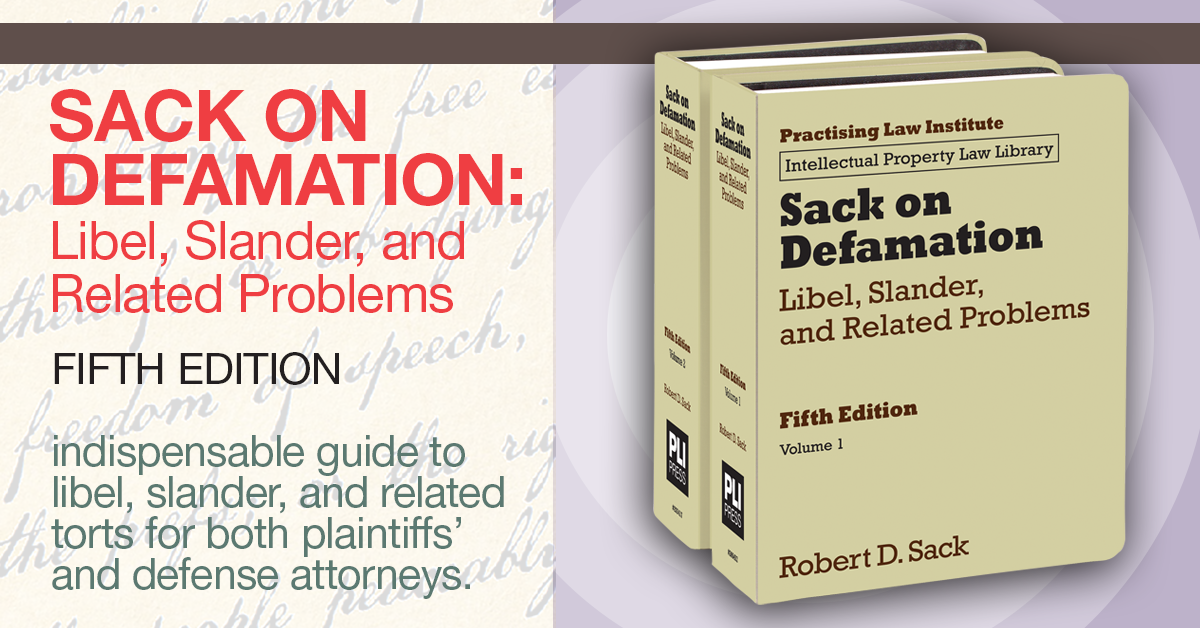
Treatise Update! Sack on Defamation

Written by a U.S. Court of Appeals judge and cited by courts throughout the United States–including by the U.S. Supreme Court–Sack on Defamation delivers definitive legal, strategic, and tactical insight into libel, slander, and other defamation-related causes of action for both plaintiffs’ and defense attorneys.

Highlights of the new release include:

Context of allegedly defamatory statement: In McKee v. Cosby, the
plaintiff accused the defendant of defaming her in a letter by using her
published statements out of context. But the First Circuit, applying
Massachusetts law, concluded to the contrary, noting that the quotations
were “immediately followed by a hyperlink to the source article, allowing
readers to put [the plaintiff’s quoted] statements into proper context.”
Defamation of groups and group members: In Elias v. Rolling Stone
LLC, the Second Circuit, applying New York law, held that it was error
to dismiss a defamation cause of action brought by a group of fifty-three
members of a college fraternity, based on a false published statement
by the defendant that some nine of the fraternity’s then members had
committed or participated in a rape at their fraternity house.
Hepps doctrine—matters of public concern: The Texas Supreme Court,
in Brady v. Klentzman, has “recognized that even if the general subject
matter of a publication may be a matter of legitimate public concern,
some of the details may not be. But if a ‘logical nexus’ exists between
these details ‘and the general subject matter’ of the article, then they are
reasonably included as a matter of public concern.”
Opinion—emojis and emoticons: Digital media may well give rise to
a new context in which to decide whether a statement is fact or opinion.
One can guess that emojis and emoticons will, by their nature, ordinarily
be treated as nonactionable opinion or commentary. See § 4:3.1[A], at
note 121.1.
• Public officials: Persons held to be public officials include the director of
budget and finance for a public school system; a former town clerk who,
as such, “had the primary responsibility for organizing and issuing the
payroll for the town”; and the deputy manager of a U.S. shuttle projects
office partially responsible for overseeing the development and operation
of the propulsion systems for the ill-fated Challenger shuttle.
“Actual malice”—fictionalization: In Lovingood v. Discovery
Communications, Inc., a federal district court in Alabama found no
“actual malice” where a BBC docudrama broadcast under license by the
defendant contained an invented scene defamatory of the public-figure
plaintiff; “there is no evidence from which jurors could reasonably infer
that the . . . defendants had reason to doubt the accuracy of the scenes
in the . . . film or that the defendants’ failure to do more to investigate
the accuracy of the two scenes at issue evidences ‘an intent to avoid the
truth.’”
Absolute privilege—statements to federal authorities: Statements to
federal officials may also be entitled to absolute privilege. For example,
in Mangold v. Analytic Services, Inc., a divided panel of the Fourth Circuit
held that statements made by a government contractor in the course of
the investigation of an Air Force colonel’s dealings with the contractor
were absolutely privileged. The court saw the privilege as analogous
to immunity for testimony in court, before a grand jury, and to public
prosecutors.
Qualified privilege—charges of child sexual abuse: In Connecticut, by
statute, charges of child sexual abuse made to the Department of Children
and Families are entitled to qualified immunity.
Damages: Although the courts continue to monitor and sometimes limit
damage awards, there are still large libel verdicts that survive appellate
review, as a number of multi-million-dollar cases demonstrate.
Jurisdiction—New York long-arm statute: New York’s long-arm
statute includes exceptions that limit its application in defamation cases;
this favorable treatment of defendants in defamation cases has been held
by the Second Circuit, in a thorough opinion by Judge Walker, to be
constitutional, abridging neither the plaintiff’s First Amendment right to
petition nor his or her Fourteenth Amendment rights to equal protection
(Friedman v. Bloomberg L.P.).
Texas Defamation Mitigation Act: In addition to its anti-SLAPP statute,
Texas has enacted the Defamation Mitigation Act, which requires a
prospective plaintiff to make a request of the prospective defendant for a
correction, clarification, or retraction of offending allegedly defamatory
material before bringing a defamation action, unless the defendant has
made such a correction, clarification, or retraction without such a request.
Anti-SLAPP laws—Massachusetts, Maine: Recent cases interpret and
apply the anti-SLAPP statutes of Massachusetts (Blanchard v. Steward
Carney Hospital, Inc.) and Maine (Gaudette v. Mainely Media, LLC),
which are both aimed at protecting the constitutional right to petition,
rather than freedom of speech or of the press generally.

The updated treatise is available on PLI PLUS, our online research database.  If you’d like to order a print copy, please email libraryrelations@pli.edu or call 877.900.5291.

New Title! Legal Guide to the Business of Marijuana

PLI recently published a new title, Legal Guide to the Business of Marijuana.

This title is a new and unique resource for lawyers who represent clients in what has been called the fastest growing industry in the United States. The majority of states have enacted laws legalizing medical marijuana — with nine states to date allowing for recreational use — but marijuana remains illegal under the Federal Controlled Substances Act, giving rise to constitutional challenges to these state laws under the doctrine of preemption. As a result, marijuana enterprises must operate in a legal and regulatory environment of uncertainty, and lawyers representing these enterprises must tread carefully when advising clients.

Written by James T. O’Reilly, a lawyer and public health specialist, Legal Guide to the Business of Marijuana offers critical guidance to help lawyers effectively represent their clients while steering clear of seen and as yet unseen perils implicit in the continued federal-state conflict. The guide provides discussion and analysis of:

• the complex and varying state regulation of medical and non-medical marijuana, including a survey of state cannabis laws, with summaries and citations

federal law, enforcement, and preemption

the various aspects of establishing and managing a marijuana enterprise, including the growing, licensing, labeling, transporting, and distribution of marijuana and related products

• the implications of preemption on employment, taxes, and banking

For lawyers new to representing marijuana clients, the author provides an understanding of the definitions of marijuana and other cannabis products, as well as a review of the policy and political issues that have led to the controversy and uncertainty of the current environment.

This essential new title is available on PLI PLUS, our online research database.  If you’d like to order a print copy, please email libraryrelations@pli.edu or call 877.900.5291.
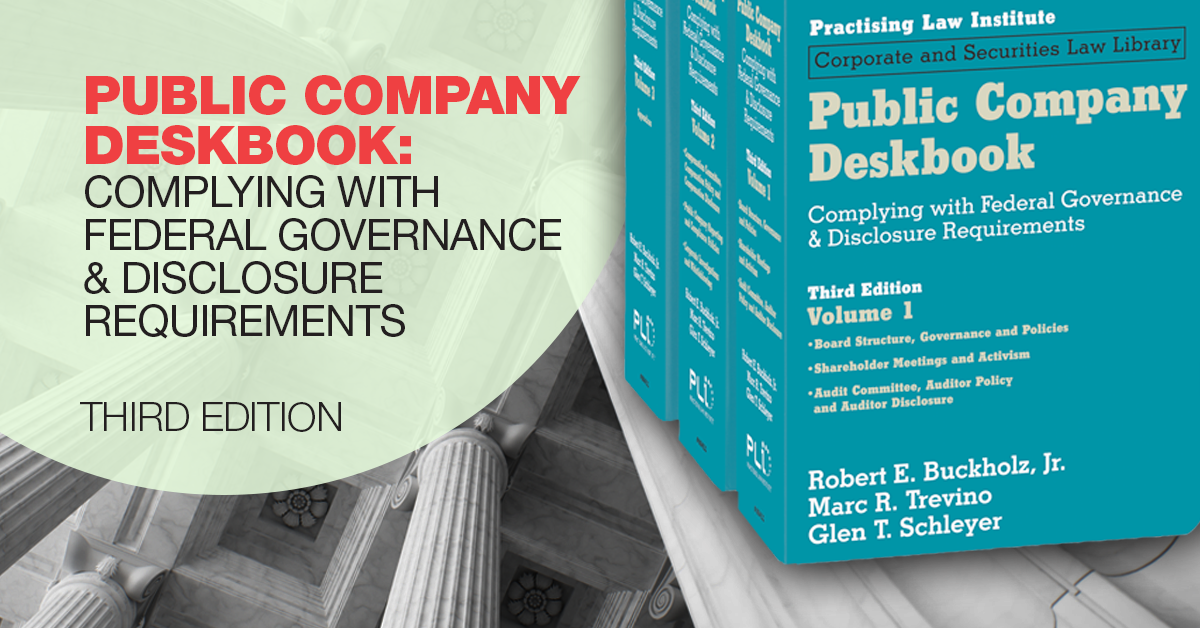
Treatise Update! Public Company Deskbook

PLI recently updated Public Company Deskbook: Complying with Federal Governance & Disclosure Requirements, which provides expert counsel on how to deal effectively with the overlapping legislative, regulatory and private initiatives to reform public company governance and disclosure practices over the past decade.

Highlights of Release #7 include:
New Chapter 5G1 addressing the latest SEC guidance on
cybersecurity disclosure and related issues, including in respect of
disclosure controls and procedures and insider trading risks.
• Updates to Chapter 2K to reflect the proposed Nasdaq rule change
relating to shareholder approval of issuances over 20%.
• Updates to Chapter 3A to reflect adoption of the new audit standard
requiring discussion of “critical audit matters” in the auditor’s
report.
• Updates to Chapter 4B to reflect the 2017 tax reform legislation
amendments to section 162(m) of the Internal Revenue Code.
• Updates to Chapter 4F to address the latest SEC guidance on pay
ratio calculation and disclosure.
• Updates to Chapter 5F to reflect the revised NYSE requirements
relating to timely disclosure at the end of the trading day.
• Updates to Chapter 6B to reflect the U.S. Supreme Court’s recent
decision limiting Dodd-Frank Act whistleblower protections to
persons who actually communicated their tips to the SEC.

The updated treatise is available on PLI PLUS, our online research database.  If you’d like to order a print copy, please email libraryrelations@pli.edu or call 877.900.5291.
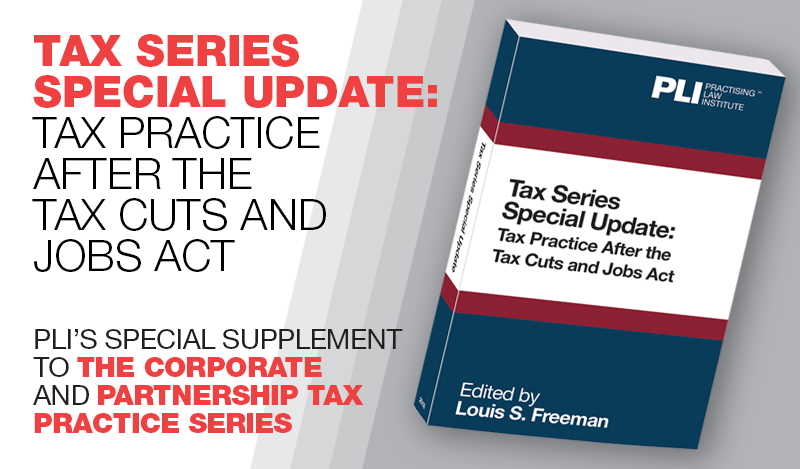
Tax Series Special Update! Tax Practice After the Tax Cuts and Jobs Act

Following the passage of the Tax Cuts and Jobs Act, we felt it was important to provide you with a resource analyzing some of the domestic and international implications of the tax reform package. The result is the Tax Series Special Update, which contains new, original articles covering topics including:

The impact of the Tax Cuts and Jobs Act on choice of entity
Observations on M&A consequences
Structuring and negotiating cross-border acquisitions
Section 965 transition and repatriation tax on foreign based earnings
New Section 245A DRD for foreign-source portion of dividends from specified foreign corporations
Global intangible low-taxed income (“GILTI”)
Foreign derived intangible income (”FDII”)
Base erosion and anti-abuse tax (“BEAT”)

The Tax Series Special Update is available on PLI PLUS, our online research database.  If you’d like to order a print copy, please email libraryrelations@pli.edu or call 877.900.5291.

Trial Handbook (Spring 2018) Now Available!

Trial Handbook is the one-stop resource you can trust for the planning, trial, and post-trial stages of litigation. Designed for quick reference in the courtroom, Trial Handbook is keyed to the Federal Rules of Evidence and focuses on the presentation of proof and the evidentiary problems faced by counsel.

Packed with practical checklists, charts, outlines, and sample jury selection questions, Trial Handbook gives you the knowledge and tools to:

New to the Spring 2018 Edition are a discussion of the amendment limiting the “ancient documents” exception to the hearsay rule and a discussion of the amendments to Rule 902 that allow certain electronic evidence to be authenticated by a written pre-trial certification of a qualified person.

At the heart of Trial Handbook is its unique Evidence Guide, also included as a laminated fold-out, which clearly explains the meaning, purpose, operation, and history of every rule, including how each rule applies to other cases and how leading cases construe a particular rule.

This essential title is available on PLI PLUS, our online research database. If you’d like to order a print copy, please email libraryrelations@pli.edu or call 877-900-5291.

Treatise Update! The Corporate Tax Practice Series

We have recently updated our treatise The Corporate Tax Practice Series.

With contributions from more than 435 of the world’s leading tax practitioners, including former Internal Revenue Service and Department of Treasury officials, this 31-volume set is the definitive resource on corporate tax.

The 2017 edition of The Corporate Tax Practice Series contains 100 articles that have been updated to reflect the latest developments in topics ranging from LLC incentive compensation to modifying debt and its consequences. We’ve also added 31 new articles that have not
previously appeared in the series that tackle issues including:

A financial and income tax analysis of earnouts
S corporation acquisition techniques
Misclassification of employees and Section 530 relief
Significant modification of debt instruments

The updated treatise is available on PLI PLUS, our research database.  If you’d like to order a print copy, please email libraryrelations@pli.edu or call 877.900.5291.

Treatise Update! Social Media and the Law

We have recently updated our treatise Social Media and the Law, which helps you understand the legal environment and mitigate the risks of using social media platforms.

Social Media and the Law provides broad coverage of social media in a variety of legal contexts, including privacy, civil litigation, employment, criminal activity and prosecution, intellectual property, brand protection, defamation, advertising, and regulated industries. This release highlights recent new legislation, cases, and usage trends, as well as industry responses, by companies such as Facebook, Twitter, YouTube, and Google, to abuses of their services.

Several new sections have been added in this release, enhancing the comprehensiveness of the book:
Section 8:5, Consumer Review Fairness Act: This Act prohibits
non-disparagement clauses in consumer transactions, which some
companies had included to obligate customers to refrain from posting
negative reviews of the company, and to give the company the right to
impose a financial penalty for any violation of the clause.
Section 9:2.8, Revenge Porn: Thirty-eight states and the District of
Columbia have criminalized the practice of posting online revealing or
sexually explicit images or videos of a person, typically by a former
sexual partner, without the consent of the subject and in order to cause
the person distress or embarrassment.
Section 9:2.9, Performance Crimes: The posting of videos and live
streaming of criminal activities has escalated recently and become the
focus of great concern. The manner in which social media platforms
address such activities will be closely watched.
Section 9:2.10, Sex Trafficking: Human trafficking is prohibited
by both federal and state laws. The U.S. Senate Commerce Committee
has also recently approved a bill entitled Stop Enabling Sex Traffickers
Act of 2017 which would allow criminal and civil actions against websites
for “knowingly assisting, supporting or facilitating” sex trafficking
through the site.

In addition, throughout the book are updates on the many developments in this field that occurred in the last year or so, such as:
• Activity by the FTC against social media influencers for failing
to properly disclose associations with companies whose products
or services they endorse.
FINRA’s new guidance on social networking websites and business
communications of regulated industries, allowing firms to
engage in native advertising that complies with FINRA Rule
2210, provided that unsolicited third-party comments posted on
a social network are not regarded by FINRA as communications
of the broker-dealer.
Placement of social media advertisements by Russian-linked
firms with the aim to influence the 2016 presidential election,
and Facebook’s new approach to combat the effects of fake news.
Recent class action employment lawsuits alleging violation of
Illinois’s biometric privacy law, largely based on the use of fingerprint-operated
time clocks.
The FTC’s actions against TaxSlayer and Uber for security
breaches and inadequate customer privacy measures.
• Approval by the Uniform Law Commission of a model uniform
employee password protection statute, Employee and Student
Online Privacy Protection Act (ESOPPA), which has already
been introduced in three states.
Recent amendments to Federal Rule of Evidence 902 that provide
additional guidance for parties seeking to authenticate social media
evidence.
Impact of President Trump’s “tweetstorms”

The updated treatise is available on PLI PLUS, our online research database.  If you’d like to order a print copy, please email libraryrelations@pli.edu or call 877.900.5291.

Treatise Update! The Circular 230 Deskbook: Related Penalties, Reportable Transactions, Working Forms

We have recently updated our Treatise, The Circular 230 Deskbook, which helps tax practitioners comply with complex Circular 230 amendments more easily — and avoid costly penalties and sanctions.

This new version includes the following:
Revised section 1:2, Chevron Deference, examining SIH Partners
LLLP v. Commissioner
, in which the court clarified the distinction
between a legislative rule and an interpretive rule for purposes of
the Administrative Procedure Act.
New section 4:13.8[D][10], Supervisor’s Approval, explaining that
a section 6751 penalty can be assessed only if it is approved by
the immediate supervisor of the individual making such determination
or such higher-level official as the Secretary may designate.
• Updated Appendix L, IRS Form 706; Appendix M, IRS Schedule M-3
(Form 1120);
and Appendix N, IRS Form 2848.

The Circular 230 Deskbook is an essential compliance tool for every tax professional who practices before the IRS.

The updated Treatise is available on PLI PLUS, our online research database.  If you’d like to order a print copy, please email libraryrelations@pli.edu or call 877.900.5291.


Treatise Update! Commercial Ground Leases

Including adaptable time-saving sample agreement language, Commercial Ground Leases is a definitive guide to drafting, negotiating, and finalizing equitable, error-free leasing documents that address the needs of both landlord and tenant. It covers the full range of relevant commercial ground leasing issues, including:

Appendices include forms of letter of intent, leasehold mortgagee protection clauses, intercreditor agreements, fee and leasehold deed of trust provisions, estoppel certificate and guaranty, and a complete ground lease with many alternative clauses.

New to this release is Chapter 2A, Reappraisal of Ground Rents, which provides an expanded discussion of ground rent reappraisals, with coverage of the various appraisal methods.

The updated Treatise is available on PLI PLUS, our online research database.  If you’d like to order a print copy, please email libraryrelations@pli.edu or call 877.900.5291.