Category Archives: Practice Areas

New Edition! Corporate Political Activities Deskbook (2018 Edition)

Corporate Political Activities Deskbook provides a thorough grounding in the current state of the law on federal and state campaign finance, pay-to-play, lobbying, gift compliance, and more. It serves as a practical manual for in-house attorneys and others who advise corporations about involvement in the political process, suggesting ways that corporations can utilize the available avenues of interacting with the government while avoiding negative press and legal and regulatory attention.

Among the developments discussed in the new 2018 edition are:

  • Trump ethics pledge: Non-career political appointees to the executive branch of the Trump administration must sign an ethics pledge. The “Trump Pledge” replaces a similar ethics pledge that President Obama required for appointees, but with some key differences: The pledge covers prohibition on the acceptance of gifts from registered lobbyists and restricts appointees from working on matters involving a former client or employer for which the appointee worked, or on which the appointee lobbied, in the previous two years. The pledge also imposes certain restrictions on lobbying activity on appointees upon leaving government service.


  • Ban on contributions by federal contractors:  In Wagner v. FEC, a federal contractor was fined a $34,000 civil penalty for a $200,000 contribution to a “super PAC,” which the Federal Election Commission (FEC) found to have violated the ban on federal contractor contributions under Federal Election Campaign Act. The penalty is significant because while the FEC previously suggested that the federal contractor ban applied to super PAC contributions, it had not previously found actual violations to have occurred, leaving open some question regarding the FEC’s appetite for imposing penalties for such contributions.


This essential and timely treatise is available on PLI PLUS, our research database. If you’d like to order a print copy, please email libraryrelations@pli.edu or call 877.900.5291.
 

New Title! Depositions Answer Book

Depositions are the key component of all litigation matters that survive a motion to dismiss, allowing parties to discover the legal and factual theories of their opponent and to explore the validity of their own case theories and themes. What litigants learn from depositions can guide critical strategic decisions such as whether to settle (and, if so, at what value) or proceed to trial.

The newest answer book title from PLI Press, Depositions Answer Book draws on author Thomas Jackson’s decades of experience in antitrust, business, securities, IP and other litigation to help you master the crucial deposition process, delivering practice-based guidance on:

This essential new title is available on PLI PLUS, our online research database. If you’d like to order a print copy, please email libraryrelations@pli.edu or call 877.900.5291.


Commercial Ground Leases: Now in its 30th Year!

Since the publication of its first edition in 1988, Commercial Ground Leases has been helping real estate professionals draft, negotiate, and finalize equitable, error-free commercial ground lease documents that address the needs of both landlord and tenant, providing clear explanations of complex issues in a framework that makes each individual subject easy to find. This one-stop volume also includes several valuable appendices that offer time-saving sample agreement language.

Commercial Ground Leases covers all the critical areas that participants in a commercial real estate development project need to know about in order to resolve any ground lease issues that may arise.

Recent updates to the third edition include:

–Chapter 4, Tenant Financing: General Updated section 4:5.3 reviews the risks posed by leasehold mortgages to the landowner.

–Chapter 6, Leasehold Financing A new section, 6:7.1[G], reviews the inclusion in the ground lease and in leasehold mortgage documents of a waiver by the ground lease tenant/borrower of any rights to a claim for damages against either the landowner or any leasehold mortgagee arising from any new lease into which they may enter.

–Chapter 7, Bankruptcy Updated section 7:3.2[C] reviews stub rent and whether the past due rent for the entire month is treated as unpaid pre-petition rent or if the portion of the rent attributable to the period after the filing date to the next rent due date is includible as a priority administrative expense.

This title is available on PLI PLUS, our research database.  If you’d like to order a print copy, please email libraryrelations@pli.edu or call 877.900.5291.


New Title! Arbitrating Commercial Disputes in the United States

PLI recently published a new title, Arbitrating Commercial Disputes in the United States.

Bringing or defending commercial arbitrations requires a clear grasp of the latest developments in the field, a practical understanding of how the arbitration process works, and knowledge of how the courts interpret and enforce arbitration agreements and treat arbitral awards. And participating in an arbitration demands a distinctive set of skills, different from those learned in the courtroom.

In Arbitrating Commercial Disputes in the United States, author/editor David Singer and his contributors—many of them arbitrators, and all of them deeply familiar with the arbitration process—provide the information and insights that will help readers master commercial arbitration.

Citing hundreds of cases, as well as drawing upon the extensive experience of the contributors, this book addresses the strategies that lead to success.

This essential new treatise is available on PLI PLUS, our research database.  If you’d like to order a print copy, please email libraryrelations@pli.edu or call 877.900.5291.


New Edition! Medical Devices Law and Regulation Answer Book (2019 Edition)

PLI recently published the 2018 edition of Medical Devices Law and Regulation Answer Book, in which more than thirty contributors from various law and consulting firms share their expertise regarding the wide range of topics encountered in this heavily regulated field.

This book provides in-depth coverage of individual FDA programs that govern everything from conducting clinical trials, preparing successful premarket submissions, adhering to quality system requirements, and fulfilling post-market obligations and more. Presented in a question-and-answer format, this guide also discusses related topics that have a marked impact on the medical devices industry, such as intellectual property, product liability, and reimbursement.

Medical Devices Law and Regulation Answer Book is designed to distill the essential elements of this complex regulatory environment and provide a practical guide to the complexities of FDA regulation of medical devices. It is a practical, in-depth reference for all lawyers, consultants, and companies operating in the medical devices sector, as well as all companies contemplating entertering it .

This updated answer book is available on PLI PLUS, our research database.  If you’d like to order a print copy, please email libraryrelations@pli.edu or call 877.900.5291.

Treatise Update! Financial Product Fundamentals: Law, Business, Compliance

PLI recently updated Financial Product Fundamentals: Law, Business, Compliance (Second Edition).

To provide attorneys, compliance personnel, and business professionals with legal, regulatory, and procedural guidance regarding the various financial products, Clifford E. Kirsch has edited Financial
Product Fundamentals, which compiles his expertise as a noted practitioner in the areas of securities regulation and compliance, together with valuable contributions from other distinguished authorities in these practice areas.

Highlights of the latest version include:

  • Chapter 2: Limited Offerings and Private Placements. Updated to reflect recent amendments to Rule 504 under Regulation D that increase the aggregate amount of securities that may be offered and sold in any twelve-month period, and disqualify certain bad actors from relying on Rule 504.
  •  Chapter 12, International Investment Funds. Commodity Futures Trading Commission (CFTC) registration analysis for commodity pool operators and commodity trading advisors (CTAs), as
    well as the exemptions from registration as a CTA pursuant to Rules 4.14(a)(4), 4.14(a)(5), and 4.14(a)(8).
  • Chapter 17, Exchange-Traded Funds. New discussions covering ETF distribution and associated fees, Authorized Participants and Authorized Participant Agreements, and marketing and advertising considerations for ETFs. Discussion updated to include recent regulatory developments regarding listing standards, reporting requirements and risk disclosures, and the Liquidity Rule’s application to In-Kind ETFs.
  • Chapter 19, A Primer on Derivative Contracts and Their
    Regulation. Updated discussion follows the actions of the CFTC and SEC in addressing the many Dodd-Frank issues under their respective jurisdictions to regulate the swaps marketplace.
  • Chapter 24, Exchange-Traded Notes and Similar Structured
    Notes. New discussion covers issues with respect to other types of structured notes that are not listed on securities exchanges.
  • New Chapter 27, Interval Funds. New discussion places interval funds in their regulatory framework, and covers issues associated with their operation and distribution, as well as the investment strategies utilized by these funds.

This essential title is available on PLI PLUS, our online research database.  If you’d like to order a print copy, please email libraryrelations@pli.edu or call 877.900.5291.

Treatise Update! Langer on Practical International Tax Planning

PLI recently published an update to Langer on Practical International Tax Planning.

This treatise provides current knowledge and expert advice you need to help clients capitalize on ripe tax havens and financial centers.

The latest update includes several newly added sections covering the following topics:

  • The 2017 Tax Act. This new section outlines numerous changes made by the 2017 Tax Cuts and Jobs Act, including changes to the capital gains rate, deduction for state and local property and income taxes, dividends-received deduction, net operating losses, and like-kind exchanges.
  • Unemployment Compensation Paid After Leaving the United States.In what it said was a case of first impression for it, the Tax Court addressed whether a nonresident alien (Canadian) who had worked in the United States was exempt under treaty from taxation on unemployment compensation she received after having gone back to Canada.
  • Expatriating Corporations—Excise Tax. Updates provide the latest on how the 2017 Tax act affect the excise tax, which can apply to certain “disqualified” individuals if a corporation expatriates and gain on any stock in the expatriated corporation is recognized by any shareholder with respect to the expatriation transaction.
  • Charitable Distributions. This discussion covers newly modified procedures for how foundations may make a “good faith determination” that a foreign grantee is a “qualifying public charity.”
  • Payments to Related “Captive Insurance Companies”. Coverage of a 2017 Tax Court case examines the Service’s denial of a taxpayers’ claimed deductions under section 162 for amounts paid by their pass-through entities to a related captive insurance company.
  • Deemed Repatriation. This new section discusses how, under the 2017 Tax Act, U.S. shareholders owning at least 10% of a foreign subsidiary generally must include in income, for the subsidiary’s last tax year beginning before 2018, the shareholder’s pro rata share of the accumulated post-1986 historical E&P of the foreign subsidiary as of the “measurement date,” to the extent such E&P has not been previously subject to U.S. tax.

The updated treatise is available on PLI PLUS, our research database.  If you’d like to order a print copy, please email libraryrelations@pli.edu or call 877.900.5291.

New Edition! Financial Institutions Answer Book: Law, Governance, Compliance (2018 Edition)

PLI recently published the 2018 edition of Financial Institutions Answer Book, which provides a comprehensive overview of the complex federal requirements regulating financial institutions in the United States in an easily accessible Q&A format.

Every aspect of a financial institution life cycle is covered, from understanding the differences in regulation based on what type of charter is chosen, through ongoing capital and deposit activities requirements and major changes in corporate control, to the cessation of entity activity through merger, acquisition, or entity failure.

Financial Institutions Answer Book describes the requirements under each type of charter for the major areas of financial institution activity, such as:

Reflecting the increased federal concern with fraud, money laundering, and protecting the federal taxpayer from bank defaults, individual chapters are devoted to describing in detail the federal enforcement agencies and their powers, anti-money laundering and other fraud issues, the required examinations and audit process, and recent regulatory approaches to problem banks and failure.

Published in a handy softcover volume, Financial Institutions Answer Book is a source for quick, concise answers for lawyers and other legal professionals, as well as financial institution managers, officers, directors, and anyone else who would like a comprehensive understanding of the legal framework regulating banks and other financial institutions.

This new answer book is available on PLI PLUS, our research database.  If you’d like to order a print copy, please email libraryrelations@pli.edu or call 877.900.5291.

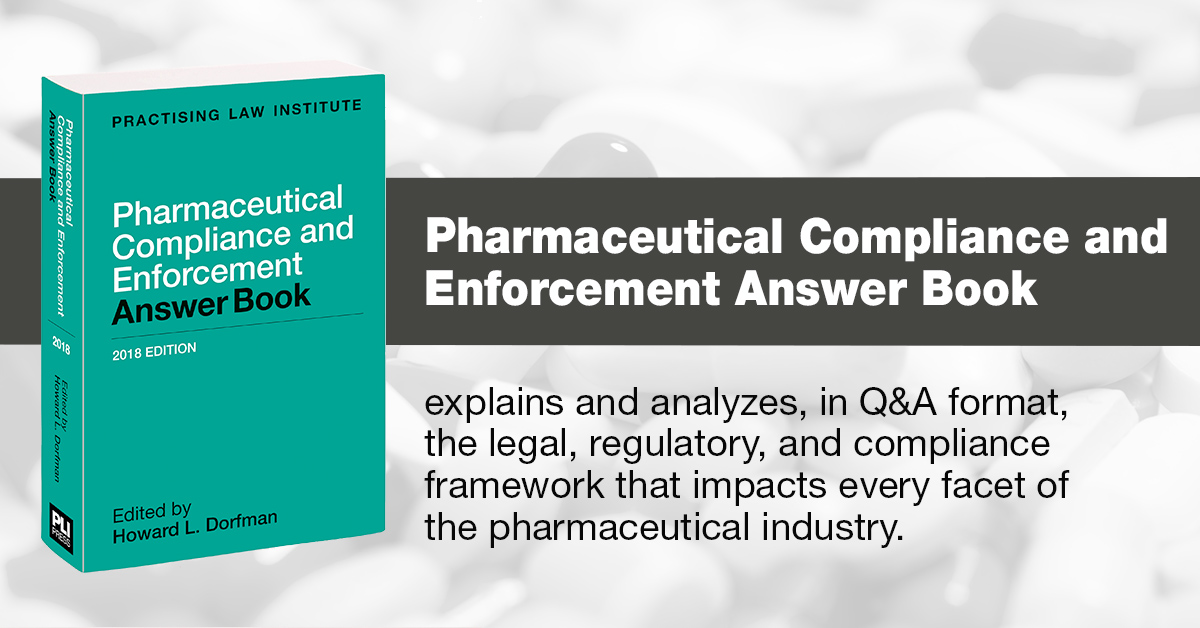
New Edition! Pharmaceutical Compliance and Enforcement Answer Book (2018 Edition)


PLI recently published the 2018 edition of Pharmaceutical Compliance and Enforcement Answer Book, which provides a comprehensive overview of the complex regulatory issues faced by the different participants in the pharmaceutical industry.

This resource gives clear, expert answers to questions on topics such as:

Filled with practical suggestions, Pharmaceutical Compliance and Enforcement Answer Book provides attorneys and compliance officers with a roadmap to effective compliance with FDA pharmaceutical regulations.

This new answer book is available on PLI PLUS, our research database.  If you’d like to order a print copy, please email libraryrelations@pli.edu or call 877.900.5291.

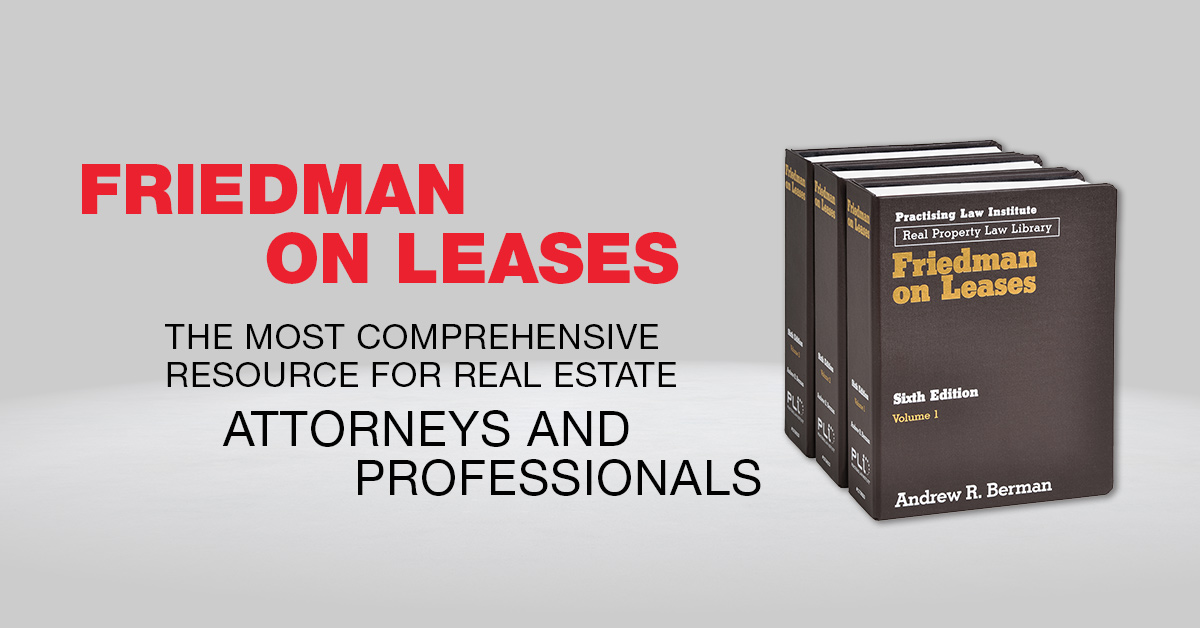
Treatise Update! Friedman on Leases

PLI recently updated Friedman on Leases (Sixth Edition). This acclaimed treatise clarifies and analyzes the full range of lease provisions and conceivable landlord-tenant situations to give you unsurpassed practical instruction on how to negotiate and draft airtight agreements that protect your clients’ rights and minimize their liability exposure.

This definitive work continues to deliver not only the foundational knowledge required by novice practitioners, but also analysis of and insight into the most current and relevant developments facing
seasoned practitioners in the commercial real estate field.

Highlights of this Release #3 include the following:

    • Disclaimer of Waiver by Landlord: Updated discussion examines
      whether a nonwaiver provision may be waived.
    • Security Deposit Clause: New samples of a lease provision that requires
      tenant to deposit cash as security; a lease provision that requires
      tenant to deposit a letter of credit as security; a lease provision that permits
      tenant to deposit either cash or a letter of credit as security; a lease
      provision that permits the security deposit to be reduced if certain conditions
      are satisfied; and a form of a letter of credit to be attached as an
      exhibit to a commercial lease.
    • Option to Cancel Lease—Sample Provisions: New samples of negotiated
      provisions granting tenant the one-time right to cancel.
    • Stipulations: Instead of a stipulation that permits tenant to remove
      its installations, an alternative approach is for the parties to define in the
      lease what constitutes “Tenant’s Property,” and that the tenant has the
      right (and/or the obligation) to remove its property. A new sample provision
      of this type is provided.

This essential title is available on PLI PLUS, our online research database.  If you’d like to order a print copy, please email libraryrelations@pli.edu or call 877.900.5291.