Our 2018 Books catalog is now available! Browse PLI Press publications here:
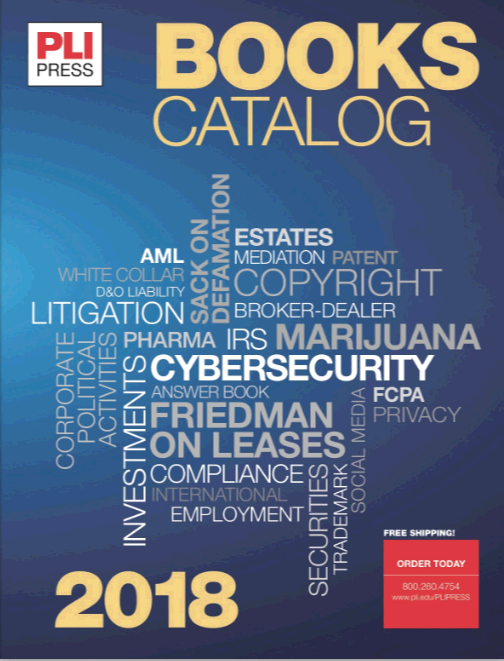
Our 2018 Books catalog is now available! Browse PLI Press publications here:
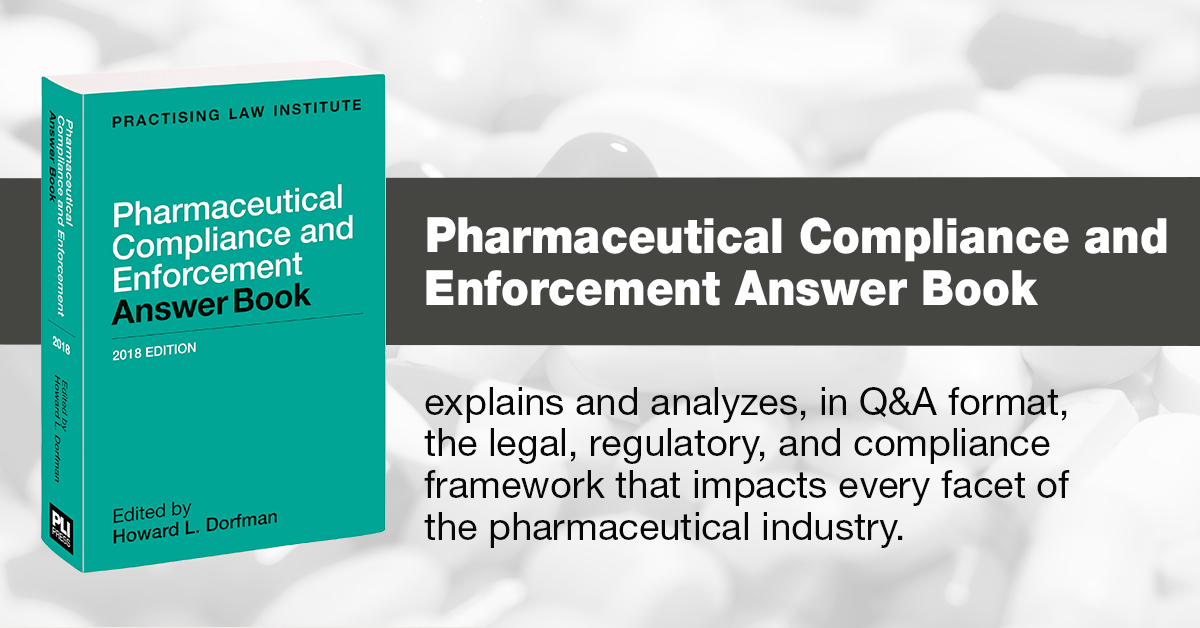
PLI recently published the 2018 edition of Pharmaceutical Compliance and Enforcement Answer Book, which provides a comprehensive overview of the complex regulatory issues faced by the different participants in the pharmaceutical industry.
This resource gives clear, expert answers to questions on topics such as:
Filled with practical suggestions, Pharmaceutical Compliance and Enforcement Answer Book provides attorneys and compliance officers with a roadmap to effective compliance with FDA pharmaceutical regulations.
This new answer book is available on PLI PLUS, our research database. If you’d like to order a print copy, please email libraryrelations@pli.edu or call 877.900.5291.

PLI recently updated Friedman on Leases (Sixth Edition). This acclaimed treatise clarifies and analyzes the full range of lease provisions and conceivable landlord-tenant situations to give you unsurpassed practical instruction on how to negotiate and draft airtight agreements that protect your clients’ rights and minimize their liability exposure.
This definitive work continues to deliver not only the foundational knowledge required by novice practitioners, but also analysis of and insight into the most current and relevant developments facing
seasoned practitioners in the commercial real estate field.
Highlights of this Release #3 include the following:
This essential title is available on PLI PLUS, our online research database. If you’d like to order a print copy, please email libraryrelations@pli.edu or call 877.900.5291.
 We add content to PLI PLUS every month to ensure our subscribers have access to the most up-to-date and relevant secondary source legal documents. Renowned legal experts regularly update our acclaimed Treatises, Course Handbooks, Answer Books, Transcripts and Forms to reflect recent changes and developments in the law.
Click here to see what we added in July!
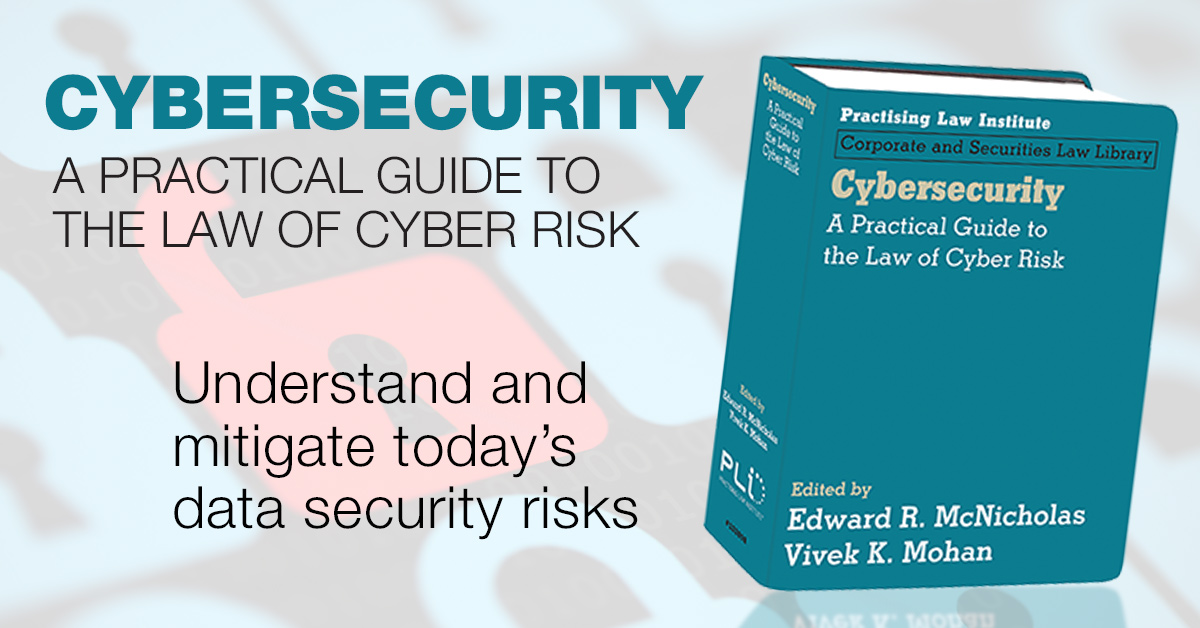
PLI recently updated Cybersecurity: A Practical Guide to the Law of Cyber Risk.
Among the many developments in this fast-moving field that are reflected in this treatise release are:
The updated treatise is available on PLI PLUS, our online research database. If you’d like to order a print copy, please email libraryrelations@pli.edu or call 877.900.5291.
Next week, Practising Law Institute will be at the AALL Annual Meeting & Conference in Baltimore, Maryland, celebrating our profession and the experts who provide meaning to our organizations. We know with all the interesting sessions and networking events taking place, conference schedules get booked fast—so be sure to save some time to visit us at the PLI booth!
Stop by to chat with our team of experts exhibiting at the show! You can find us at booth #324, where you can enter our raffle giveaway for an one-year subscription to Ancestry.com, see a demonstration of PLI PLUS, and learn about exciting recent enhancements to the online research platform.
You’ll find us at booth #324, where you can chat with our team of experts, see a demonstration of PLI PLUS, and learn about exciting recent enhancements to the online research platform. And be sure to enter our raffle giveaway for a one-year subscription to Ancestry.com!
Also, don’t miss our Librarian Advisory Breakfast on Sunday, July 15th at 7:30am. To reserve your spot, please email PLUS@pli.edu by July 13, 2018.
(null)
(null)

Interested in learning more about our Employment law resources on PLI PLUS? Take a look at our Employment Law Research Center!
(null)
(null)
You can also find the Employment Law Research Center document on our Training Center.
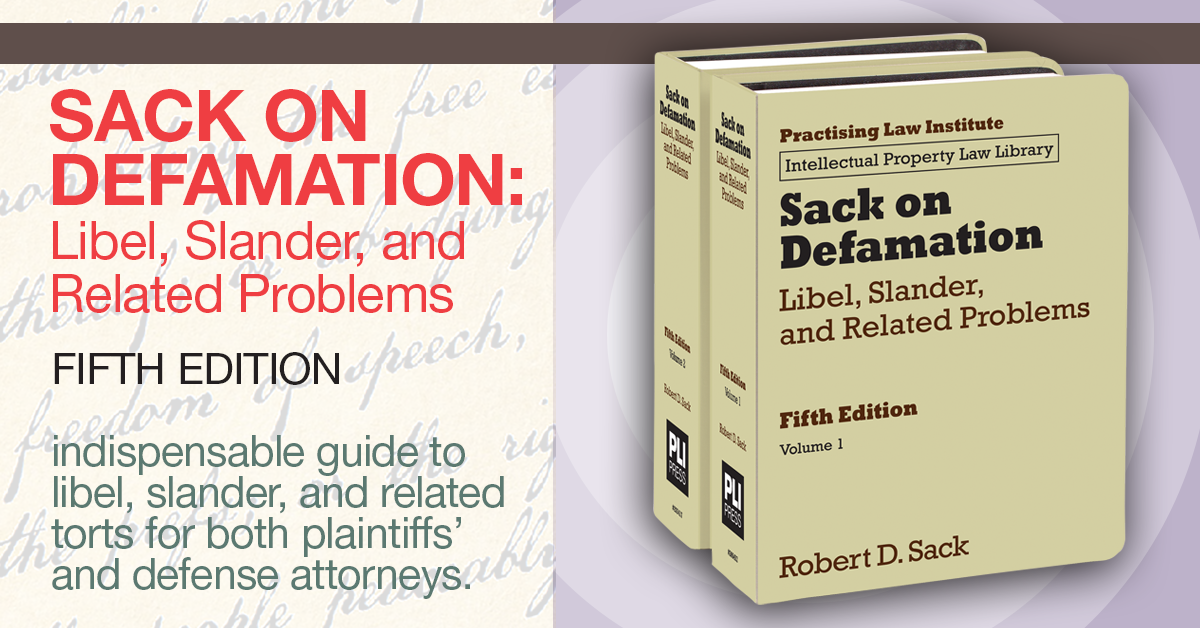 Written by a U.S. Court of Appeals judge and cited by courts throughout the United States–including by the U.S. Supreme Court–Sack on Defamation delivers definitive legal, strategic, and tactical insight into libel, slander, and other defamation-related causes of action for both plaintiffs’ and defense attorneys.
Highlights of the new release include:
• Context of allegedly defamatory statement: In McKee v. Cosby, the
plaintiff accused the defendant of defaming her in a letter by using her
published statements out of context. But the First Circuit, applying
Massachusetts law, concluded to the contrary, noting that the quotations
were “immediately followed by a hyperlink to the source article, allowing
readers to put [the plaintiff’s quoted] statements into proper context.”
• Defamation of groups and group members: In Elias v. Rolling Stone
LLC, the Second Circuit, applying New York law, held that it was error
to dismiss a defamation cause of action brought by a group of fifty-three
members of a college fraternity, based on a false published statement
by the defendant that some nine of the fraternity’s then members had
committed or participated in a rape at their fraternity house.
• Hepps doctrine—matters of public concern: The Texas Supreme Court,
in Brady v. Klentzman, has “recognized that even if the general subject
matter of a publication may be a matter of legitimate public concern,
some of the details may not be. But if a ‘logical nexus’ exists between
these details ‘and the general subject matter’ of the article, then they are
reasonably included as a matter of public concern.”
• Opinion—emojis and emoticons: Digital media may well give rise to
a new context in which to decide whether a statement is fact or opinion.
One can guess that emojis and emoticons will, by their nature, ordinarily
be treated as nonactionable opinion or commentary. See § 4:3.1[A], at
note 121.1.
• Public officials: Persons held to be public officials include the director of
budget and finance for a public school system; a former town clerk who,
as such, “had the primary responsibility for organizing and issuing the
payroll for the town”; and the deputy manager of a U.S. shuttle projects
office partially responsible for overseeing the development and operation
of the propulsion systems for the ill-fated Challenger shuttle.
• “Actual malice”—fictionalization: In Lovingood v. Discovery
Communications, Inc., a federal district court in Alabama found no
“actual malice” where a BBC docudrama broadcast under license by the
defendant contained an invented scene defamatory of the public-figure
plaintiff; “there is no evidence from which jurors could reasonably infer
that the . . . defendants had reason to doubt the accuracy of the scenes
in the . . . film or that the defendants’ failure to do more to investigate
the accuracy of the two scenes at issue evidences ‘an intent to avoid the
truth.’”
• Absolute privilege—statements to federal authorities: Statements to
federal officials may also be entitled to absolute privilege. For example,
in Mangold v. Analytic Services, Inc., a divided panel of the Fourth Circuit
held that statements made by a government contractor in the course of
the investigation of an Air Force colonel’s dealings with the contractor
were absolutely privileged. The court saw the privilege as analogous
to immunity for testimony in court, before a grand jury, and to public
prosecutors.
• Qualified privilege—charges of child sexual abuse: In Connecticut, by
statute, charges of child sexual abuse made to the Department of Children
and Families are entitled to qualified immunity.
• Damages: Although the courts continue to monitor and sometimes limit
damage awards, there are still large libel verdicts that survive appellate
review, as a number of multi-million-dollar cases demonstrate.
• Jurisdiction—New York long-arm statute: New York’s long-arm
statute includes exceptions that limit its application in defamation cases;
this favorable treatment of defendants in defamation cases has been held
by the Second Circuit, in a thorough opinion by Judge Walker, to be
constitutional, abridging neither the plaintiff’s First Amendment right to
petition nor his or her Fourteenth Amendment rights to equal protection
(Friedman v. Bloomberg L.P.).
• Texas Defamation Mitigation Act: In addition to its anti-SLAPP statute,
Texas has enacted the Defamation Mitigation Act, which requires a
prospective plaintiff to make a request of the prospective defendant for a
correction, clarification, or retraction of offending allegedly defamatory
material before bringing a defamation action, unless the defendant has
made such a correction, clarification, or retraction without such a request.
• Anti-SLAPP laws—Massachusetts, Maine: Recent cases interpret and
apply the anti-SLAPP statutes of Massachusetts (Blanchard v. Steward
Carney Hospital, Inc.) and Maine (Gaudette v. Mainely Media, LLC),
which are both aimed at protecting the constitutional right to petition,
rather than freedom of speech or of the press generally.
The updated treatise is available on PLI PLUS, our online research database. If you’d like to order a print copy, please email libraryrelations@pli.edu or call 877.900.5291.
 PLI recently published the 2018 edition of Transfer Pricing Answer Book.
The phenomena of increasingly global business enterprises with valuable intangible property expose companies to transfer pricing enforcement by different countries around the world. Many of these countries are increasingly aggressive in enforcing their local transfer pricing rules, as they attempt to protect their tax revenue base. To avoid double taxation of the same income in this environment, companies often are required to deal with the highly specialized, bilateral treaty-based competent authority process developed to prevent double taxation at a time when trade mainly involved only two established countries. Even more challenging today, companies and tax authorities increasingly are faced with the potential for multiple taxation of the same income, as supply chains cross many borders and as the tax authorities of emerging countries become players in the global taxation process, and the resulting stresses, strains, and limitations of the bilateral treaty-based competent authority process have become more apparent.
In light of the high-dollar risks presented by the increased enforcement efforts of tax authorities worldwide, the complexity of the ever-changing, inherently uncertain transfer pricing standards, and the continually evolving business models of businesses adapting to the constantly changing global economy, companies need practical guidance to permit them to develop and defend their transfer pricing strategies.
Transfer Pricing Answer Book gives companies such guidance by discussing all aspects of transfer pricing, from initially planning a transfer pricing strategy, to alternative ways to defend the strategy from attack by two or more tax authorities, to resolving a case before competent authorities, to bringing a transfer pricing case to court. It also provides an overview of the IRS’s approach to transfer pricing enforcement. The book’s non-technical discussion is presented in a question-and-answer format that will appeal to readers regardless of their prior level of experience or familiarity with taxes in general and transfer pricing in particular.
Transfer Pricing Answer Book is an invaluable resource for company executives and their advisors who are seeking to better understand this important area of tax law–one that has become an important economic facet of so many businesses.
The new edition is available on PLI PLUS, our research database. If you’d like to order a print copy, please email libraryrelations@pli.edu or call 877.900.5291.