PLI PLUS offers unlimited electronic access to more than 4,500 downloadable, searchable, and editable legal forms ready for use in your practice. In an effort to highlight this unique content type, we’ve selected one form per month and made it available for anyone to download for free – no subscription required.
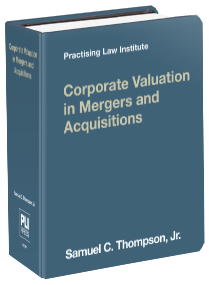
This book offers a solid primer on the legal, finance, accounting, and economic aspects of valuation in merger and acquisition (“M&A”) transactions. It addresses a wide range of issues that can arise in the process of evaluating a target or acquirer in an M&A transaction. The book also provides helpful reference materials in each chapter that the reader may consult when facing a particular issue, along with many documentary appendices relating to valuation issues.
This book offers a solid primer on the legal, finance, accounting, and economic aspects of valuation in merger and acquisition (“M&A”) transactions. It addresses a wide range of issues that can arise in the process of evaluating a target or acquirer in an M&A transaction. The book also provides helpful reference materials in each chapter that the reader may consult when facing a particular issue, along with many documentary appendices relating to valuation issues.
Notably, the book covers the following important topics:
Basic business and regulatory M&A principles (see Chapter 1)
Is your library interested in subscribing to PLI’s Standing Order Plan (SOP)? SOP subscribers automatically receive print copies of new titles to review upon release. If you decide to keep the title, you will receive a discount up to 25% off the title and all future supplements. Call 877.900.5291 or email libraryrelations@pli.edu to learn more.
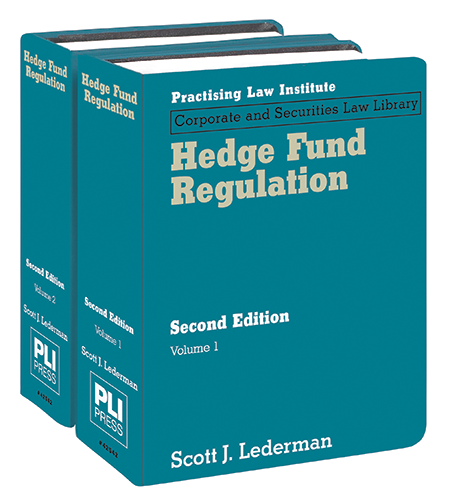
Hedge Fund Regulation offers a thorough examination of hedge funds and the ever-changing regulations that impact their structure, activities, and operations. Hedge fund counsel and financial industry stakeholders will find invaluable pointers on Regulations D, S, and other statutes; anti-money laundering and privacy compliance; highly-regulated investors; complex assets and transactions; and federal agency reporting requirements. The guide includes flowcharts and checklists that cover investment advisor registration, CPO annual reporting, and recordkeeping requirements.
Highlights from the updated release include:
Rationale for Regulation: Updated analysis concerning the SEC’s regulatory shift towards more substantive regulation of investment advisers (see section 3:4).
Marketing the Manager: Added discussion of recent SEC enforcement activity regarding the Marketing Rule (see section 6:2.1[B][4][e][iv]).
Compliance: Extensive revisions to cover the new rules and rule amendments under the Investment Advisers Act that substantially modify existing regulatory requirements and create new compliance obligations for investment advisers to private funds (see section 13:8). Updated discussion of SEC examinations of investment advisers (see section 13:14).
Books and Records: Revisions address new SEC books and records requirements related to recent major modifications to the Investment Advisers Act. Updated analysis of recent significant changes to Form PF (see section 14:3.2).
Financial Product Fundamentals offers a comprehensive dive into the regulatory, pricing, marketing, and viability issues surrounding registered offerings. It also provides the legal fundamentals underlying private placements, real estate investment trusts, hedge and exchange-traded funds, and other registered offering types. The book gives pointers on completing and filing Forms F-1 and 20-F, navigating policy closings, devising IPO timelines, and more. In addition, this compendium addresses the Dodd-Frank Act, SEC actions, foreign broker-dealers, advertising in connection with prospectuses, insurance-linked securities, and life settlements.
Highlights from the updated release include:
Alternative Capital Raising for Public Companies: Revision covers the settlement cycle for ATM offerings (see section 2A:2.2[E]).
International Securities Offerings: New discussion covers the Holding Foreign Companies Accountable Act (see section 3:13).
Special Purpose Acquisition Companies: New discussions cover the adoption of a U.S. federal excise tax on corporate share repurchases (see section 5A:8.4); the 2022–2023 SPACs special meetings for approval of business combinations and extensions of business combination deadlines and liquidations (see section 5A:8.5); the ratification actions in Delaware (see section 5A:8.6); and restructurings and re-SPACs (see section 5A:8.7).
Sustainable Finance: Extensive updates to Chapter 5, with new coverage of sustainability-linked loan documentation guidance (see section 5B:4.4); the EU Corporate Sustainability Reporting Directive, which came into force in January 2023 (see section 5B:5.3); and the EU green bond standard (see section 5B:5.4).
Exchange-Traded Funds: Revisions cover Rule 12d1-4 under the Investment Company Act, a new rule designed to streamline and enhance the regulatory framework for funds that invest in other funds (“funds of funds”) (see section 17:3.3).
We add content to PLI PLUS every month to ensure our subscribers have access to the most up-to-date and relevant secondary source legal documents. Renowned legal experts regularly update our acclaimed Treatises/Practice Guides, Course Handbooks, Answer Books, Transcripts, and Forms to reflect recent changes and developments in the law.
PLI PLUS offers unlimited electronic access to more than 4,500 downloadable, searchable, and editable legal forms ready for use in your practice. In an effort to highlight this unique content type, we’ve selected one form per month and made it available for anyone to download for free – no subscription required.
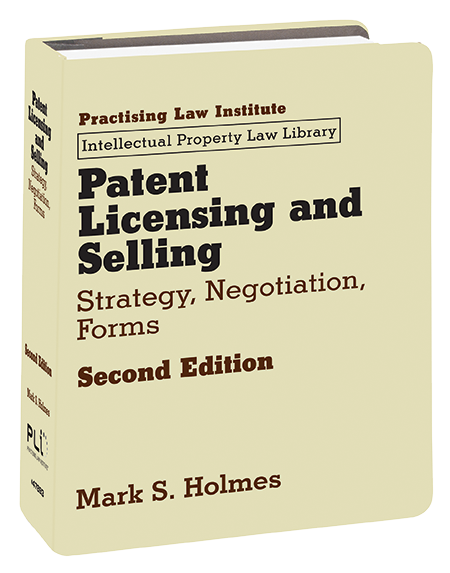
Patent Licensing and Selling guides practitioners through the fundamentals of drafting and structuring profitable patent licensing deals. Containing more than 350 sample agreements and clauses, the book provides actionable strategies to negotiate these deals. It also highlights terms that can trigger delays and disputes, strategies around exclusive licenses, and pointers for selecting markets for specific licensees. In addition, the text integrates discussion on infringement protection and enforcement steps, license duration and termination guidelines, and confidentiality considerations.
The new release includes revised and expanded coverage of the following topics:
Definitions: New sections 1:1.1 and 1:5.1[C] discuss the implications of failing to define a term, using the as term “affiliate” as an example and showing the need to uncover the identity of each affiliate (section 1:5.1[A]) and to determine whether an entity qualifies as an affiliate (section 1:5.1[B]), as well as any limitations around the term (section 1:5.1[C]), the consequences of leaving the term “affiliate” undefined (section 1:5.1[D]), which edition of dictionary to use (section 1:5.1[E]), and the overall lessons to be learned (section 1:5.1[F]).
Additional future licenses: Inclusion of a sample provision dealing with a situation in which the licensee discovers that he or she unknowingly developed products that infringed patents already owned by the licensor and that are not licensed to the licensee under the patent license agreement (see section 2:5.4).
Royalties: Added information on withholding taxes on royalty payments (see NEWsection 4:9.8).
Prosecution and maintenance: Instruction on the consequences of a party’s decision to abandon prosecution and maintenance (see section 6:3.2[A]).
Licensee efforts: Extensive coverage of a licensee’s obligation to use “best efforts” and commercially reasonable efforts (see section 12:1.1 and section 12:6, respectively).
Technology license agreements: New coverage around licensing of other intellectual property, such as trade secrets, confidential information, and know-how (see NEWChapter 20).
New contract provisions: Examples 1:5B, 1:9, and 1:20 (Definition of affiliate); Example 1:41A (Choice of law); Example 1:51A (Commercially reasonable efforts); Example 2:53 (Additional future patent license; licensee infringing licensor patents not licensed under the patent license agreement); Examples 4:55A, 4:55B, and 4:55C (Tax withholding); Example 5:10 (Audit; payment for audit); and Example 6:6 (Notice of intent to abandon prosecution or maintenance of licensed patents).
We add content to PLI PLUS every month to ensure our subscribers have access to the most up-to-date and relevant secondary source legal documents. Renowned legal experts regularly update our acclaimed Treatises/Practice Guides, Course Handbooks, Answer Books, Transcripts, and Forms to reflect recent changes and developments in the law.