Category Archives: Law Libraries

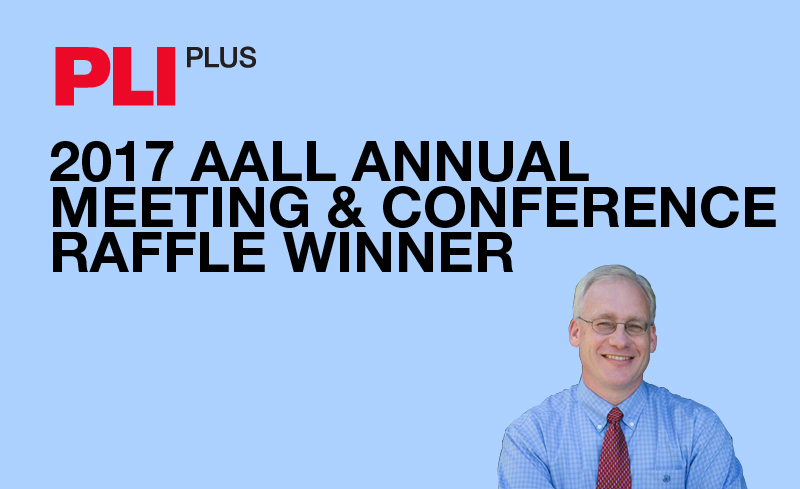
Meet Our AALL 2017 Raffle Winner: James Wirrell

2017AALLRaffleWinnerAt the AALL Annual Meeting & Conference in Austin this year, PLI raffled off a $1,000 AmericanExpress gift card. James Wirrell, Assistant Dean for Library Sciences at McGeorge School of Law at University of the Pacific, was our lucky winner. Check out our interview with James below!

Tell me a little about yourself. Why did you become a librarian?

I am originally from the Vancouver area in Canada and attended law school there. After meeting an American (who I am now married to), I did my third year as a visiting student at Hastings in San Francisco. As an international student, the only place I could work at Hastings was in the library. While working in the library and interacting with the law librarians, I decided that this was the career for me. After Hastings, I attended both library school and law school again at the University of Illinois. I am now a citizen of both the US and Canada and have worked in law libraries at the University of Illinois, the University of Richmond and the University of the Pacific, McGeorge School of Law.

What do you like most about your job at University of the Pacific, McGeorge School of Law?

As the director of the law library, I enjoy working with everyone on my staff to provide the best possible service to the law school in as efficient a manner as possible. Budgets are an issue for us, and I like to be able to give our school and its students good value for the money. I enjoy working with people and with making a positive contribution in this world.

What is the most common research question you receive?

Our research questions are becoming increasingly complex and involve multi-faceted research projects. Typically, the research questions we now face are ones that the users were not able to solve for themselves using the basic search tools in the common electronic databases. As such, the questions we now get require us to go outside of the usual channels to find the answers.

Which PLI publication do you most frequently recommend to students?

One of our leading professors has an interest in alternative dispute resolution. Accordingly, we have referred students to American Arbitration: Principles and Practice.

What did you think of AALL 2017? Did you do any sightseeing in Austin?

I always enjoy the networking at AALL with both fellow law librarians, but also with vendors. This year I was particularly excited by the pre-conference workshop I attended on the new academic law library data collection platform, ALLStAR. My wife accompanied me and we did some walking around the city and took in some art galleries and the Texas state capitol. She also came to see the AALL Exhibit Hall once and was given a red PLI bag which she decided was the very best swag given out at the conference. We also were able to spend a couple of nights after the conference visiting some friends who live in greater Austin.

How do you plan on using your AmEx gift card?

Good question! I haven’t thought too much about it. I tend to be more of a saver than a spender. I think I will earmark the value and use it down the road to be a bit more adventurous with new technology and mobile phone upgrades.

Thank you, James! And congratulations!

AALL Austin 2017: Visit us at booth #813!

Next month, Practising Law Institute will be at the 110th AALL Annual Meeting & Conference in Austin, Texas celebrating our profession and the experts that provide meaning to our organizations. We know everyone’s conference schedules get booked fast with the interesting sessions and networking events taking place, but we look forward to meeting and seeing you!

Stop by to chat with our team of experts exhibiting at the show! You can find us at booth #813 where you can enter our raffle giveaway, see a demonstration of PLI PLUS and learn about recent enhancements to the online research platform.

Also, don’t miss our Librarian Advisory Breakfast on Sunday, July 16th at 7:30am.  To reserve your spot, please email PLUS@pli.edu by July 14, 2017.

See you in Austin!

AALL2017FloorPlan


9 Terms to Include in Your Privacy Policy

A privacy policy should disclose the types of information that a company collects, how that information is used, and with whom that information is shared.

The authors of Privacy Law Answer Book, edited by Jeremy Feigelson (Debevoise & Plimpton LLP), recommend, at a minimum, the following terms:

  1. A description of the personal information that will be collected—for example, a user’s name, email address, phone number, mailing address, or credit card number.
  2. When that personal information will be collected—for example, information may be collected when a user registers for an online account or places an order.
  3. A description of the non-personal information that will be collected—for example, a user’s browser information or IP (Internet Protocol) address.
  4. How that non-personal information will be collected—for example, through the use of cookies or web beacons.
  5. How the collected information will be used—for example, personal information may be used to send the user information about a company’s products or services, and non-personal information may be used to provide targeted advertising by displaying products or advertisements that may be of interest to the user.
  6. Whether the collection of any information is voluntary or mandatory for consumers— for example, if non-personal information is automatically collected via cookies, that is considered mandatory collection.
  7. The categories of third parties with whom the information is shared—for example, information may be shared with a company’s affiliates, outside vendors, or other third parties (this disclosure need not list each third party by name).
  8. Whether and how a user can review or change her personal information—for example, explaining how a user can update her profile or contact a company to request a change or request that information be deleted from the user’s records.
  9. A statement that the privacy policy should not be construed as establishing a contractual relationship.

TO LEARN MORE ABOUT DATA PRIVACY LAW AND PRIVACY POLICIES, INCLUDING THE AUTHOR’S POLICY OUTLINE, PURCHASE:

Privacy Law Answer Book (2017 Edition) Edited by Jeremy Feigelson, Debevoise & Plimpton LLP

Subscribe to Discover PLUS?  Read it here ›

3 Elements of an FDA Recall Strategy

James P. Ellison and Anne K. Walsh’s FDA Deskbook: A Compliance and Enforcement Guide provides an in-depth discussion on recalls.

A firm conducting a recall must develop a recall strategy taking into account the results of the Health Hazard Evaluation (HHE), ease in identifying the product, the degree to which the product’s deficiency is obvious to the consumer or user, the degree to which the product remains unused in the marketplace, and the continued availability of essential products. FDA will review and approve the recall strategy of a recalling firm. The elements of a recall strategy are:

  1. Depth of Recall The depth of recall pertains to the level in the distribution chain to which the recall will be extended. This will depend on the product’s degree of hazard and extent of its distribution. For example, the recall could extend all the way to the consumer or user level, it could stop at the retail level, or it may not need to go beyond the wholesale level.
  2. Public Warning A public warning is intended to alert the public that “a product being recalled presents a serious hazard to health.” It is only used in urgent situations for which other means of preventing use of the product appear inadequate. FDA will usually issue the warning in consultation with the recalling firm. If the firm issues its own warning, it should submit the warning to FDA for review and comment prior to distribution, along with a plan for distribution. The recall strategy should indicate whether a public warning is needed and how it will be issued, for example, via general or specialized news media.
  3. Effectiveness Checks Effectiveness checks are required to confirm that all consignees at the specified recall depth received the notification. Consignees may be contacted by whatever means deemed appropriate by the recalling firm, including by letter, telephone calls, or a combination. It is recommended that a firm conduct at least the initial effectiveness check in writing, and may then follow up via telephone if no response is received. When a phone call is made, the firm should document the call and that documentation should be retained in the recall record. The recall strategy will specify the methods to be used and the level of effectiveness checks that will be conducted. Depending on the product involved and the health hazard presented by the product, a firm may be required to contact 100% of consignees, or may not be required to conduct an effectiveness check at all.


TO LEARN MORE ABOUT THE FDA, READ:

FDA Deskbook: A Compliance and Enforcement Guide Edited by James P. Ellison and Anne K. Walsh (Hyman, Phelps & McNamara, P.C.)

Subcribe to Discover PLUS?  Read it here — ›

Last Day – National Library Week Book Sale!

2016 National Library Week II

In celebration of National Library Week, Practising Law Institute is offering a 20% discount on all Treatises and Answer Books from April 10 – 16. Today is the last day of our sale!

Prefer to do your research digitally?  We encourage you to access our publications online through a subscription to PLI’s research database, Discover PLUS.   Discover PLUS gives you access to our Course Handbooks, Treatises and Answer Books, in addition to over 3,000 downloadable forms and close to 1,000 program transcripts.


Happy National Library Week – Libraries Transform

2016 NLW-banner_0


This year, National Library Week is celebrating library transformation. The Library Relations team here at PLI is aware that many libraries are undergoing their own transformations from print to digital and we’re here to help! Schedule a Discover PLUS demo or training at any time.

PLI Discover PLUS Coverage List 2015

We’ve updated our coverage list!  Check it out below.

Discover PLUS is updated continuously; this list serves as a snapshot of published online content as of July 2015. This comprehensive coverage list is organized as follows: Books in Alphabetical Order; Books by Practice Area; Forms in Alphabetical Order; and Transcripts.

If you have any questions about the coverage list or would like to learn more about Discover PLUS, please contact PLI Library Relations at libraryrelations@plu.edu or 877-900-5291.

Card