Category Archives: PLI PLUS

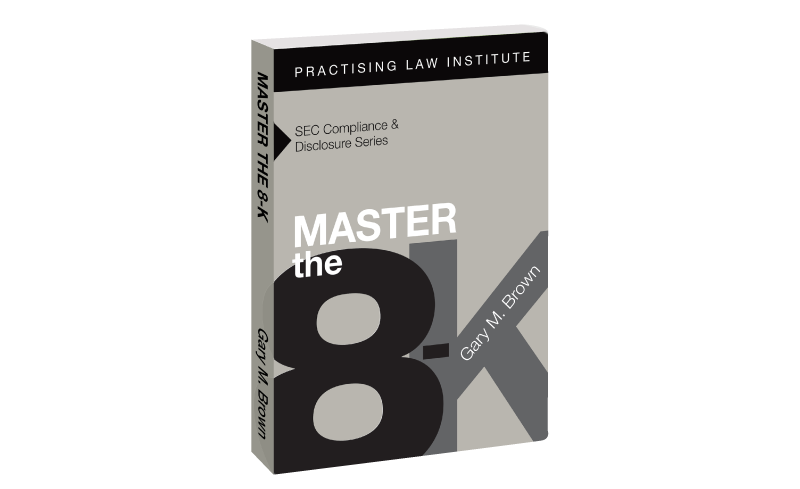
New Title! Master the 8-K

Master the 8-KMaster the 8-K is the first publication from PLI’s new SEC Compliance and Disclosure series. It is a clear, concise, and comprehensive guide to filing the SEC’s Current Report on Form 8-K that every securities lawyer will want to have close at hand.

This handbook begins with an overview of the Form 8-K requirements and principles generally applicable to all Form 8-K Items, such as:

In this easy-to-use handbook, each Form 8-K Item is broken down and begins with “highlights” that, at a glance, alert you to critical matters about that Item, such as whether the “safe harbor” applies, whether there are exhibit requirements, whether there are possible update requirements, and whether there are critical definitions to consider. Then, you will find step-by-step instructions and expert practice tips on:

  • Triggering events and disclosure requirements for every Form 8-K Item
  • The requirements for effective disclosure controls
  • Filing procedures and deadlines
  • Possible 8-K “traps”, such as update requirements, and how to avoid them

Master the 8-K also includes sample disclosure language, and detailed appendices containing the Form 8-K itself, key regulations, and SEC Compliance and Disclosure Interpretations (C&DIs)—it is intended to be a stand-alone resource for those attempting to master the Form 8-K.

This essential title is available on PLI PLUS, our online research database.  If you’d like to order a print copy, please email libraryrelations@pli.edu or call (877-900-5291).


What’s New for November on PLI PLUS


11-2017 What's NewWe add content to PLI PLUS every month to ensure our subscribers have access to the most up-to-date and relevant secondary source legal documents. Renowned legal experts regularly update our acclaimed Treatises, Course Handbooks, Answer Books, Transcripts and Forms to reflect recent changes and developments in the law.

Click here to see what we added in November!

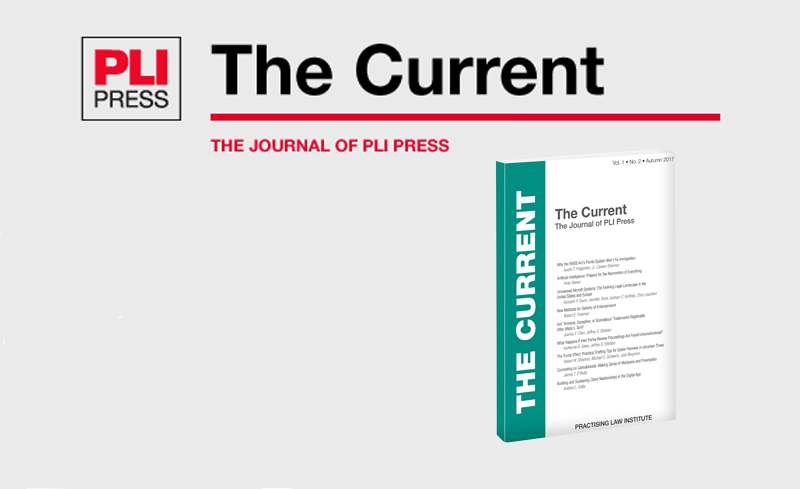
The Current: The Journal of PLI PRESS, Volume 1, Issue 2

Current Volume 2

PLI is pleased to announce that the second issue of The Current, PLI’s new quarterly journal, has been released and is available on PLI PLUS.

Each issue of The Current features original articles that cover new and emerging developments impacting the law and the legal profession. In every issue you’ll find expert insights, commentary, and analysis from leading practitioner’s, including PLI’s authors and faculty members.

Articles featured in the Autumn 2017 issue include:
Artificial Intelligence: Prepare for the Reinvention of Everything, Peter Brown (Peter Brown & Assocs. PLLC)
Are “Immoral, Deceptive, or Scandalous” Trademarks Registrable After Matal v. Tam?, Joanna Y. Chen & Jeffrey G. Sheldon (Cislo & Thomas)
The Trump Effect: Practical Drafting Tips for Estate Planners in Uncertain Times, Robert W. Sheehan, Michael S. Schwartz, Josh Bergman (Curtis, Mallet-Prevost, Colt & Mosle LLP)
Counseling on Cannabinoids: Making Sense of Marijuana and Preemption, Prof. James O’Reilly (University of Cincinnati)

The Current  is available through your PLI PLUS subscription.

Not a PLI PLUS subscriber? Click here to sign up for a FREE digital version of The Current. The journal is also available here for purchase in print.

What’s New for October on PLI PLUS

2017-10 What's NewWe add content to PLI PLUS every month to ensure our subscribers have access to the most up-to-date and relevant secondary source legal documents. Renowned legal experts regularly update our acclaimed Treatises, Course Handbooks, Answer Books, Transcripts and Forms to reflect recent changes and developments in the law.

Click here to see what we added in October!

Library Ledger, October 2017, Volume 5, Issue 2

10-2017 Library Ledger

The latest edition of the Library Ledger is now available!

In this edition, we review the new look and feel of PLI PLUS and dive into our content on immigration and refugee law. We also highlight our recent and upcoming travels in the letter from Library Relations Manager, Zehava Brickner.

Looking for an older edition? The complete archive of The Library Ledger is available here.

What’s New for September on PLI PLUS

What's New 17-09We add content to PLI PLUS every month to ensure our subscribers have access to the most up-to-date and relevant secondary source legal documents. Renowned legal experts regularly update our acclaimed Treatises, Course Handbooks, Answer Books, Transcripts and Forms to reflect recent changes and developments in the law.

Click here to see what we added in September!

PLI’s New Guide to Financial Services Mediation!

Did you know that Mediation Can Be a Powerful Tool for In-House Counsel? Check out the interview below with the editors of PLI’s new Financial Services Mediation Answer Book (2017 Edition) .

(null)

(null)

Financial Services Mediation Answer Book is available on PLI PLUS, our online research database. If you’d like to order a print copy, please email libraryrelations@pli.edu or call 877-900-5291.

New Update! Faber on Mechanics of Patent Claim Drafting (7th Edition)

Release #4 is now available for Faber on Mechanics of Patent Claim Drafting (7th Edition)

Faber Patent Claim Drafting 7th ED“This work must be included in the library of anyone who considers himself or herself an attorney [in the field].” – The Licensing Journal

A trusted working tool for more than two decades, Faber on Mechanics of Patent Claim Drafting spotlights proven claim drafting practices and techniques that have been firmly established by patent authorities and custom. Faber on Mechanics of Patent Claim Drafting provides full coverage of U.S. Supreme Court and other court decisions critical to claim drafting. It is an indispensable guide for patent specialists and other intellectual property attorneys, corporate counsel, patent agents, patent officials, and inventors.  Among the topics covered in the recently updated book are the following:

  • Patent eligibility—computer-related claims: Several recent Federal Circuit opinions emphasize that patent claims directed to data processing or pure software can be patent-eligible. Software modifications that improve functioning or capacity of a known system are generally patent-eligible. This applies to improvements in computer functionality or solving technology-based problems, even with conventional generic components when combined in an unconventional manner. It is recommended to disclose and discuss the practical benefits of the claim in the specification. The differences from the art, the technological improvement, and the reasons for this may convert what appears to be known technology into something patent-eligible. See 1:5.5, at note 88.3.
  • “Visually negligible”: Words of approximation are not restricted to words like “about,” “approximately,” and “substantially.” The Federal Circuit held that “visually negligible” was definite because the specification provided examples of visually negligible indicators, namely an objective baseline to determine what is visually negligible based on what can be seen by the normal human eye, and neither the examiners nor the experts during prosecution and reexamination had apparent difficulty determining the scope of this term (Sonix Technology Co. v. Publications International, Ltd.). See § 3:19, at note 389.1.
  • Claims in continuing applications—claim construction: According to the Federal Circuit, where more than one patent derives from, that is claims priority to, a common parent, construction of the same claim in two or more of those patents should be the same, since they are all based off the same disclosure and specification (Trustees of Columbia University v. Symantic Corp.). See § 5:5, at note 43.1.

The updated Treatise is available on PLI PLUS, our online research database.  If you’d like to order a print copy, please email libraryrelations@pli.edu or call 877-900-5291.

2017 Edition – Foreign Account Tax Compliance Act Answer Book


FATCA Answer Book_NWForeign Account Tax Compliance Act Answer Book (2017 Edition) provides a detailed analysis of requirements with which U.S. taxpayers with overseas accounts must comply.

Written and edited by Matthew D. Lee (Fox Rothschild LLP), this question-and-answer guide walks the reader through every aspect of the Foreign Account Tax Compliance Act (FATCA) requirements. The book explains FATCA terms and concepts, identifies which foreign financial institutions (FFIs) are covered by the Act (over 155,000) and which countries (over 100) have signed, or indicated their willingness to sign, bilateral tax treaties with the United States (called Intergovernmental Agreements), and describes the obligations placed upon FFIs under the Act.

Additionally, Foreign Account Tax Compliance Act Answer Book provides guidance on how to create an acceptable compliance program and what is required to register as a foreign financial institution.

This new edition is available on PLI PLUS, our online research database. If you’d like to order a print copy, please email libraryrelations@pli.edu or call 877-900-5291.