Category Archives: PLI Press

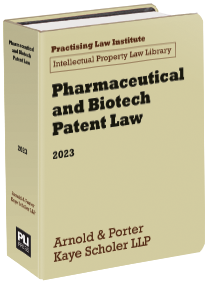
New Edition! Pharmaceutical and Biotech Patent Law (2023)

PLI Press is proud to announce the publication of the new edition of Pharmaceutical and Biotech Patent Law.

This book provides the legal, scientific, and technical information needed to help clients obtain, defend, and challenge patents in these important business areas. It shows readers how to craft problem-free patent applications and includes detailed checklists that help resolve tricky patent issues in the complex pharmaceutical and biotech fields. It is regularly updated to reflect Federal Circuit rulings and other significant court decisions.

Some of the recent developments reflected in this new edition include:

  • Inter Partes Review: Coverage of the PTO guidance for discretionary denials which clarifies when institutions will not be denied under Fintiv (see Section 1:5.3).
  • Patentability of Stereoisomers and New Salts: Discussion of the Federal Circuit’s decision in Mylan Pharmaceuticals Inc. v. Merck Sharp & Dohme Corp. regarding whether Mylan Pharmaceuticals had failed to show that the claims of U.S. Patent No. 7,326,708 were either anticipated or rendered obvious by the asserted prior art (see Sections 7:2.4[A][2] and 7:2.6[C][1]).
  • Cell and Gene Therapy Products: New chapter exploring the patent landscape for cell and gene therapy products and the current disputes related to these products (see Chapter 15).
  • ITC Litigation: New chapter providing recent trends and practice tips on ITC Litigation (see Chapter 16).

Order a print copy today.

PLI PLUS subscribers can access this title through their subscription.

Recommended Reading: Erin Pulaski’s Article in July’s PLI Chronicle

New pay transparency laws are coming into effect across the nation, which is why we are excited about Erin Pulaski’s article, Bringing Pay Data into the Sunlight: California’s New Pay Transparency Protections, published in July’s issue of PLI Chronicle: Insights and Perspectives for the Legal Community.**

The article serves as an excellent primer on how the recently enacted Senate Bill 1162 impacts employers and employees in California. It reviews California’s existing protections, describes the changes imposed by the new law, and answers questions about pay data confidentiality and remote employees. Pulaski, a partner at Rudy, Exelrod, Zieff & Lowe LLP, regularly represents employees and executives in all aspects of individual and class action employment litigation. She is co-author, along with Lindsay Hutner, a shareholder at Greenberg Traurig LLP, of PLI’s recently published California Employment Law treatise.

**Articles published in the PLI Chronicle are available to everyone. Check out July’s issue: PLI Chronicle: July 2023.

Treatise Update – Technology Transactions:  A Practical Guide to Drafting and Negotiating Commercial Agreements

Technology Transactions enables practitioners to draft, review, and negotiate technology transaction agreements. Readers will encounter a trove of sample forms and best practices for negotiating some of the most common and sophisticated types of technology transactions. The book specifically covers issues relevant to software license, technology escrow, non-disclosure, domain name transaction, and cloud computing agreements. It also discusses the relevant privacy and intellectual property regulations lawyers should consider when drafting transactional documents.

Highlights of the new release include:

  • Chapter 4: A new section discusses the increasing adoption of sovereign cloud solutions and industry-specific clouds (see section 4:2.2[G]).
  • Chapter 5: Updated content discusses ICANN’s proposal of the new WHOIS Disclosure System which would facilitate access to nonpublic registration data associated with generic top-level domains (gTLDs) (see section 5:2.1[A]).
  • Chapter 11: New content discusses the increased use of efforts provisions in commercial agreements, the variants of the clauses that have been introduced, and issues litigated (see section 11:4), including the enforceability of such clauses (see section 11:4.1), efforts hierarchies in determining whether the standard was met (see section 11:4.2), and defining efforts standards (see section 11:4.3).
  • Chapter 19: Updated discussion describes the nine new elements that an information security program must include (see section 19:4.2).
  • Chapter 20: New content previews California’s Age-Appropriate Design Code Act which will take effect in 2024 (see section 20:7).

Order a print copy today.

PLI PLUS subscribers can access this title through their subscription.

PLI Librarians in Beantown: Highlights from AALL 2023

Earlier this month, the PLI librarians enjoyed connecting with law librarians from across the country at the 2023 American Association of Law Libraries Annual Meeting & Conference in Boston.

At the PLI Booth, we provided demos of PLI PLUS, answered questions about the PLI Press catalog of publications, and shared our new podcast PLI Ever Current: The Practising Law Librarian. Hosted by Karen Oesterle, PLI’s associate director of legal research development, The Practising Law Librarian features interviews with movers and shakers in the law librarian community – many of whom were at the conference – including Cornell H. Winston, the incoming vice president/president-elect of AALL, and Becky Katz, whose poster “On the Right Track: A New Approach to Access to Justice in the District of Columbia” was on display in the exhibit hall.

At PLI’s Lunch & Learn, attendees watched a demonstration of PLI PLUS that highlighted several new enhancements added to the platform in the last year including an archival titles filter, Ever Current links, the trending titles and topics display, and more. Check out the slides from the presentation.

Trisha Petitt, Foley & Lardner LLP’s technical services librarian, pictured here next to PLI’s associate director of library relations Kay Mitchell (on the left), was the lucky winner of this year’s Lunch & Learn raffle.

It was great seeing so many of our colleagues in Boston this year! For anyone who couldn’t attend, check out these flyers from our booth:

Treatise Update – Kane on Trademark Law: A Practitioner’s Guide (Seventh Edition)

Kane on Trademark Law is a comprehensive resource on trademark law that provides court-tested practical suggestions on how to quickly spot potential conflicts and save time on searches, overcome common descriptiveness rejections, update or amend registrations, and prepare witnesses for depositions. It includes detailed lists of cases, full-color illustrations of previously litigated marks, sample forms, and step-by-step checklists.  The treatise is updated regularly to provide in-depth analysis of the most recent developments in the field.

The new release provides expert analysis and practical insights regarding a wide range of trademark issues. Topics of interest include:

  • Trade dress: A color illustration from the Tenth Circuit’s Bimbo Bakeries case has been added to Appendix B. The case is also cited in section 3:2.2[F].
  • Clearance: Revisions discuss the importance of ensuring that the appropriate rights have been secured to use the planned typeface for the brand (see section 4:3.4).
  • Priority: Revisions cover requirements to estab­lish “use analogous to trademark use” (see section 5:1.1).
  • Internet: Revisions cover the Metabirken NFT jury verdict and issues surrounding artificial intelligence tools, such as ChatGPT and Dall-E (see section 11:1.3).
  • Defenses: Revisions include updates to the General Cigar case (see section 12:2.2[D][1]) and Bluetooth case (see section 12:1.4).

The Table of Authorities has also been updated.

Order a print copy today.

PLI PLUS subscribers can access this title through their subscription.

New Edition! Net Leases and Sale-Leasebacks: A Guide to Legal, Tax and Accounting Strategies (2023 Edition)

PLI Press is proud to announce the publication of the new edition of Net Leases and Sale-Leasebacks: A Guide to Legal, Tax and Accounting Strategies.

This pragmatic guide offers invaluable strategies on how to best approach the most common ownership, financing, documentation, taxation, and accounting issues associated with net leases and sale-leaseback transactions.  It provides example lease documents and in-depth coverage around net leases — along with the legal and structuring issues that impact how they are taxed. Author Ken Miller packs the pages with practical guidance and insight gleaned from his storied career helping clients close more than $7 billion of U.S. commercial real estate transactions, primarily involving net-leased properties.

Some of the highlights from the new edition include:

  • Chapter 2: New sections on legal doctrines relevant to net leases, including landlord liability for injuries on the premises (see §2:2.1), tenant estoppel certificates (see §2:2.2), implied covenants to provide tenant with possession (see §2:2.3), and liability of successor landlord for breaches by former landlord (see §2:2.4).
  • Chapter 5:  
    • New discussion of section 467 rental agreement accrual, including assignment of a tenant’s interest in a section 467 rental agreement (see §5:3.8) and early termination of such an agreement (see §5:3.9).
    • New sections on self-employment taxes (see §5:12) and state taxes (§5:13), with a focus on franchise, excise, and similar taxes in Tennessee, Texas, and California.
  • Chapter 6:  New discussion of I.R.C. section 4975 and the “look through” rule as it applies to investments made by benefit plan investors (see §6:1).
  • NEW Appendix F: Section 467 Rental Agreement Accrual Table.
  • Appendix D and Appendix E have also been updated.

Order a print copy today.

PLI PLUS subscribers can access this title through their subscription.

New Title! Cybersecurity Obligations for Attorneys: Confidential Information in the Age of Cyber Crime

PLI Press is proud to announce the publication of the new practice guide Cybersecurity Obligations for Attorneys: Confidential Information in the Age of Cyber Crime.

This book provides a general understanding of the scope of cyber threats facing the legal profession.  It focuses on the expansion of Rule 1.6 (confidentiality) obligations to specifically address cyber threats and security measures.  It also gives lawyers ways to think about cyber risks when managing their practices on a day-to-day basis. Attorneys can use this one-stop reference to determine their baseline cybersecurity obligations to clients and third parties.

The book covers the following important topics:

  • The cybersecurity threat landscape (see Chapter 1)
  • Cyber threat prevention under the Model Rules and various state codes (see Chapter 2)
  • Obligations imposed by federal and state data breach and privacy laws (see Chapter 3)
  • Federal regulation of cybersecurity obligations (see Chapter 4)
  • How to demonstrate that cybersecurity measures are reasonable using the SAFETY Act (see Chapter 5)
  • Cyber risk mitigation options (see Chapter 6)

Notably, the book also offers attorneys practical recommendations on creating a cybersecurity strategy (see Chapter 7).  All lawyers, ranging from solo practitioners to senior managers at large firms, can benefit from the information and guidance in this book.

We are excited to share this new title with you!

PLUS Subscribers can access this title with their subscription.

Order a print copy today.

 Is your library interested in subscribing to PLI’s Standing Order Plan (SOP)? SOP subscribers automatically receive print copies of new titles to review upon release.  If you decide to keep the title, you will receive a discount up to 25% off the title and all future supplements. Call 877.900.5291 or email libraryrelations@pli.edu to learn more.


New Title! Employment Discrimination:  A Practitioner’s Deskbook

PLI Press is proud to announce the publication of the new comprehensive resource Employment Discrimination: A Practitioner’s Deskbook.

This book serves as a valuable ref­erence for employment law practitioners and individuals interested in helping their organizations effectively navigate employment discrimina­tion-related investigations, mediations, litigations, and jury trials.  Presented in a straightforward, comprehensible manner, it provides the reader with information relating to the full range of employment discrimination litigation from an active practitioner’s perspective.

Notably, the book covers the following important areas:

  • Responding to employment discrimination and harassment complaints (see Chapter 1)
  • Discovery tools (see Chapter 3)
  • Motion practice before and at trial (see Chapter 5)
  • Jury selection (see Chapter 7)
  • Questioning witnesses (see Chapter 8)
  • Addressing the jury (see Chapter 9)
  • Handling matters before government agencies (see Chapter 10)

Additionally, it answers the following questions:

  1. Does failing to “officially” respond to an unofficial “off-the-record” complaint create risk?
  2. What are the best strategies for conducting effective and thorough investigations remotely?
  3. What are tried and true discovery strategies and the best ways to participate in motion practice?
  4. What should lawyers consider when picking a jury and how do they make compelling arguments at trial? 

We are excited to share this new title with you!

PLUS Subscribers can access this title with their subscription.

Order a print copy today.

 Is your library interested in subscribing to PLI’s Standing Order Plan (SOP)? SOP subscribers automatically receive print copies of new titles to review upon release.  If you decide to keep the title, you will receive a discount up to 25% off the title and all future supplements. Call 877.900.5291 or email libraryrelations@pli.edu to learn more.
Treatise Update – Advertising and Commercial Speech: A First Amendment Guide (Second Edition)

Advertising and Commercial Speech: A First Amendment Guide offers a practical examination of how the U.S. Supreme Court’s commercial speech doctrine impacts advertising across nearly 50 industries and professions. The book explores legal standards for defamation, false commercial speech, and disparagement along with developments around advertising for alcohol, financial institutions, professional services, medication, real estate, tobacco, and more.

Among the many topics discussed in this new release are the following:

  • Compelled editorial transparency: New section 12:13 discusses laws passed in Florida and Texas targeting social media platforms’ efforts to combat user-generated disinformation posted on their websites.
  • On-site and off-site signs and billboards: Section 13:2.1[A][7] covers the Seventh Circuit’s ruling regarding whether to apply strict scrutiny or intermediate scrutiny to an ordinance limiting digital displays and off-premises signs.
  • Drugs & drug paraphernalia: Section 14:14 explores a case from the Washington Court of Appeals rejecting a challenge to the state’s advertising restrictions on marketing cannabis products.
  • Regulation of advertising content: Revisions to chapter 14 include:
  1. The ruling of a Florida judge regarding whether part of the state’s Stop W.O.K.E. Act, which forbids companies from undertaking mandatory employee DEI training programs designed to limit or avoid discrimination practices, is unconstitutional (see section 14:16 on fair employment); and
  2. The Eastern District of Arkansas’ final ruling in the Tofurky case involving marketing of plant-based foods (see section 14:20 on food).

In addition, this release includes an updated Table of Cases, Defendant-Plaintiff Table, and Index.

Order a print copy today.

PLI PLUS subscribers can access this title through their subscription.