Category Archives: Treatise

PLI Discover PLUS Immigration Content

PLI has numerous immigration resources, many of which are available on PLI Discover PLUS. Below, we’ve highlighted some of our Immigration materials that may be of particular interest:

If you have any questions about PLI Discover PLUS or our Immigration materials, please email or call (877-900-5291) us.

PLI Discover PLUS: Content Added in 2016

PLI Discover PLUS continually grows: new books are published; Treatises are updated; Forms are added; and new programs generate our Course Handbooks and Transcripts. Here’s a listing of the content added or updated to PLI Discover PLUS in 2016. It can be used as a reference guide for librarians, attorneys, researchers and other subscribers.

  • 19 Answer Books
  • 202 Course Handbooks
  • 611 Archived Course Handbooks
  • 7 Forms
  • 253 Transcripts
  • 16 Treatises
  • 63 Treatises – Supplemented

(null)

PLI Update on Privacy and Data Security Law

PLI recently published a new second edition of our acclaimed, Proskauer on Privacy: A Guide to Privacy and Data Security Law in the Information Age.

Today’s hodgepodge of privacy and data security standards creates greater compliance burdens for corporations, employers, public agencies, and legal advisers. Proskauer on Privacy: A Guide to Privacy and Data Security Law in the Information Age reduces those costly burdens. This comprehensive, one-stop reference covers the laws governing every area where data privacy and security is potentially at risk — including:

Proskauer on Privacy provides essential details on how to develop compliance programs that help your entity satisfy federal and state standards, ensure data privacy and security, prevent cybercrime, and help entities avoid fines, penalties, litigation, damages, and negative publicity.

This Treatise also examines Europe’s rigorous privacy and data security standards, the laws in Canada, Australia, Japan, China, Hong Kong, India, Russia, and Dubai, as well as legal initiatives in California and other states.

This essential title is available on PLI Discover PLUS, our online research database. If you’d like to order a print copy, please email or call (877-900-5291) us.


 

New Edition of PLI’s Guide for Accountants, Auditors and Attorneys

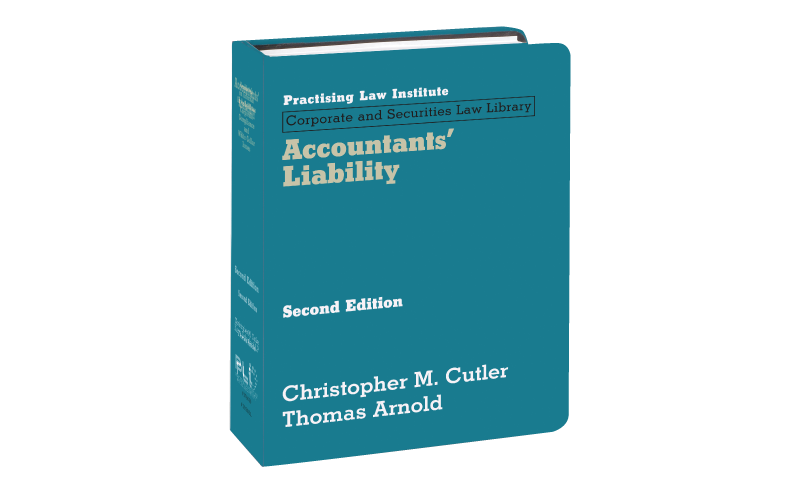
acc-liaPLI recently published the second edition of Accountants’ Liability.

Accountants’ Liability has been the reliable and readable resource that accountants have turned to for guidance on how they can meet their professional responsibilities, comply with relevant rules, and avoid the increased number of legal land mines.

This newly updated edition provides attorneys with the legal, strategic, and tactical knowledge they need to prove (or successfully defend against) claims against accountants such as:

  • Breach of contract
  • Breach of fiduciary duty
  • Negligence
  • Securities claim fraud
  • Common law fraud
  • Civil RICO actions, and
  • Practice and ethical violations.

Accountants’ Liability explores the damage done if accountants fail to follow professional conduct, auditing, accounting or tax standards. The expert authors discuss the sources of current claims, the various legal theories upon which they may be instituted, and some of the practical problems faced by the parties in litigating such claims.

This essential title is available on PLI Discover PLUS, our online research database. If you’d like to order a print copy, please email or call (877-900-5291) us.
New Edition of Securities Litigation: A Practitioner’s Guide

Securities Litigation.jpegPLI recently published a new edition of Securities Litigation: A Practitioner’s Guide (2nd Edition).

This treatise provides you with the guidance you need to help your clients gain the competitive edge in securities class actions. Securities Litigation: A Practitioner’s Guide (2nd Edition) is a timely reference that helps you master relevant federal procedural rules for securities class actions, effective defenses against such actions, appellate standards of review, and the steps involved in achieving favorable settlements.

With this new and expanded edition, the authors have added two additional chapters:
New Chapter 17: Mergers & Acquisitions Litigation, provides an overview of the principal issues presented in one now very common form of securities litigation: lawsuits arising out of mergers and acquisitions.
New Chapter 18: Derivative Litigation and Pre-Suit Demands, provides an overview of derivative litigation—a suit brought on behalf of a corporation by one or more of its stockholders—and includes discussion of common claims, procedural issues, board responses to pre-suit demands and litigation, and other practical considerations that frequently arise.

This essential new title is available on PLI Discover PLUS, our online research database. If you’d like to order a print copy, please email or call (877-900-5291) us.

7 Techniques for Speeding Up Your Patent Filing Process

Jeffrey G. Sheldon’s How to Write a Patent Application (Third Edition) provides expert insight and guidance on the full patent application process. Here are Sheldon’s 7 tips to speeding up the patent filing process:

  1. File the inventor’s original disclosure document or draft scientific paper as a patent “application” by adding an abstract and a single claim. Although such an application would be nowhere near the quality of an application prepared using the procedures of this book, assuming that the disclosure by the inventor satisfies the basic requirements of 35 U.S.C. § 112, at least a filing date will be obtained. Moreover, even if the application does not satisfy the U.S. disclosure requirements of 35 U.S.C. § 112, it may be sufficient for many foreign countries. This basic application can then be converted into a quality application by filing a continuation-in-part application as promptly as possible. Clearly this approach gets an early filing date. However, one disadvantage is the increased cost of filing two applications. Another disadvantage is that the one-year priority date for filing in foreign countries begins to run on the date of filing of the first application, which means that the decision of whether to file a foreign application needs to be made earlier, and costs associated with filing foreign applications are incurred earlier.
  2. During the initial meeting with the inventor, draft at least the broadest claim, and preferably some of the dependent claims. As discussed below, preparation of the claims is the most critical and difficult part of an application. It is efficient and effective to prepare the claims when the inventor is readily available to provide instant feedback and while the patent practitioner’s mind is freshly acquainted with the merits and novelty of the invention.
  3. Forego a novelty search, or have the novelty search done in parallel with drafting the application. As discussed in chapter 5 of the book, novelty searches are often ordered before preparing a patent application. However, when time is of the essence, it may be necessary to forego the novelty search, or conduct it in parallel with preparation of the application. When the novelty search is conducted while the application is being prepared, once the search results are available, the application can be polished and the claims modified as required, based on the search results.
  4. Order the drawings as soon as possible. Preparation of the drawings can be the longest lead-time item due to the schedule of draftsmen. Get the drawings on order promptly.
  5. Do not wait for the drawings to prepare the application. Many practitioners wait until the drawings are available before beginning the application. An advantage of this procedure is that the reference numbers can be placed on the drawings as the specification is prepared. However, when it is important to file promptly, rough sketches of the invention can serve the same purpose for preparation of the application. Although some time is lost when the reference numbers are added to the draftsman’s drawings, that lost time can be sacrificed when filing early is important.
  6. Use the inventor’s drawings or drawings prepared by the patent practitioner for filing. The inventor may have some drawings of the invention, or the patent practitioner may be a sufficiently skilled draftsman to prepare rough sketches. If those sketches are sufficient for filing, they can be used for that purpose when it is important to file early. Formal drawings can be prepared later by a skilled draftsman.
  7. File the application without the formal papers, including the declaration. A week or more can be lost while the inventor reviews the application and signs the declaration and other papers. It is possible to file without the declaration and formal papers. A disadvantage is that the Patent Office charges a surcharge for filing the application piecemeal. Another possible disadvantage is that the inventor or inventors may have problems with the application and not like it. If the claims are not satisfactory, it may become necessary to file a preliminary amendment under 37 C.F.R. § 1.115, which adds to the expense of filing the application. If something is incomplete or inaccurate in the specification, then it may become necessary to file a continuation-in-part application. In the latter instance, the original filing date may be lost, and thus the fees incurred for filing the first application would have been for naught.


TO LEARN MORE ABOUT THE PATENT FILING PROCESS, READ:

How to Write a Patent Application (Third Edition) Jeffrey G. Sheldon (Leech Tishman Fuscaldo & Lampl, LLC)

Subscribe to Discover PLUS? Read it here ›

New Treatise! Net Leases and Sale-Leasebacks: A Guide to Legal, Tax and Accounting Strategies

Net Leases and Sale-Leasebacks

Net Leases and Sale-Leasebacks: A Guide to Legal, Tax and Accounting Strategies covers of every aspect of the ownership, financing, documentation, taxation and accounting for net leases and sale-leasebacks. The book focuses on those areas where the treatment of net leases and sale-leasebacks differs from the treatment of other forms of real estate investment.

This new title authored by specialist Ken Miller (Gorman & Miller) provides a detailed discussion of the important concepts underlying transactions in this area, as well as a clause-by-clause explanation of the mandatory and optional provisions of a net lease investment agreement.

Net Leases and Sale-Leasebacks: A Guide to Legal, Tax and Accounting Strategies includes in-depth guidance on sophisticated and complex structuring issues involving real estate, regulatory, bankruptcy, tax and financial accounting concerns.

This essential new title is available on PLI Discover PLUS, our online research database. If you’d like to order a print copy, please email or call (877-900-5291) us.

6 Temporary Detention Tips for Defense Attorneys

John L. Weinberg’s Federal Bail and Detention Handbook 2016 offers insightful advice on temporary detention. Below, find Judge Weinberg’s six temporary detention tips for Defense Attorneys:

  1. Prior to the initial appearance, gather as much information as possible as to whether the case is appropriate for entry of an order of temporary detention. Be prepared to argue these issues at the initial appearance. Determine also, if possible, whether the other court or INS intends to place a detainer or has already done so.
  2. If the U.S. Attorney moves for temporary detention at the initial appearance, be prepared to present any available challenge to its eligibility, under either half of Sec. 3142(d).
  3. Be prepared to propose and defend a specific duration of temporary detention. Whatever duration is set, ask the court to schedule a further hearing on release or detention for the day the temporary detention order expires.
  4. Decide whether you will move for pretrial detention, which extends beyond any period of temporary detention. If so, make this motion as well at the initial appearance. The court should set the hearing for the last day of the period of temporary detention.
  5. If at the initial appearance the court has ordered temporary detention, contact the other court or agency promptly thereafter. Attempt to persuade the other authority to decline to seek custody of defendant.
  6. If a detainer is lodged or if the other authority declines to proceed before the order of temporary detention expires, contact the court and attempt to reschedule the bail status hearing for an earlier date.


TO LEARN MORE ABOUT TEMPORARY DETENTION TIPS, INCLUDING ADVICE FOR U.S. ATTORNEYS, READ:

Federal Bail and Detention Handbook 2016 John L. Weinberg (U.S. Magistrate Judge for the Western District of Washington at Seattle)

Subcribe to Discover PLUS? Read it here — ›

3 Elements of an FDA Recall Strategy

James P. Ellison and Anne K. Walsh’s FDA Deskbook: A Compliance and Enforcement Guide provides an in-depth discussion on recalls.

A firm conducting a recall must develop a recall strategy taking into account the results of the Health Hazard Evaluation (HHE), ease in identifying the product, the degree to which the product’s deficiency is obvious to the consumer or user, the degree to which the product remains unused in the marketplace, and the continued availability of essential products. FDA will review and approve the recall strategy of a recalling firm. The elements of a recall strategy are:

  1. Depth of Recall The depth of recall pertains to the level in the distribution chain to which the recall will be extended. This will depend on the product’s degree of hazard and extent of its distribution. For example, the recall could extend all the way to the consumer or user level, it could stop at the retail level, or it may not need to go beyond the wholesale level.
  2. Public Warning A public warning is intended to alert the public that “a product being recalled presents a serious hazard to health.” It is only used in urgent situations for which other means of preventing use of the product appear inadequate. FDA will usually issue the warning in consultation with the recalling firm. If the firm issues its own warning, it should submit the warning to FDA for review and comment prior to distribution, along with a plan for distribution. The recall strategy should indicate whether a public warning is needed and how it will be issued, for example, via general or specialized news media.
  3. Effectiveness Checks Effectiveness checks are required to confirm that all consignees at the specified recall depth received the notification. Consignees may be contacted by whatever means deemed appropriate by the recalling firm, including by letter, telephone calls, or a combination. It is recommended that a firm conduct at least the initial effectiveness check in writing, and may then follow up via telephone if no response is received. When a phone call is made, the firm should document the call and that documentation should be retained in the recall record. The recall strategy will specify the methods to be used and the level of effectiveness checks that will be conducted. Depending on the product involved and the health hazard presented by the product, a firm may be required to contact 100% of consignees, or may not be required to conduct an effectiveness check at all.


TO LEARN MORE ABOUT THE FDA, READ:

FDA Deskbook: A Compliance and Enforcement Guide Edited by James P. Ellison and Anne K. Walsh (Hyman, Phelps & McNamara, P.C.)

Subcribe to Discover PLUS?  Read it here — ›

What’s New on Discover PLUS for May

05-2016 What'

We add content to PLI Discover PLUS every month to ensure our subscribers have access to the most up-to-date and relevant secondary source legal documents. Renowned legal experts regularly updated our acclaimed Treatises, Course Handbooks, Answer Books, Transcripts and Forms to reflect recent changes and developments in the law.

Click here to see what we added in May.