Author Archives: Library Relations

What’s New for October on PLI PLUS

2017-10 What's NewWe add content to PLI PLUS every month to ensure our subscribers have access to the most up-to-date and relevant secondary source legal documents. Renowned legal experts regularly update our acclaimed Treatises, Course Handbooks, Answer Books, Transcripts and Forms to reflect recent changes and developments in the law.

Click here to see what we added in October!

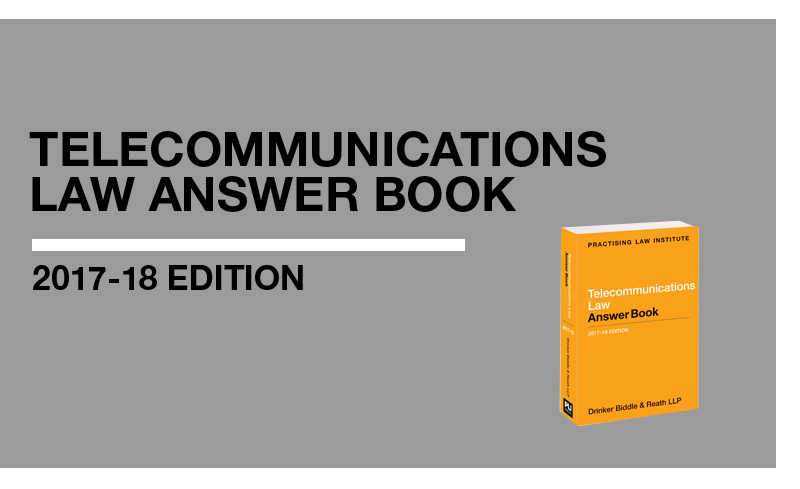
New Edition! Telecommunications Law Answer Book 2017-2018

Telecommunications Law 2017 18 editionTelecommunications Law Answer Book provides answers to key questions about the issues faced by the various participants in the U.S. telecom industry. Designed for every day, practical use, this valuable resource covers the recent Congressional and FCC initiatives on data privacy and security, as well as the restrictions on foreign ownership of U.S. communications companies regulated by the FCC.

In an easy-to-read Q&A format, Telecommunications Law Answer Book describes:

Telecommunications Law Answer Book also provides a comprehensive overview of the recent Congressional and FCC initiatives on data privacy and security, as well as the restrictions on foreign ownership of U.S. communications companies regulated by the FCC.

The new edition is available on PLI PLUS, our research database.  If you’d like to order a print copy, please email libraryrelations@pli.edu or call 877-900-5291.

Library Ledger, October 2017, Volume 5, Issue 2

10-2017 Library Ledger

The latest edition of the Library Ledger is now available!

In this edition, we review the new look and feel of PLI PLUS and dive into our content on immigration and refugee law. We also highlight our recent and upcoming travels in the letter from Library Relations Manager, Zehava Brickner.

Looking for an older edition? The complete archive of The Library Ledger is available here.

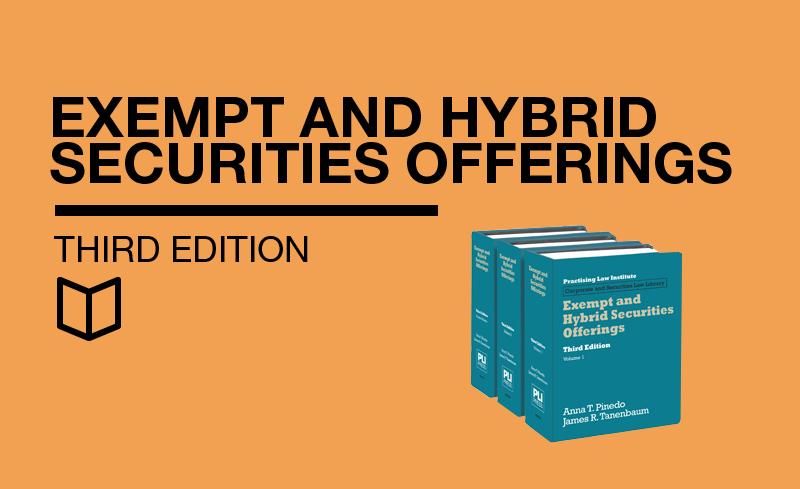
New Edition! Exempt and Hybrid Securities Offerings

ExemptandHybridSecuritiesOfferings3rdEditionThis Third Edition of Exempt and Hybrid Securities Offerings reflects significant updates in order to account for recent market trends, such as the increasing tendency on the part of privately held companies to stay private longer and defer their initial public offerings, or IPOs, as well as the increased reliance by public companies on exempt offerings and hybrid offerings.

The latest edition of Exempt and Hybrid Securities Offerings contains updates to the legal, regulatory, and procedural guidance regarding offerings exempt from or excluded from the registration requirements of section 5 of the Securities Act, including guidance provided in connection with or provided following the enactment of the JOBS Act.

Highlights include:

  • Chapter 3, providing a more detailed discussion of Rule 506 under Regulation D, which is the most frequently used of the safe harbors under Regulation D. Given the changes brought about by the JOBS Act mandate to relax the prohibition against general solicitation in the context of certain Rule 506 offerings, this chapter provides background regarding the types of communications that constitute a “general solicitation,” as well as the conditions for reliance on Rule 506.
  • Chapter 4, regarding the section 4(a)(1) exemption, the concept of section 4(a)(1½), and a new discussion of the limited resale exemption, section 4(a)(7).
  • Chapter 9, discussing Rule 701, which provides an exemption from the registration requirements for securities issued by non-reporting companies as compensation and which has been recently updated to reflect SEC Staff guidance.
  • Chapter 13, addressing the legal and regulatory issues arising for companies that choose to remain private longer and defer IPOs or other liquidity events, including the SEC rules regarding the Securities Exchange Act section 12(g) threshold.
  • Chapter 18, discussing institutional and cross-border debt private placements, which have grown increasingly important as the availability of long-term bank loans has declined in many jurisdictions and for many industries.
  • All of the chapters comprising Part II of the treatise have been updated to account for market developments affecting the conduct of exempt offerings, and Part III of the treatise has been supplemented with chapters on Regulation A and on Crowdfunding.

The new edition is available on PLI PLUS, our research database.  If you’d like to order a print copy, please email libraryrelations@pli.edu or call 877-900-5291.

What’s New for September on PLI PLUS

What's New 17-09We add content to PLI PLUS every month to ensure our subscribers have access to the most up-to-date and relevant secondary source legal documents. Renowned legal experts regularly update our acclaimed Treatises, Course Handbooks, Answer Books, Transcripts and Forms to reflect recent changes and developments in the law.

Click here to see what we added in September!

New Update! The Partnership Tax Practice Series

PLI recently updated our Partnership Tax Practice Series. The 2017 version is now available on PLI PLUS.

The Partnership Tax Practice Series includes more than 425 articles written by over 290 prominent partnership tax practitioners and delivers a sound analysis of cutting-edge transactional tax-related issues and innovative solutions for highly effective tax planning results. To provide a historical framework for today’s partnership tax practice, the series includes retrospectives on significant developments in partnership and real estate taxation, interesting partnership transactions of the past decade, and analysis of major decisions, including Hubert, Canal Corporation, G-I Holdings and Castle Harbour.

The 2017 version contains 24 new articles that tackle issues including:
The Up-C revolution
The proposed regulations under Sections 707 and 752
Sham partnerships and equivocal transactions
Hedge fund tax considerations

The update Treatise is available on PLI PLUS, our research database.  If you’d like to order a print copy, please email libraryrelations@pli.edu or call 877-900-5291.

New Edition! Sack on Defamation: Libel, Slander and Related Problems (5th Edition)

sack-on-defamationThe Fifth Edition of Sack on Defamation: Libel, Slander, and Related Problems is now available.

Written by Robert D. Sack, U.S. Circuit Judge, U.S. Court of Appeals, Second Circuit, and member of the adjunct faculty of Columbia Law School, Sack on Defamation provides in-depth coverage and analysis of the law of defamation, invasion of privacy and related torts. This seminal work covers the full range of issues, from the basic elements of a defamation claim and First Amendment protections to motion practice and appeals.

First published in 1980, Sack on Defamation remains an indispensable and authoritative resource in the field of defamation law and practice.

The new Fifth Edition features the latest cases on the standards of liability for private and for public figures, libel by implication, the single-publication rule, and pleading requirements in the federal courts. It offers expanded treatment of anti-SLAPP statutes, updates on privacy torts and “libel tourism,” and much more. And with a broader view, Judge Sack’s preface to the Fifth Edition assesses the state of defamation law and of the press in a changing political and social environment. It addresses the viability of the traditional concept of a marketplace of ideas in a time of “fake news,” talk of lowering the bar for libel plaintiffs, and the aggressive use of the privacy torts to seek recovery for statements not actionable as defamation because they are true.

As Judge Sack writes in the book,

“Information and what purports to be news are, instead, increasingly disseminated by a splintered array of digital, often home-made, media to cells of people who already agree with one another about what is being told them and its truth. Such media are fertile grounds for ‘confirmation bias.’ Subsequent discussion of what they report no doubt ensues, but it tends to be limited to those already persuaded. Their notions of what is true echo; they do not compete. If there is little serious interaction among people with different views on important issues, it is not literally or figuratively a “marketplace of ideas”; it is a Tower of Babel. A Tower of Babel seems to me to be virtually useless in the search for better ideas or a better society, government, or institutions.

If that is so, what effect has it on constitutional and other legal protection for the freedom of the press? If the marketplace metaphor is informed in part by the goal of enabling informed, vigorous debate, as the Sullivan Court suggested, what might or should the effect of its weakening be on its protection? If the New York Times no longer plays the role in public discourse and the dissemination of information and opinion that it did in 1960s, is the rule of Sullivan any the less wise or necessary?”

The update Treatise is available on PLI PLUS, our online research database.  If you’d like to order a print copy, please email libraryrelations@pli.edu or call 877-900-5291.

PLI’s New Guide to Financial Services Mediation!

Did you know that Mediation Can Be a Powerful Tool for In-House Counsel? Check out the interview below with the editors of PLI’s new Financial Services Mediation Answer Book (2017 Edition) .

(null)

(null)

Financial Services Mediation Answer Book is available on PLI PLUS, our online research database. If you’d like to order a print copy, please email libraryrelations@pli.edu or call 877-900-5291.
Meet Our AALL 2017 Raffle Winner: James Wirrell

2017AALLRaffleWinnerAt the AALL Annual Meeting & Conference in Austin this year, PLI raffled off a $1,000 AmericanExpress gift card. James Wirrell, Assistant Dean for Library Sciences at McGeorge School of Law at University of the Pacific, was our lucky winner. Check out our interview with James below!

Tell me a little about yourself. Why did you become a librarian?

I am originally from the Vancouver area in Canada and attended law school there. After meeting an American (who I am now married to), I did my third year as a visiting student at Hastings in San Francisco. As an international student, the only place I could work at Hastings was in the library. While working in the library and interacting with the law librarians, I decided that this was the career for me. After Hastings, I attended both library school and law school again at the University of Illinois. I am now a citizen of both the US and Canada and have worked in law libraries at the University of Illinois, the University of Richmond and the University of the Pacific, McGeorge School of Law.

What do you like most about your job at University of the Pacific, McGeorge School of Law?

As the director of the law library, I enjoy working with everyone on my staff to provide the best possible service to the law school in as efficient a manner as possible. Budgets are an issue for us, and I like to be able to give our school and its students good value for the money. I enjoy working with people and with making a positive contribution in this world.

What is the most common research question you receive?

Our research questions are becoming increasingly complex and involve multi-faceted research projects. Typically, the research questions we now face are ones that the users were not able to solve for themselves using the basic search tools in the common electronic databases. As such, the questions we now get require us to go outside of the usual channels to find the answers.

Which PLI publication do you most frequently recommend to students?

One of our leading professors has an interest in alternative dispute resolution. Accordingly, we have referred students to American Arbitration: Principles and Practice.

What did you think of AALL 2017? Did you do any sightseeing in Austin?

I always enjoy the networking at AALL with both fellow law librarians, but also with vendors. This year I was particularly excited by the pre-conference workshop I attended on the new academic law library data collection platform, ALLStAR. My wife accompanied me and we did some walking around the city and took in some art galleries and the Texas state capitol. She also came to see the AALL Exhibit Hall once and was given a red PLI bag which she decided was the very best swag given out at the conference. We also were able to spend a couple of nights after the conference visiting some friends who live in greater Austin.

How do you plan on using your AmEx gift card?

Good question! I haven’t thought too much about it. I tend to be more of a saver than a spender. I think I will earmark the value and use it down the road to be a bit more adventurous with new technology and mobile phone upgrades.

Thank you, James! And congratulations!